

The Chairman Jerome Powell era will be known in the future as the period where the Federal Reserve pivoted away from an independent watchdog and transitioned into a political organization. During the Biden Administration, when it suited their political aims, they pivoted to a coordination role with the Treasury Department rather than a supervisory body focusing on inflation and employment.
Instead, they talked about a good game and became masters of the press conference. There, they explained that what we saw was not the real economy and that their “dot plots” indicated where their actions should be focused. The Fed and the Treasury knew we had monetary markets focused on liquidity, so they pumped up the M2 Money Supply to help President Biden in his reelection bid. They ignored the apparent struggles of everyday Americans in favor of a false narrative.
A Sure Sign of Politization
We continually thank the website OpenSecrets.org for its research, clarity, and exposure of political contributions by politicians. An independent FED would not make political contributions and would balance hiring to ensure that diverse opinions are considered when debating actions. So, let us see how they did. Fair representation and dissenting views are necessary to reach compromises on economic actions affecting us all.
In the 2024 Presidential election, employees, officials, and FED Board members directed 90.7 % of their contributions to Vice President Harris. This one-sided support would have been even more pronounced without the Minneapolis Fed, where the contributions favored President Trump 68.2% to Vice President Harris 31.8%.
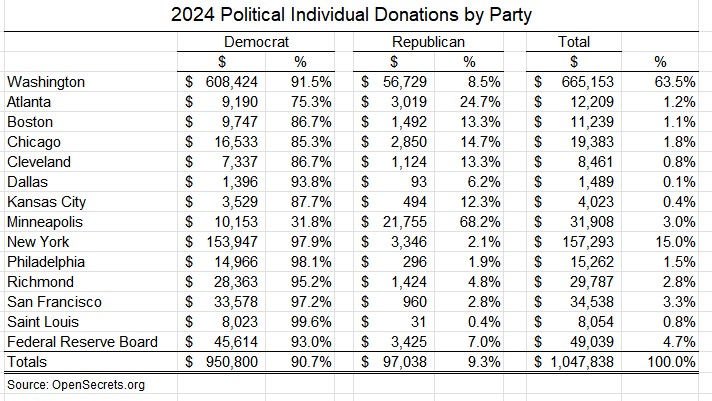
Outside of Washington and New York, the dollar contributions were smaller than in these two primary locations but no less biased (withstanding Minneapolis) than the two primary Fed locations.
Why it Matters
Neutrality in the Fed matters because all analysts have biases, and there must be opposing voices when data is provided to decision-makers. We may think that “the numbers are the numbers,” but all data is subject to interpretation. When all analysts are like-minded, they have a confirmation bias to collect, review, and render opinions that support their worldview.
This can be especially problematic for the FED because they constantly analyze data looking backward and not forward. They also make rate decisions and shape opinions globally from their policy meetings. When regional governors voting in favor of or objecting to policy opinions are all of one opinion, they become an echo chamber, not a deliberative body.
The minutes from FED meetings are analyzed in minute detail, with brokers, economists, and media pundits “reading between the lines” to see if there is more to the pronouncements than meets the eye. The FED briefings are a little better, with the chairman working to say or not say things in a media show that takes on the air of reality TV. The public buys into this show because it fits the expected narrative of media “experts.” We now have a far-left financial media being fed and regurgitating financial data that is biased.
The regional presidents have become little more than reality show stars. In years past, only the chairman spoke to the media, which helped reduce market speculation and confusion. But now, the regional presidents speak to their specialty in another reality show, where they audition to become the next chairman or, worse, the next network show expert.
No Checks and Balances
One would hope that when the information reaches the Federal Reserve Board, this voting body would sort out fact from fiction. But they also come with their bias. In the 2024 election, 93% of that body voted democrat.
We must wonder if they had an incentive to keep the economy going and make decisions that would make President Biden appear more decisive than he was. This may have been revealed when they dropped interest rates going into the election when everyone was advising “raise rates” to curb inflation.
The FED’s missteps here fit the classic definition of confirmation bias.
Confirmation bias refers to our inclination to seek out and prioritize information that aligns with our existing beliefs, leading us to disregard any evidence that contradicts those views.
Various Sources
From top to bottom, the FED has become a Democratic Party echo chamber, making decisions that favor one side of our political spectrum. But this happens on all sides of the political and economic spectrum. For example, when presented with new unemployment data, Democrats and Republicans will interpret the causes and meanings, often in polar opposite ways. The same happens with inflation, housing, crime, and other measures.
The big difference is that if you or I have an opinion on inflation or unemployment, our sphere of influence is very small. When the FED chairman speaks, the reverberations are worldwide. We can acknowledge our confirmation bias; they never do.
The Road to Perdition
How did we get here? Like most political changes in our nation, this swing to the left has been long and slow. But the left has well-executed a plan to move a generation’s thinking toward socialism, Marxism, and government dependence. We know this because of the one-sided nature of these political affiliations within government jobs. We saw it in the analysis of political contributions in colleges, and we can see it here. These glacial moves happen through hiring, peer pressure, promotional opportunities, and other subtle or subliminal messages.
Let us look at the political donations of FED employees and the Board. We see a similar pattern to our colleges that started in the 1990s and morphed into an utterly biased organization.
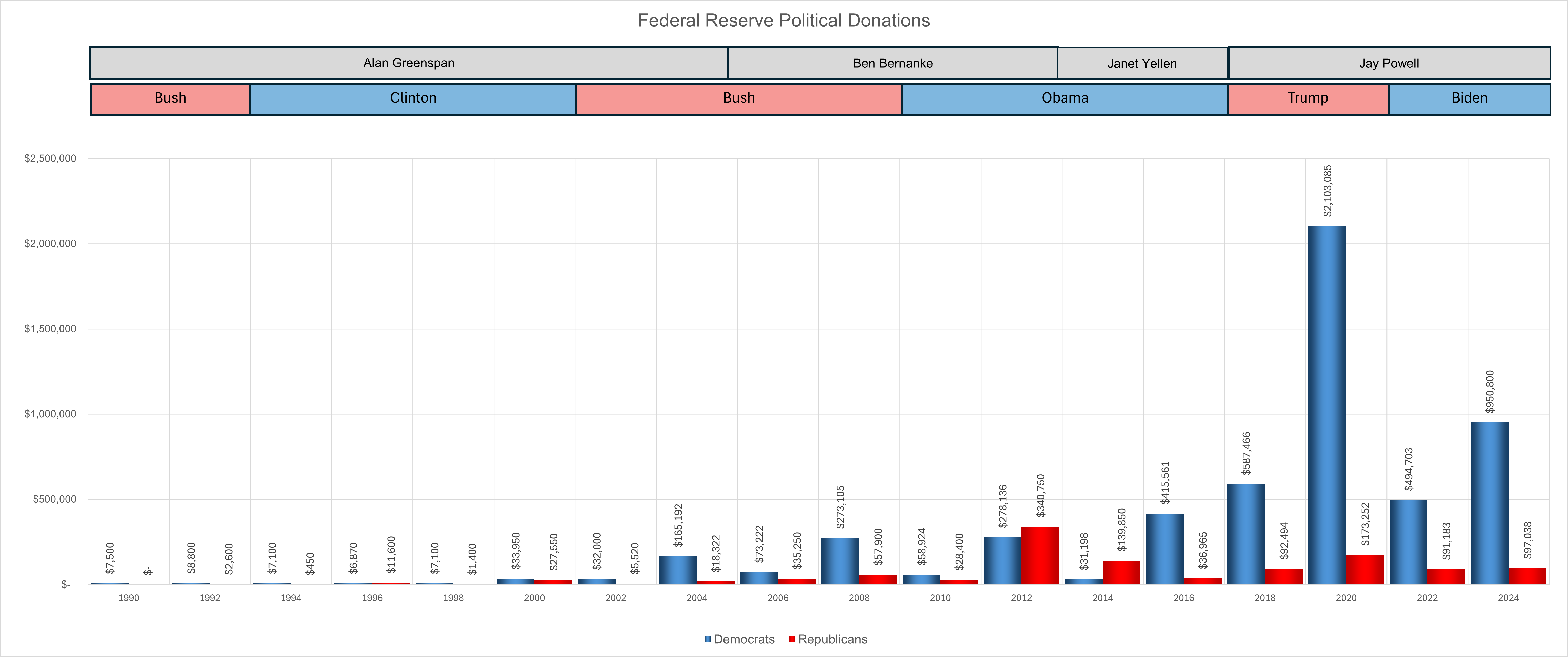
From 1990 until 2003, the FED was a politically neutral organization with few political contributions. Even when they did occur, they were evenly divided between Democrats and Republicans. Then, in 2008, we saw a decided shift in contributions as Democrats worked to elect Barack Obama. Then, in 2012 and 2014, there was a shift back right, with more donations moving toward Republicans. I believe 2014 was the last year of FED independence. From that point on, Democrat contributions began to skyrocket while Republican contributions waned.
This disparity was most pronounced in the Democratic campaign against President Trump and peaked at $2.1 million. While total dollar contributions were less in 2024, this disparity between liberal and conservative employees continued, with donations favoring Democrats by nine to one.
The Federal Reserve Board of Governors
One independent source of bias prevention should be the Federal Reserve Board of Governors. We hoped this group would include both men and women with academic and business experience. It would seem that you need theorists and people with practical business experience to make wise economic choices that drive decisions worldwide. But I have explored various areas of the Federal Government and have enough experience to know that logic rarely applies.
“A Consultant is a guy who knows 125 different ways to make love, but who doesn’t know any women.”
Mark Russell, American PBS Satirist
All the men and women on the Federal Reserve Board have well-written and impressive resumes. I do not doubt that they are intelligent, well-read, and well-respected in their fields. But there is one glaring hole in their collective resumes: business experience.
Of the seven people listed, only Michelle W. Bowman from Kansas lists any real banking experience. She served as a Vice President of the Farmers and Drovers Bank for seven years in Council Grove, Kansas. This is the 161st largest bank in Kansas, with assets of roughly $100 million. A Vice President of a bank that small is usually confined to making small loans, signing official checks, and opening accounts. They have a title, in this case Vice President, not for skill but so they can sign documents like loans and checks on behalf of the bank. There may be other practical banking knowledge among the other members, but none are listed.
All the members have excellent academic credentials and have served on committees, faculties, and boards with impressive-sounding names. A few have served in other Federal Reserve Bank capacities. The group has enough law, economics, history, and government experience to start a college. They are people of significant influence and book knowledge, but it is a closed circle of elitists with little practical business experience.
Like many we are finding in government, they are the consultant described by Mark Russell, working in an environment with a confirmation bias feedback loop of their very own. Even though the FED is not a real government agency, it acts like one with its unique bureaucracy. It has twelve regional banks, each of which has a board. Then, the regional banks have branches with more staff, boards, and economists.
As currently formatted, the Federal Reserve is an anachronistic remnant of the early 1900s when technology was an adding machine. The FED needs some honest businesspeople supported by economists, not academicians supported by economists. None on the FED Board have likely skipped a meal, shopped at Walmart, or run their own business. Their frame of reference is Wall Street and academia, not Main Street. Send in DOGE before it is too late. Like other government agencies, lifelong bureaucrats run the show and have no balanced perspective.
Birds of a Feather Flock Together
We can also see that the FED Board members align politically with the FED employees. Starting with the George Bush Presidency, Democratic donations by board members began showing up in sufficient amounts to make a difference. However, the most significant contributions were made to the Biden campaign’s effort to unseat President Trump. In the 2020 election cycle, board members donated $425,896 to Democrats and only $26,132 to Republicans. The bias of the board is as evident as the bias of the employees.
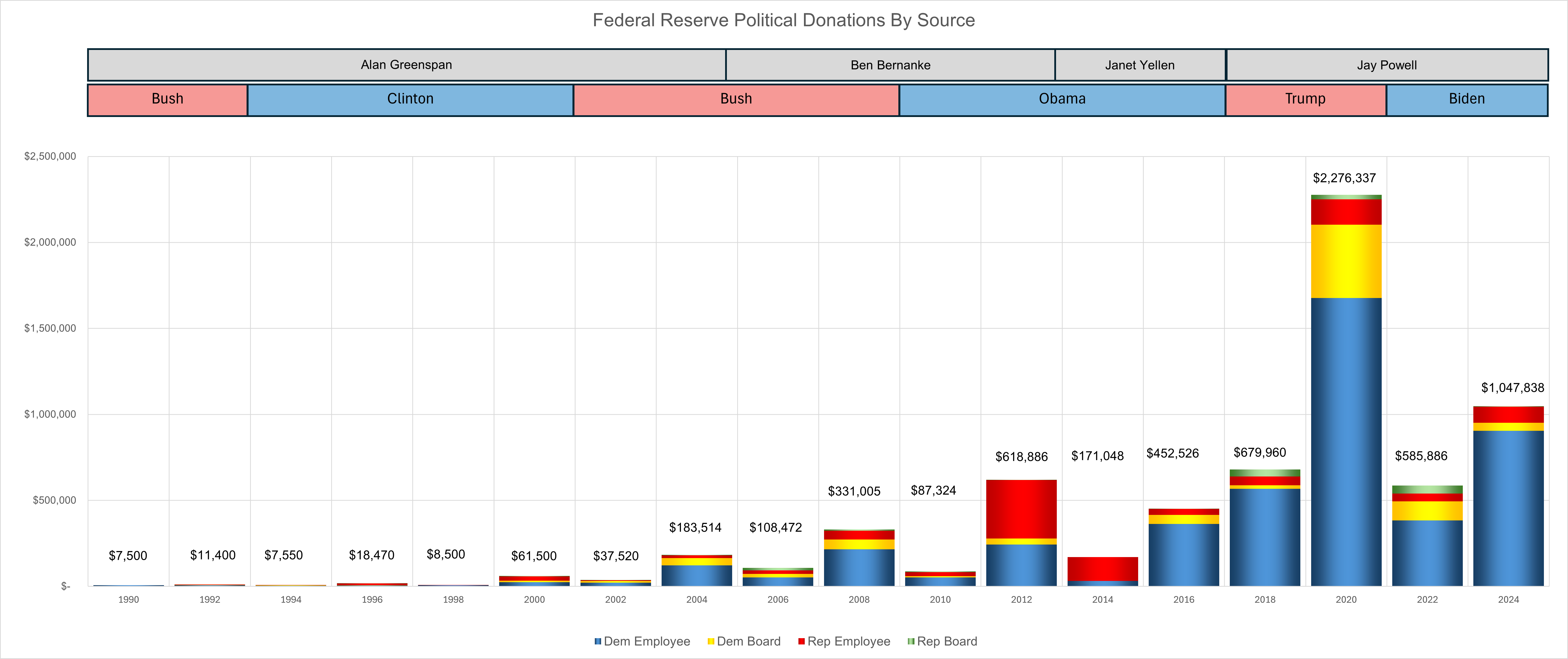
When we combine the contributions of the board and employees, we see that 92.4% of all contributions went to Democrats in 2020 and 90.7% in 2024. Many employees read the actions of their bosses and those who control promotions and salary increases.
The Problem Is Evident and Intentional
There was a point leading up to the election in 2024 when everyone was speculating whether or not the FED would raise or lower interest rates. If they raised rates, it would help curb inflation, but it would hurt the national debt. If they lowered rates, it might “juice” the economy and help the Democrats going into the voting season. Most thought the FED would leave the rates alone to remain neutral; I thought they would lower them because of the extreme left-leaning nature of the FED.
They lowered rates on September 18, followed by additional post-election rate cuts on November 7 and December 18. All this action was made to make President Trump’s job more difficult. The first-rate cut did not influence the election as it might have, but the three rate cuts put upward pressure on inflation.
The Echo Chamber
Like our far-left-leaning colleges and universities, the FED is on a trajectory to have a major influence on elections and policy beyond its policymaking. When you combine the far-left-leaning nature of its political contributions with that of other government agencies, it becomes a powerful force.
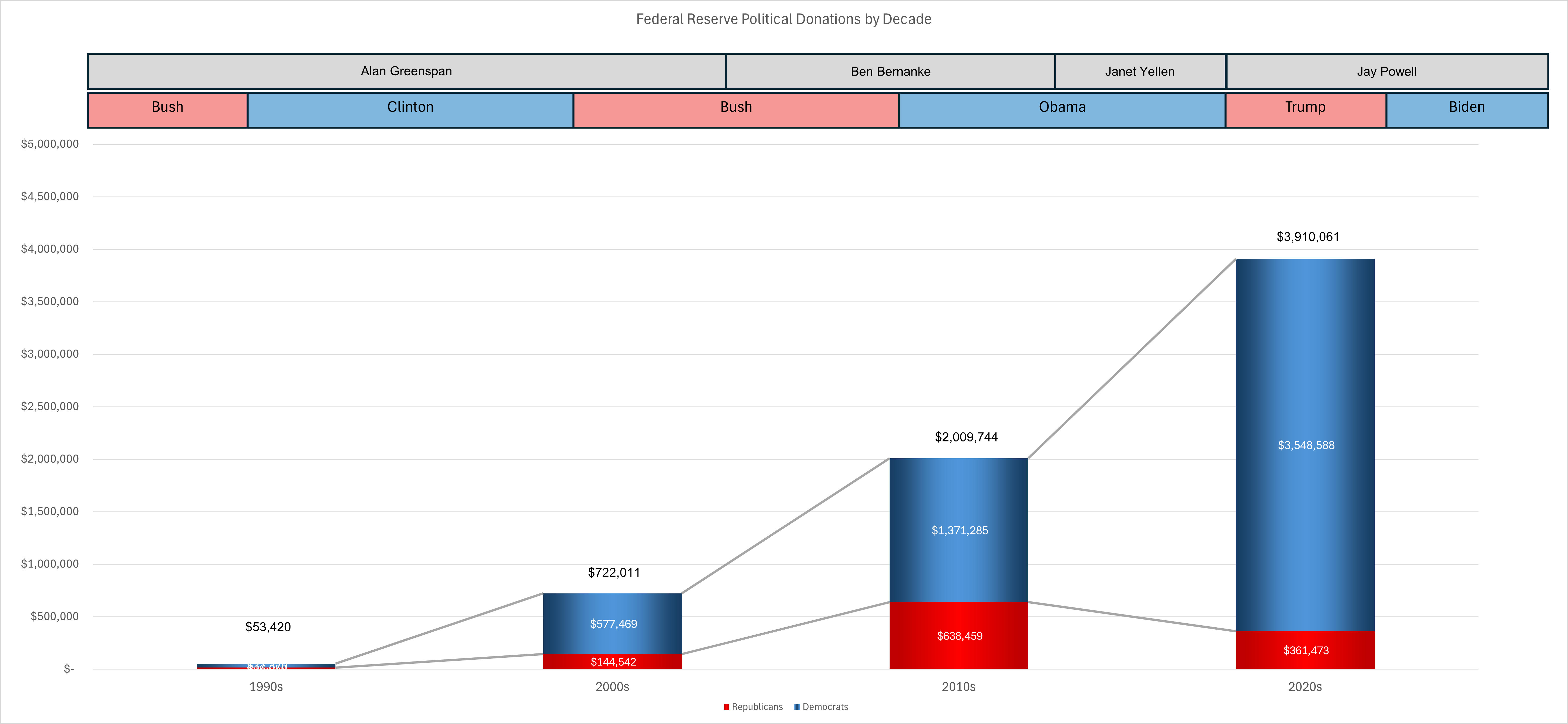
In the 1990s, the FED was politically neutral, and we might surmise that its economic advice and policy were also neutral. But decade by decade, they have become increasingly political until they are now a force to be reckoned with. Their policymaking is one-sided, operating within that Democrat echo chamber with a liberalism lens.
Only the Senate and House can deal with this issue through their Banking Committees. Employees are entitled to vote their conscience, but administrators must ensure that the voices they hear and the data they are presented with are balanced. One solution is to have senior management at the FED approved by Congress. This is not perfect, but like the judiciary, the ebb and flow of bias will be done in the open light.
The employees and management of the Federal Reserve Bank are well on track to make political donations of $13 million in this decade, with 91% going to one political party. I do not believe this was the intent of the founders of the FED, nor was it the will of Congress, and I would encourage all of us to work to change this to a more balanced view.
Resources and Further Reading
Board of Governors of the Federal Reserve System, Federal Reserve, federalreserve.gov, Last accessed March 5, 2025.
Farmers and Drovers Bank, Wikipedia, wikipedia.org, Last accessed March 5, 2025.
Federal Reserve Political Contributions, OpenSecrets.com, opensecrets.com, Last accessed March 3, 2025.
What Is Confirmation Bias? Definition & Examples, By Kassiani Nikolopoulou, Scribbr, scribbr.com, September 19, 2022.