
If you are like me, you are not surprised by the rise in gold and silver prices but by how long this transition to higher prices took. If you want a conspiracy theory to hang on to, this is a good one. If there were any conspiracy theory ripe for discussion, this is it. Like many of you, I am nothing more than a participant in the markets, working to understand the ebb and flow of things.
We have seen a sometimes gradual and sometimes precipitous rise in our national debt and the money supply. Gold was the one commodity that never seemed to respond to our money printing. No one has any real sense of how gold prices are controlled; the picture is too complex, and too many governments and entities are involved to grasp it all. I do not look for conspiracy theories because they are impossible to validate, and there are enough other forces at work to account for much of what we see.
Three things have converged, making controlling gold prices much more difficult than in the past, or perhaps now impossible. These are COVID-19, Basel III and IV, and our National Deficit. As an observer of financial markets, I see that these three all place pressure on gold prices, and the cumulative effect has been to increase gold prices. They have made the once controllable now less controllable. President Trump’s tariffs have not helped, but they are more of a distraction than a catalyst.
We know from financial history that many things do not matter until the day they do, and on that day, it is too late. We saw that in 1929, again in 1986 with the S&L Crisis, in 2000 with the Dot Com Bubble, and now in 2020, Congress flooded the markets with COVID-19 Relief Money and drove the national debt to unsustainable levels.
We are saddled with many politicians with little financial knowledge or understanding. These men and women make important decisions about collecting and distributing trillions of dollars. Many of our economic problems stem from the deception and manipulation of this uninformed group by those who do understand. As in general elections, the vote of an uninformed Congressman or Congresswoman counts the same as that of the most intelligent. It is a bit like giving your teenager your credit card and telling them not to spend too much. We now live in a bizarre world where the vote of businessman Elon Musk counts the same as Bernie Sanders or AOC.
Fiscally, there was little difference between President Trump’s plans in either election. He wants to lower taxes, raise tariffs, spend less, and cut waste. He believes we can grow from the mess, and I hope he is right.
Has the Fed Become Politically Corrupted?
In a recent article, we delved into the political leanings of the Fed and the Fed Board. They are now far left and support more of a socialist agenda than any Fed in the past. We saw this in the 2024 election as they cut rates when they should have been raised. Looking to the Fed for help with any fiscal or monetary issues is a fool’s errand.
Fortunately, we now have Secretary Bessent in the Treasury as an offset to Chairman Powell. Scott Bessent is a real-world investor who knows more about markets than anyone in Washington. So long as President Trump can keep him at the Treasury, things might stay only on the verge of disaster, and not a full-blown disaster.
COVID-19 and Gold
There is no direct link between gold and COVID-19, but there is a connection with the trillions spent in relief, our national debt, and the decline in trust of the dollar. Deficits from the COVID-19 era and fights to continue spending make markets wonder if any sanity is left in Washington.
The Basel III and VI Issues
Unless you are a real financial nerd, you have never heard of Basel III or Basel IV. Put simply, Basel III and IV are a set of accounting principles that form a worldwide standard for financial reporting for banks. Until recently, only the US Dollar and dollar-denominated debt obligations (Treasuries, etc.) were considered Tier 1 assets for central banks. Tier 1 assets are the most stable, least risky, and best things for central banks to hold as a safety net for bad times.
Basel III changed all this when it expanded the definition of Tier 1 assets to include gold when a central bank physically holds it. This pressured our national debt because unfriendly nations could hold gold instead of dollars and be just as safe. Basel IV strengthened the consideration of gold as a reserve asset.
Since Basel III, central banks worldwide have been on a gold buying binge. If there is any supply/demand component to the gold market, this is the driver. Central Banks buy gold in tonnes, not ounces. The BRICS nations are looking to diversify away from the dollar and Basel III has opened that door.
Federal Deficits
For me, the link between our deficits and the rising price of gold is obvious. But how do you prove it? It is logical that with our national debt beginning to spiral out of control, other nations want fewer dollars, and Basel III opened that door. But the connection is one of sentiment, not calculation. President Biden made this even worse with the seizure of President Putin’s assets, but the crisis of confidence was already brewing. We all need to pray that the DOGE group gets some teeth and backing to cut waste.
The Long View
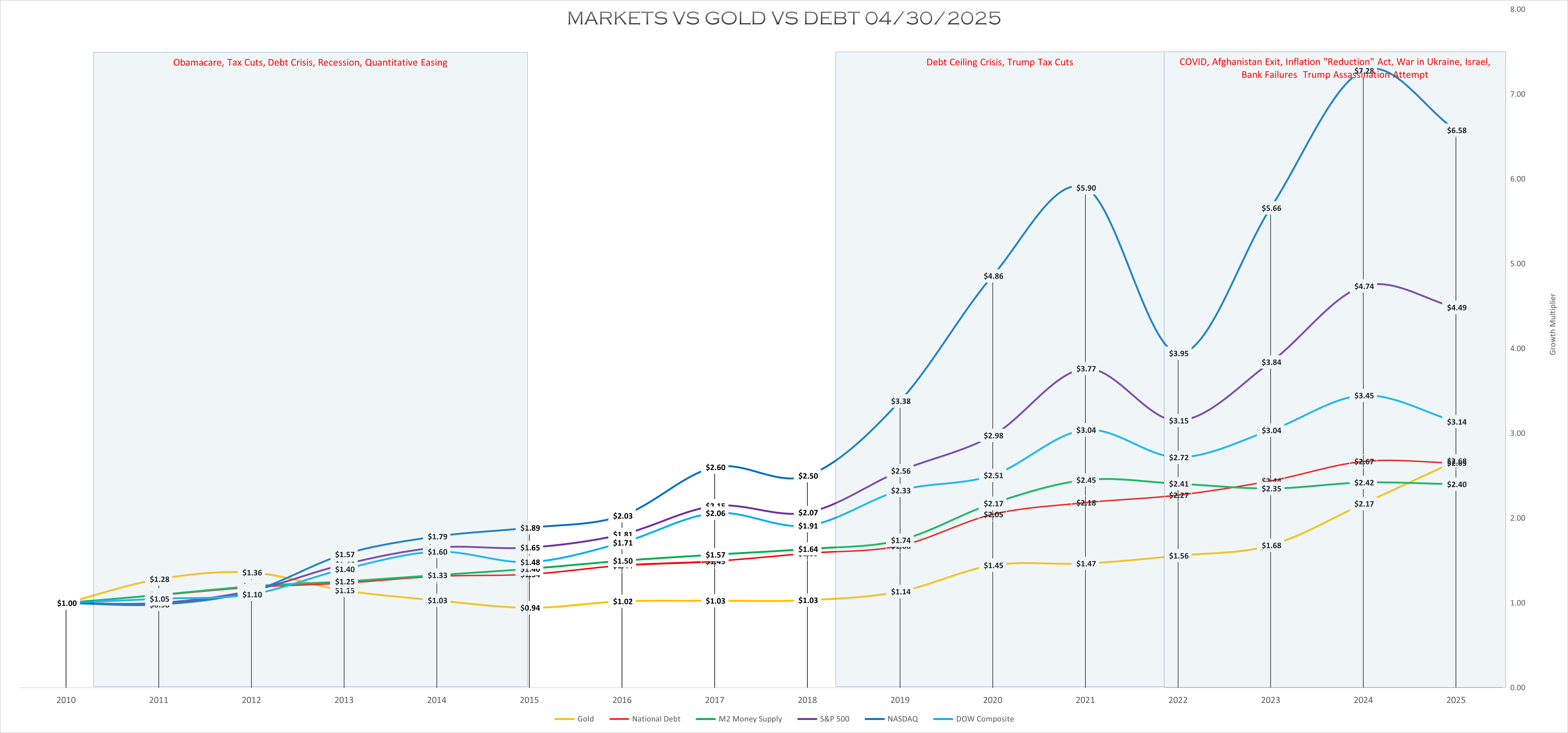
The long view is for those of us who hit our peak earnings in the early 2000s. This view is most relevant to Baby Boomers and our investments and overlaps the other two periods discussed here. The long, upward movement of all assets, debt, and money supply can be easily understood here.
I talked with a friend who is a broker last week and he noted that just in 2025 gold and silver had moved up by about 25%. This obviously true with gold briefly hitting $3,500. But even more true is that no investment has performed better than gold since 2000. If you are a Baby Boomer and you saved your coins collection from your youth, you are a happy camper.

The Medium View
Nothing has changed significantly in our Medium View of Markets, which continues to show gold as the underperforming but rising asset in this time period. Gold has risen and is continuing to make upward moves as stocks have eased from their highs. Unlike stocks gold has continued to do well as we sort out what will and will not happen under President Trump’s tariffs.
The Short View
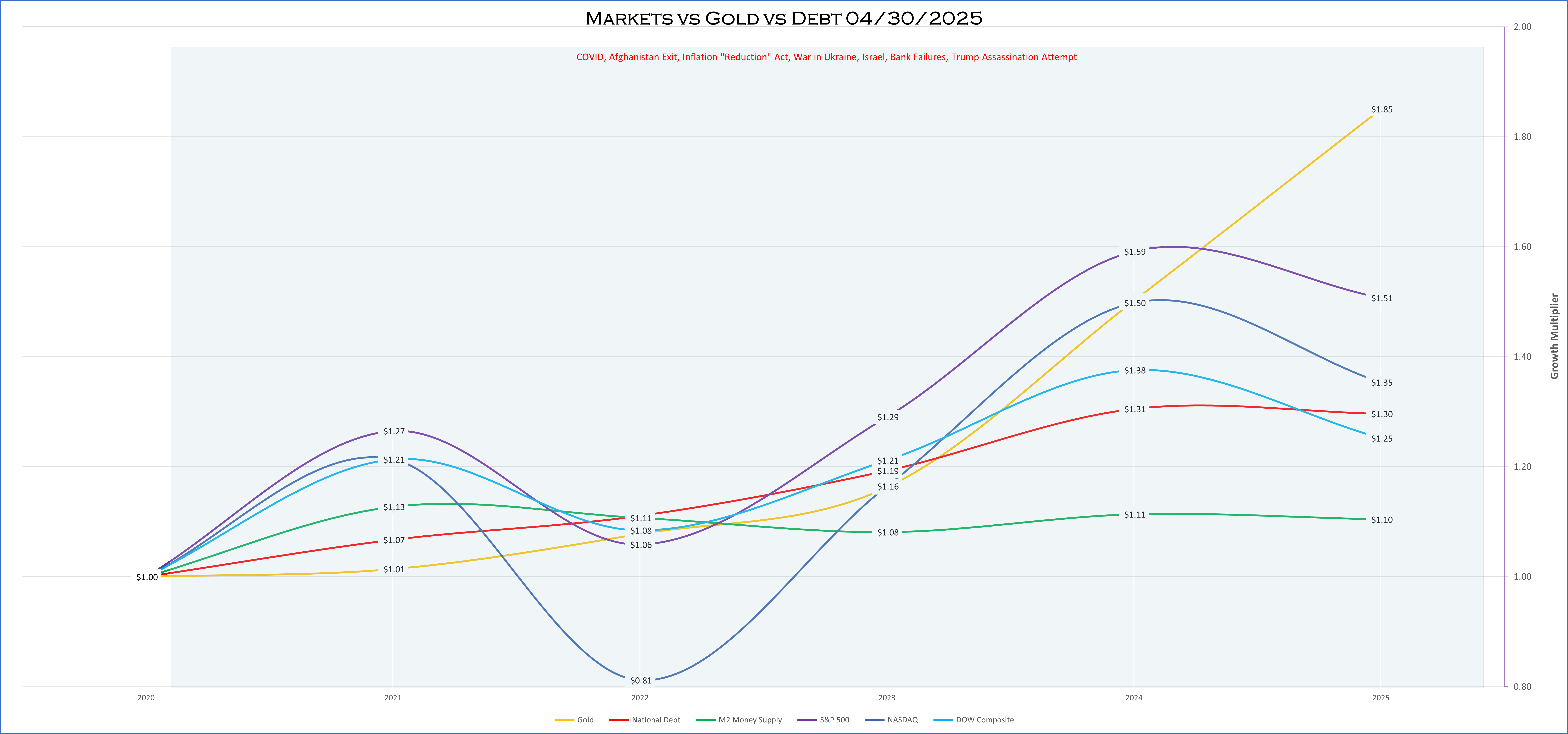
Our Short-Term View of markets now looks more like the Long-Term View, with gold moving up rapidly and out performing all other investment classes. Briefly, before the election, uncertainty pushed gold to the same level as the S&P 500. Now that the new administration is moving on with tariff negotiations and flooding the news with more and more issues gold looks as safe to investors as it does to central banks.
Why Does All This Matter
Decades ago, our financial issues took place primarily on our shores. Today, our challenges are interconnected to all economies. The recent shift in political leadership and focus on tariffs as a significant revenue source may make major changes in how we look at all financial assets.
Resources
China’s gold market in October: unseen price records bring unprecedented gold ETF inflows, By Ray Jia, World Gold Council, gold.org, November 13, 2024.
David Stockman: It’s “Damn Near Impossible” To Avoid A 30-50% Market Correction, Adam Taggart and David Stockman, YouTube, youtube.com, Last accessed November 5, 2024.
Various Charts and Tables, Open Secrets, OpenSecrets.org, Last accessed April 25, 2025.
Will Debt Sink the American Empire?, By Gerald F. Seib, Wall Street Journal, wsj.com, June 21, 2024.