
At first, ponding might not sound like a real verb, but it is when used correctly. We are all familiar with its noun derivation, pond. Ponds are still small bodies of water that form in a natural or artificial depression.
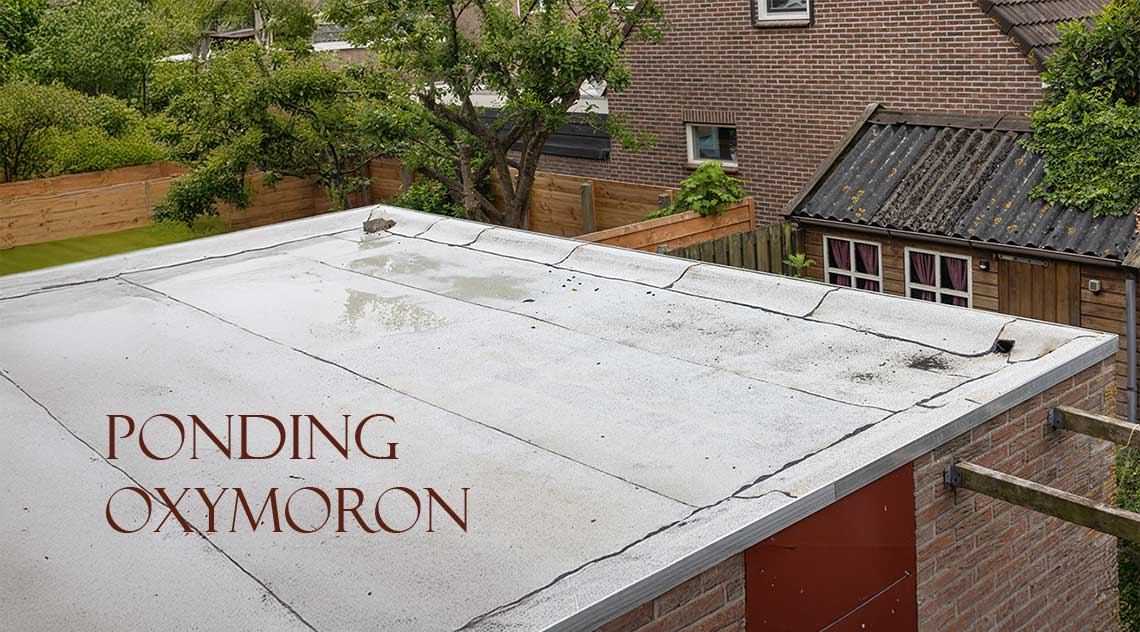
Ponding is the accumulation of water in a depression after a hard rain and is distinguished by being unwanted. Ponding can occur on roofs, roadways, and gutters, and if unattended, it can cause deterioration of the surface.
“George let the gutters over the flat garage roof clog, and there was a lot of ponding after each rain that rotted the wood.”
“Sally stepped off the curb into a deep puddle of water that had accumulated quickly because of ponding after the downpour.”
“The path they built dipped too abruptly, and water was constantly ponding in the low spots.”

An oxymoron is a noun or a figure of speech in which contradictory terms appear together. Joking terms like honest politician, old news, and deafening silence all fit the definition. The terms contradict themselves.
“The ‘honest politician’ explained her insider trading in a way that no one over the age of twenty would believe.”
“When we describe the War Between the States in America, we often use the term ‘Civil War,’ but there was nothing civil about it.”
“Tom said that the cost of the new house was ‘almost exactly’ two hundred thousand dollars, confusing everyone.”
Combining an oxymoron and the term ponding is not easy. But let’s give it a try.
“As I sat by the lake, lost in deafening silence, I found myself mesmerized by the water ponding on the road.”
“As I sat watching the water ponding in the road, I realized I had this love-hate relationship with thunderstorms.”
“Looking out the window at the water ponding in the gutter, I wondered if everyone’s life is just a series of true lies.”