

I have a running discussion with our sons and grandchildren about climate change, and while we are not always opposites in our opinions, we are close to opposites. Much of our perspective is based on where you live and what you see daily. They live in big cities in the Midwest and Northwest; we live in a rural area in the Eastern United States. Their temperatures may have ticked up, but ours have not and, in some years, have been cooler. Their climate is drier, but ours has become wetter. Climate changes, but not always for the worse and not always to a degree that the world will end.
In just one anecdotal story, I can explain how much change we have experienced in the South and throughout the United States. When I was much younger, growing up in North Georgia, my uncle told me that when our ancestors settled there in the early 1800s, a squirrel could get in a tree in Georgia and go all the way to Maine without touching the ground. I thought it was just a tale, but it was not, and his reference was to the landscape before the Chestnut blight that devastated the forests in the eastern United States. But it was also true since we were standing near the western boundary of the United States in 1800.
The Southeastern Climate Phenomena
Many studies have been published about the cooling effects of forests through evaporation, biodiversity, and shade. However, a new study published in February 2024 in the AGU Advanced Earth and Space Sciences journal explains how this has affected the Southeastern United States. The study specifically focuses on this region of the country and how our climate is not changing as rapidly or severely as other regions.
“The Eastern United States (EUS) has undergone extensive reforestation over the last century, providing a unique opportunity to investigate the biophysical impacts of large-scale land cover change.”
AGU Advanced Earth and Space Sciences
The study explains that in the eighteenth and nineteenth centuries, large areas of the Southeastern United States were deforested through timber harvesting and land clearing for agriculture. In the twentieth century, large swaths of land were converted back to deciduous forests or pine plantations as less land was needed or used for crops. While the pine plantations have a lowering effect on the calculation of forest age, they also provide extended periods supporting cooling effects. This would also mean that many Eastern and Southeastern forests are much older than the average and have an even more significant impact on the climate in the region. The Southeast is also home to large National Forests that are returning to a pre-industrial state. Much of this can be attributed to George W. Vanderbilt, who donated much of his estate to create the first managed National Forest.
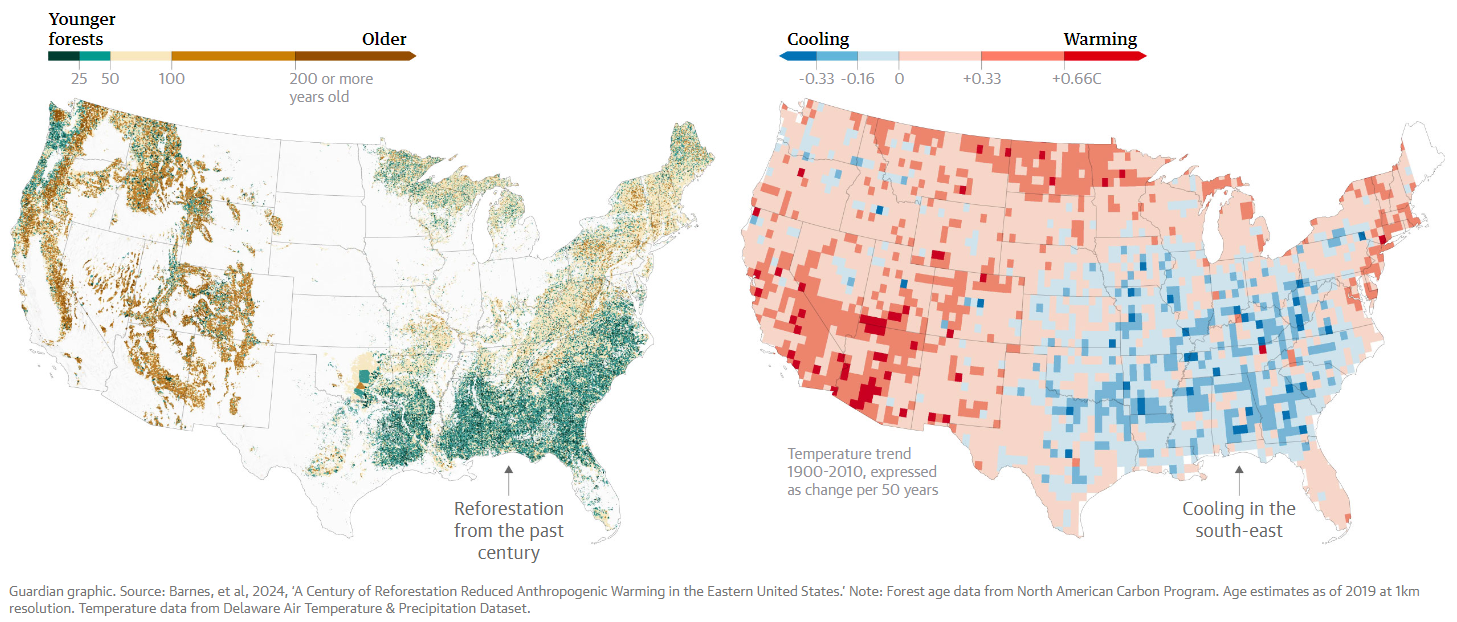
As the study explains, with reforestation has come cooling and temperature moderation in many areas. This creates a “Hole” in the climate data, where not all of the United States experiences the same temperature changes. It explains much of the discussion I have with our children and grandchildren. Where we live, it is cooler, and where they live, it is warmer.
The Chestnut Tree
The study does not officially discuss the Chestnut blight and the deforestation that took place in the early to mid-1900s. Introducing Asian plants, specifically Chinese chestnuts, for their larger fruit was considered a great thing then, but it was a disaster. The Chinese Chestnut carried a blight that the American Chestnut could not defend against, and it completely wiped out the American Chestnut. Think of it as COVID for trees.
An environmental catastrophe cannot often be attributed to a single event, but the Chestnut blight can be traced to the introduction of plants like the azalea and Chinese Chestnut. The devastation was so complete that, by some estimates, as many as four billion trees were wiped out. The loss of this canopy had a devastating effect on the eastern forests and climate. American Chestnut trees could reach 110 feet in height and provided much of the canopy needed to cool our eastern climate.
Today, several groups are working to reintroduce the hybrid American Chestnut tree into our forests. However, the crossbreeding of trees and the time needed to check for blight tolerance make that a slow process. If the original canopy can be restored, it will take centuries.
America’s Forests
Our forests are now dominated by pine, oak, poplar, hickory, sycamore, and many smaller trees. These are not the giants of the Chestnut era, but many can easily reach a height of sixty to eighty feet and provide a cooling canopy. The regrowth of the forests provides the trees that create the climate hole.
There is a lesson here that we all need to consider.
Electrification Might Just Kill Us All
In the rush by some, including the United States, to electrify everything, there seems to be little regard for the devastating effects of harvesting raw materials. Many of the raw materials needed for things like electric vehicles are in South America and Africa, where ecology is less of a concern than economic viability. When a family is starving, convening them to clear-cut their land or sell it for clear-cutting is not difficult.
Cutting down forests for raw materials or covering miles of land with solar panels might sound like a dream to some, but not to me. I have seen the positive impact of just letting nature do its thing. The less we tamper with the earth and its natural cycles, the better.
Climate activists think raw materials for solar panels and batteries materialize out of thin air. Or perhaps they do not care so long as the clear-cut land, child and slave labor, and strip mines are in lesser-developed nations. For me, solar panels and batteries made this way are no more appealing than blood diamonds.
A Welcomed Pause in the Action
Fortunately, the American consumer is now being heard, and they do not want vehicles that are totally electric. This is causing car manufacturers to stop and catch their breath, and it may provide the pause needed to reassess the plans for electrification. Consumers do not want to sit in the dark, suffer through brown/blackouts, or step backward to a time without electricity.
The introduction of artificial intelligence and the awareness of the power consumption of those data centers brings awareness to the inadequacy of solar and wind for continuous power needs. We will need to weigh our desire for new technologies of all types with the environmental challenges they face.
States’ Rights, the Law of the Land
Our climate may be changing, and this was not on the minds of the Founding Fathers when they drew up the Constitution. But as usual, the Constitution may provide the solution to the climate issue. We know that climate varies by state and region, so a Federal solution to the issues is both impractical and inefficient.
Just as with NASA, the argument that private enterprises cannot do space travel has now been proven wrong. If I need to bet, left alone, private enterprises in America will find an answer to electrification and climate change faster, cheaper, and more efficiently than any government will ever do.
Personally, I hope I live to see the squirrels leaping from tree to tree from Georgia to Maine. I just hope they do not get fried on a solar panel or cut up on a wind farm before this happens.
Resources Used in This Article
A Century of Reforestation Reduced Anthropogenic Warming in the Eastern United States, by Mallory L. Barnes, Quan Zhang, Scott M. Robeson, Lily Young, Elizabeth A. Burakowski, A. Christopher Oishi, Paul C. Stoy, Gaby Katul, and Kimberly A. Novick, American Geophysical Union, Advanced Earth and Space Sciences, agupubs.onlinelibrary.wiley.com, February 13, 2024.
American Chestnut Trees once the Pride of the Appalachia’s, by Donnie Laws, YouTube.com, Last accessed April 4, 2024.
Chestnut Trees Are Returning to Forests, by Mike Rogers, Colin White, Kent Wiley, and Tim Wright, The American Chestnut Foundation, YouTube.com, Last accessed April 4, 2024.
Rebirth of the American Chestnut as a Dominant Forest Species in Eastern North America, by Scott Merkle, Forest Biology, Environmental Ethics Seminar Series, YouTube.com, October 24, 2023.
Solar power occupies a lot of space – here’s how to make it more ecologically beneficial to the land it sits on, by Matthew Struchio, The Conversation, theconversation.com, March 12, 2024.
Very cool: trees stalling effects of global heating in eastern US, study finds, by Oliver Milman, The Guardian, theguardian.com, February 17, 2024.
When Giants Roamed Appalachia: The Story of The Chestnut, YouTube: The Appalachia Channel, YouTube.com, Last accessed April 4, 2024.