
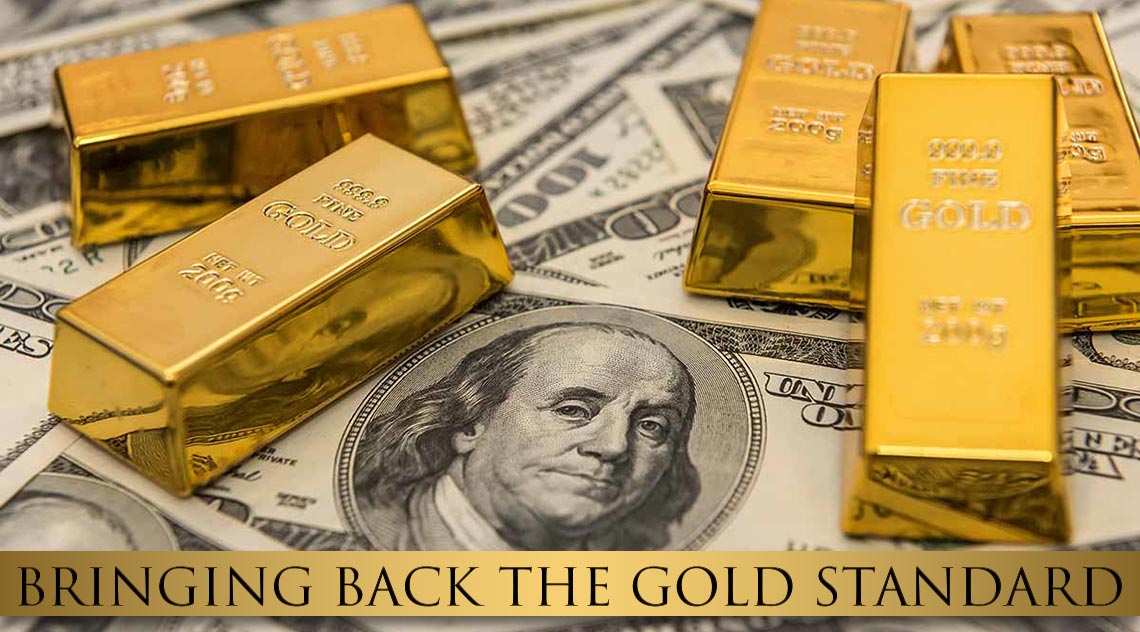
When the concept of the gold standard is mentioned, it often triggers memories of William Devane’s ads for Rosland Capital or the Gold Rush show on the Discovery Channel. These references, along with the history of gold usage in America and the gold coins sold by the U.S. Mint, provide a glimpse into gold’s rich history and significance in our society.
Considering the idea of a modern nation, particularly one with a fiat currency, contemplating a return to the gold standard may seem implausible. However, even the most unexpected scenarios can emerge for discussion in these uncertain times. No country is left with a currency backed by anything other than trust. The phrase “Backed by the full faith and credit” starts sounding hollow as politicians continue to spend our money.
The gold standard presents a formidable challenge for politicians. It places strict limits on their spending or compels them to confront currency devaluation. Given politicians’ propensity for spending and reluctance to turn down a free cocktail gala from lobbyists, the gold standard becomes a contentious issue that demands our attention.
Going Off the Gold Standard
Let us take a step back in time. On March 14, 1900, the Gold Standard Act was passed and signed by President McKinley. This Act established a fixed relationship between the paper dollar and a specific weight of gold. The dollar’s value was 25.8 grains of gold, roughly equivalent to $20.67.
Fast forward to June 5, 1933, during the presidency of Franklin D. Roosevelt. In the midst of the Great Depression, the Federal Government made a drastic decision. It ended creditors’ right to demand payment in gold, effectively severing the connection between the dollar and gold as an underlying asset. To reinforce this policy change, the Government seized the gold held by private citizens and introduced a fiat currency standard. FDR, realizing the limitations of a gold-backed dollar for his social programs, devalued the dollar by approximately one-third after confiscating what he could.
After World War II, we only returned to a Gold Standard for central banks. But again, Richard Nixon ended this in 1971 when he suspended the central bank exchange of dollars for gold. Runaway inflation as oil prices rose and from Congressional spending for the Vietnam War forced the break between the dollar and gold.
The Federal Government’s desire to spend with fewer controls always breaks the gold/dollar connection. Reestablishing that connection is problematic because it means an immediate stop to uncontrolled spending, which is not a popular concept for Congress.
Nut Cases, Fanatics, and Scam Artists
Another challenge for the gold standard is the spread of communication and the proliferation of unverified point and counter-point arguments. Unfortunately for the “gold bugs,” many who advocate for the gold standard lack the economic experience to advocate effectively for their position. Doomsayers and government conspiracists often drown them out and ruin the conversation before it begins.
One of my favorite fake gold pitches is aimed at retirees who know nothing about coin collecting or gold. The sales pitch starts with a conversation about the US Mint and its Gold Buffalo $50 gold bullion coin. Then, the conversation slickly moves to a 24-carat gold-plated look-alike “tribute” coin. The conversation slickly weaves back and forth between the real and tribute coin. You may not remember anything about the ad except for this catchy line: “Avoid disappointment and future regret.”
Real Gold Buffalo proof coins cost around $3,000, not the $49.95 advertised on television for the “tribute” coin. There is no special deal on gold unless you are the seller of fake or “tribute” coins.
The Lady Who Loves the Gold Standard
Mixed into all of this confusion is Judy Shelton, President Trump’s nominee for the FED Board. Shelton sharply criticizes the FED and its interest rate policies and advocates for returning to the gold standard. More than 100 economists opposed her appointment to the FED Board. But before we dismiss her point of view, let us remember that many intelligence experts said the Hunter Biden laptop was a fake.
Only the COVID pandemic and political procedural maneuvers kept her off the FED Board. I wish she had made it to the FED Board. The meetings would have been more exciting and fun, and maybe, just maybe, some of the financial shenanigans we have seen over the past three years would have been different. In a Wall Street Journal article, she voiced her opinion:
“The classical gold standard established an international benchmark for currency values, consistent with free-trade principles.”
“Today’s arrangements permit governments to manipulate their currencies to gain an export advantage.”
Judy Shelton
Shelton also advocates ending the FDIC insurance on deposits because doing so would encourage sound banking practices and benefit the economy in the long term. Many dismiss her views as unworkable, but are they?
Other Gold Standard Advocate Groups
We write about the BRICS consortium here with some frequency. The lead players in the BRICS group are China and Russia, and I believe they are making a slow but steady move toward a gold or gold/commodity-backed currency. China is a master of the long game and might be willing to bide its time while it amasses enough gold to set a new standard. Doing so would undermine the U.S. dollar as the world reserve currency. The Bank for International Settlements also wants to play a part in this transition, and they are backing the BRICS group with technology to create an alternative for inter-country settlements and payments.
For the past few years, we have watched as China and Russia slowly began to accumulate gold reserves and stopped holding dollars as a reserve currency. The recent run-up in gold prices only strengthens their case. At a macro level, they take their excess trade dollars and swap them for gold as their central bank reserves. From their perspective, they are swapping something with a future declining value for something with a stable value. The addition of oil-rich and commodity-rich nations can add more weight to their position.
Another possibility is a dual currency system where countries use a fiat currency for domestic transactions and a gold-backed currency for international settlement. Requiring a gold settlement would be difficult for any nation, and many believe it impossible. But the BRICS nations are gaining a little steam and world political tensions are at a high.
Case Study for Gold Standard
But before we dismiss this directional discussion as fiction, we must consider the issues the FED faces in the U.S. The FED is fighting inflation with an out-of-control Congress that refuses to stop spending. Making corrections to our economy to stem inflation and avoid recessions or, worse yet, depressions are becoming more difficult. When fiscal policy is fighting monetary policy the job is nearly impossible. Now that Congress is accustomed to higher budget levels and higher deficits, they are like fiscal crack addicts.
A report from the Philadelphia FED on the benefits of the gold standard surfaced out of nowhere. Titled Price-Level Determination Under the Gold Standard, the report goes into great detail about the gold standard’s benefits in controlling the money supply and restricting uncontrolled spending. The paper discusses how the gold standard ensures long-term price stability and restricts inflation and deflation to temporary phenomena. However, in their conclusions, they do not recommend that any modern economy convert back to a gold standard.
Why Bring Up the Gold Standard
This and other papers about the gold standard surfacing from the Philadelphia FED could be nothing more than coincidence, or they could be published to counteract arguments coming from the BRICS nations.
Another possibility is that the FED has had it with Congress’s uncontrolled spending and needs to “fire a shot across the bow” to get their attention. This is like taking a child to the woodshed and saying, “If you don’t know how to get yourself under control, I have something that will do it.” If we want to take Congress to the woodshed, bring a big switch; a little one will not do.
Whatever the reason, the FED’s spending so much time and energy on the gold standard indicates something, but what? The FED knows the gold standard for the U.S. would be a disaster and could decouple the dollar’s market relationship with gold. Gold may sell for roughly $2,360 an ounce, but you could not afford an ounce if we had to couple the dollar to gold to slow spending.
Let us all hope that the FED’s threat to Congress is heard!
Resources
BRICS: US Bank Agrees Switching To Gold Standard Will Stabilize Prices, by Vinod Dsouza, Watcher.Guru, watcher.guru, March 27, 2024.
Gold Buffalo Tribute Proof is a SCAM, By Nick Hodge, Energy & Capital, energyandcapital.com, January 10, 2023.
How the Classical Gold Standard Can Inform Monetary Policy, By James A. Dorn, Cato Institute, cato,org, April 14, 2024.
Judy Shelton, Wikipedia, Wikipedia.org, Last accessed April 30, 2024.
Nixon shock, Wikipedia, Wikipedia.org, Last accessed April 30, 2024.
Price-Level Determination Under the Gold Standard, By Jesus Fernandez-Villaverde and Daniel Sanchez, Federal Reserve Bank of Philadelphia, philadelphiafed.org, February 2024.
SWIFT Ready to Launch CBDC & Challenge BRICS Currency, By Vinod Dsouza, Watcher.guru, watcher.guru, March 26, 2024.
Switch to gold standard could stabilise prices – Philadelphia Fed research, By Central Bank Newsdesk, Central Banking, centralbanking.com, March 26, 2024.
Three Congressmen Introduce Gold Standard Bill to Stabilize the Dollar’s Value, Sound Money Defense League, finance.yahoo.com, April 4, 2023.
Trump Fed pick wants to revive the gold standard. Here’s what that means, By Amlee Picchl, CBS NEWS, cbsnews.com, July 10, 2019.
Trump’s Fed Nominee Advocates a Gold-Backed Currency, Even a Crypto One, By Marie Huillet, Coin Telegraph, cointelegraph.com, May 21, 2020.
Watch CNBC’s full interview with Independent Institute’s Judy Shelton, CNBC, CNBC.com, July 29, 2021.
Who Really Killed the Gold Standard?, By Jay Zawatsky, The National Interest, nationalinterest.org, March 18, 2015.
Gold Demand Trends Q1 2024, By ICE Benchmark Administration, Metals Focus, World Gold Council, gold.org, April 30, 2024.