


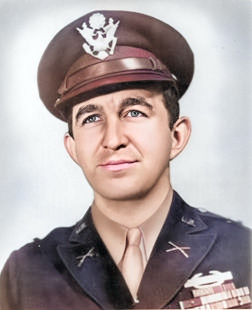
Robert Burton Nett enlisted in the Army at the age of 17, which was not unusual for the time. The legal age for enlistment was 18, but a story persists that he obscured his year of birth to enlist.
He was stationed at Fort Benning, Georgia, where he graduated from Officer Candidate School. From there, he was sent to the Philippines for active duty. While in the Philippines, he met his future wife, Frances Kabler. She continued to serve in the military and passed away in 2012 at the age of 94.
They had a son named Robert Burton Nett, Jr., who served as a Major in the U.S. Army and passed away in 2012.
By direction of Congress, the President of the United States takes pleasure in awarding the Medal of Honor to Captain (then Lieutenant) Robert B. Nett, US Army, Company E, 305th Infantry, 77th Infantry Division, for action near Cogon, Leyte, Philippine Islands, 14 December 1944.
He commanded Company E in an attack against a reinforced enemy battalion which had held up the American advance for 2 days from its entrenched positions around a 3-story concrete building. With another infantry company and armored vehicles, Company E advanced against heavy machinegun and other automatic weapons fire with Lt. Nett spearheading the assault against the strongpoint.
During the fierce hand-to-hand encounter which ensued, he killed 7 deeply entrenched Japanese with his rifle and bayonet and, although seriously wounded, gallantly continued to lead his men forward, refusing to relinquish his command. Again he was severely wounded, but, still unwilling to retire, pressed ahead with his troops to assure the capture of the objective. Wounded once more in the final assault, he calmly made all arrangements for the resumption of the advance, turned over his command to another officer, and then walked unaided to the rear for medical treatment.
By his remarkable courage in continuing forward through sheer determination despite successive wounds, Lt. Nett provided an inspiring example for his men and was instrumental in the capture of a vital strongpoint.
Colonel Nett served during World War II, the Korean War, and Vietnam. Veterans like Colonel Nett were able to serve across decades, in part due to their early enlistment in World War II.
Colonel Nett’s leadership philosophy left a lasting imprint on generations of Army officers, especially through his deep involvement with the Officer Candidate School (OCS) at Fort Benning. He wasn’t just a war hero; he was a mentor, teacher, and symbol of enduring military values.
Core Principles of Nett’s Leadership Philosophy
Influence on Officer Candidate School (OCS)
He retired in 1978 after 38 years of service but remained active with various associations in the Fort Benning area. He also taught for seventeen years in the Columbus, Georgia, school system.
Shown here are the medals and badges Colonel Robert Burton Nett earned during his career.
Medal of Honor
Combat Infantry Badge with Star
Glider Badge
Air Assault Badge
Ranger Tab
Colonel Nett’s legacy also lives on through tributes in Georgia like Camp Nett, the Nett Warrior system, and the Robert B. Nett Medal of Honor Highway.
In Connecticut, the Colonel Robert B. Nett Leadership Hall at the Connecticut National Guard camp at Niantic, Connecticut, is named in his honor.
In 2007, the USO awarded him its Spirit of Hope Award.
He is buried at Fort Benning Main Post Cemetery at Fort Benning, Georgia.
