For over 1,000 years, Christians have traveled to the Holy Land to share in the experience of walking where Jesus walked and praying where Jesus prayed. Whether in the early eleventh century or today, there has been and remains a pull toward the Holy Land for people of many faiths, especially Christians. But to preserve access and peace in this region, Christians and other faiths have fought many “just” wars. Yet the ground that draws pilgrims to worship also draws conflicts and armies.
The First Crusade
The Council of Clermont in 1095, convened by Pope Urban II, ignited a new kind of pilgrimage. He called for armed pilgrimages to reclaim Jerusalem and aid the Byzantine Empire. In his speeches, he proclaimed “Deus vult,” Latin for “God wills it.” Thus, Pope Urban II initiated the Crusader movement, which set off a chain of events that still reverberates today.
Pope Urban II was from a French noble family and became Pope on March 12, 1088, at a time when the Vatican was a political state with its own army. He is best remembered for sanctioning the Catholic military expeditions that would come to be known as the Crusades. Byzantine King Alexios I Komninos asked the Pope for military help, prompting the need for knights to go to the Holy Land.
The Pope’s personal “crusade” to ignite enthusiasm among Catholics centered on promises of forgiveness of sins and pardons for anyone who would fight to reclaim the Holy Land for Eastern Orthodox Christians and to free them from Muslim expansion. He also hoped the aid would help reunite the Eastern and Western churches under Rome. His call was both spiritual and political.
The Knights Templar
You know of the Knights Templar from church, movies, the History Channel, endless speculation about their findings in Jerusalem, and their supposed missing treasure after King Philip IV of France disbanded them. They were a real, elite fighting order founded around 1119 by Hugues de Payens and Godfrey de Saint-Omer
The Knights Templar received papal sanction under Pope Honorius II at the Council of Troyes in 1129, about twenty years after Urban II’s call at Clermont. There, the Knights Templar received formal recognition from the Catholic Church. This event granted them ecclesiastical protection and legitimacy. Their founding and later papal recognition trace to this early Crusader era.
The Templars became even more powerful when they were granted the right not to pay taxes, to retain their spoils of war, and to be answerable only to the Pope. These rights were granted by Pope Innocent II in 1139 through the Papal Bull Omne Datum Optimum, meaning “Every Perfect Gift.” The Templars had evolved from a military force with monastic beliefs into a powerful military-religious-monetary entity.
The Templars occupied Jerusalem briefly before Saladin expelled them in 1187. They then retreated to Acre, where they remained for 104 years. In 1291, they were defeated again, this time by the Mamluks, and withdrew to Cyprus. This marked the end of their presence in the Holy Land.
The Templars also became formidable financiers who invented many banking practices we still use today. The idea of depositing money in Europe and withdrawing it in Jerusalem was revolutionary. But their wealth became their downfall when they ran afoul of King Philip IV of France. King Philip IV had borrowed enormous sums to wage wars, money he could not repay. For him, it was easier to declare the Templars “heretics” and confiscate their wealth than to find honest ways to repay the debt. King Philip’s attack on the Templars on October 13, 1307, marks the historical origin of Friday the 13th as an unlucky day.
The Historical Pivot
The Crusader-era Vatican was a territorial power with soldiers, fortresses, and political ambitions. The Vatican of the modern era is a city-state of barely one hundred acres, whose influence is moral and spiritual rather than military. The transformation from armed sovereignty to symbolic sovereignty took centuries and unfolded amid conflict, loss, and negotiation.
Then the “Prisoner of the Vatican” era began in 1870, when the Kingdom of Italy seized the Papal States, leaving the Pope’s territory confined to the Vatican itself. Refusing to recognize the new Italian state’s legitimacy, the Pope declared himself a voluntary prisoner within the Vatican walls. This standoff lasted until the Lateran Treaty of 1929, which established the modern Vatican City and ended the Pope’s temporal rule. From that point forward, the papacy wielded spiritual authority but no army, no territory, and no political dominion beyond its borders.
This state of affairs has existed all my life, but it has been in place for less than 100 years.
From Swords and Knights to Statements and Emissaries
The papacy’s journey from military to moral sovereignty frames every modern papal statement. Without a real army, today’s Popes rely on quiet rhetoric, doctrine, and public pressure. They often work behind the scenes with world leaders to exert influence. To me, they are quiet, reverential leaders who still fight for truth and fairness, but without the means to enforce them physically. Understanding that shift is essential before examining the current Pope and his recent attacks.
Modern Popes face a difficult and evolving set of challenges. In a world that moves at the speed of electrons, time to reflect is compressed into a dangerous window for both Presidents and Popes.
A medieval Pope spoke with the weight of armies behind him. His words could send armored men across continents. A modern Pope speaks without that power behind him. He commands no battalions, no fortresses, and no military orders like the Templars. His authority is moral, not martial. That difference matters when he chooses to condemn or criticize those who now carry the burdens once carried by the knights who fought under papal banners.
When a Pope without an army speaks about war, he does so from a place of safety that his predecessors did not enjoy. Urban II sent men into danger. Modern Popes watch others go. The moral weight of the office remains, but the personal risk has vanished. That distance creates a tension with other world leaders that cannot be ignored, especially with America and Israel.
This is why recent statements by Pope Leo XIV regarding the conflict in Iran strike many of us as out of place, out of touch. A Pope who commands no army now speaks sharply about those who must act in the world he only observes. His words carry great moral weight, but they carry no personal risk as in centuries past. The soldiers he criticizes bear the dangers once borne by the Templars, yet they seem to do so without the unwavering support of a Church that once sent its own warriors into battle.
Muslims and Jews have been in almost constant conflict since Moses crossed the Red Sea. Christians have been in conflict with Muslims at least since the early eleventh century. These conflicts are not new, nor is their origin unknown.
Pope Leo XIV set off a firestorm when he criticized the Americans and Israelis. He made this statement in the wake of President Trump’s threat to escalate to de-escalate the war. This is not a new strategy in fighting. In World War II, when bombing was less precise, the Allies bombed the Axis powers repeatedly to create an environment where continuing was impossible.
Iran’s desire to wipe out Israel is a direct parallel to historical evil empires. A willingness to murder over thirty thousand of their own citizens to retain power is a direct parallel to our World War struggles, and a bold statement of intent. It is always the fear of loss of power that corrupts, not power itself.
This is a case where I believe Pope Leo XIV is off base. War is never desirable over peace, but when war is waged for reasons of extermination, someone must stand up for what is right and say “enough.” America and Israel have taken that stand. Scripture offers a clear answer to the question of who must act when danger rises. In the Book of Isaiah, Chapter 6, Eighth Verse, it says:
“Then I heard the voice of the Lord saying, 'Whom shall I send? And who will go for us?'”
And I said, “Here am I. Send me!”Isaiah 6:8 New International Version
I believe this is the stand the American people have taken through our leaders. It is a stand we have taken for decades whenever bad actors have surfaced around the world. This is a war we did not want, fought in a faraway place, with the only possible gain being the hope of world peace. Our possible losses are great, from soldiers to armaments to finances. Our methods of communicating this are harsh, as they should be. The Iranian people face difficult, life-and-death decisions. Our objectives are to give the Iranian people the right to self-government and to live in a world where freedom of choice is not just a concept.
Praying for Peace, Preparing for War
We all hope for peace, not just in the Middle East but worldwide. Yet history has taught brutal lessons about how fragile peace can be in a world of “bad actors.” During the time of Pope Urban II and Pope Honorius II, the Popes bore both spiritual and military responsibility. They often had to back up their religious and political declarations with military force. It seems to me that these two Popes would have heeded the Roman warning, “Si vis pacem, para bellum” (If you want peace, prepare for war). They did not send the Templars to protect the Holy Land, assuming no one would be hurt.
We are in a difficult time, with European countries lacking effective military forces and little desire to confront evil. The Vatican has no army, no Templars. If the Vatican were still sovereign, and the Pope still commanded an army, he would face the same question we face today: whether to send his own men to defend the innocent. That is exactly what the Americans and the Israelis are doing now. Their armies stand between the innocent and those who would do them harm, not only in Iran but across the region and in the Holy Land itself. We now carry the burden once borne by the Templars.
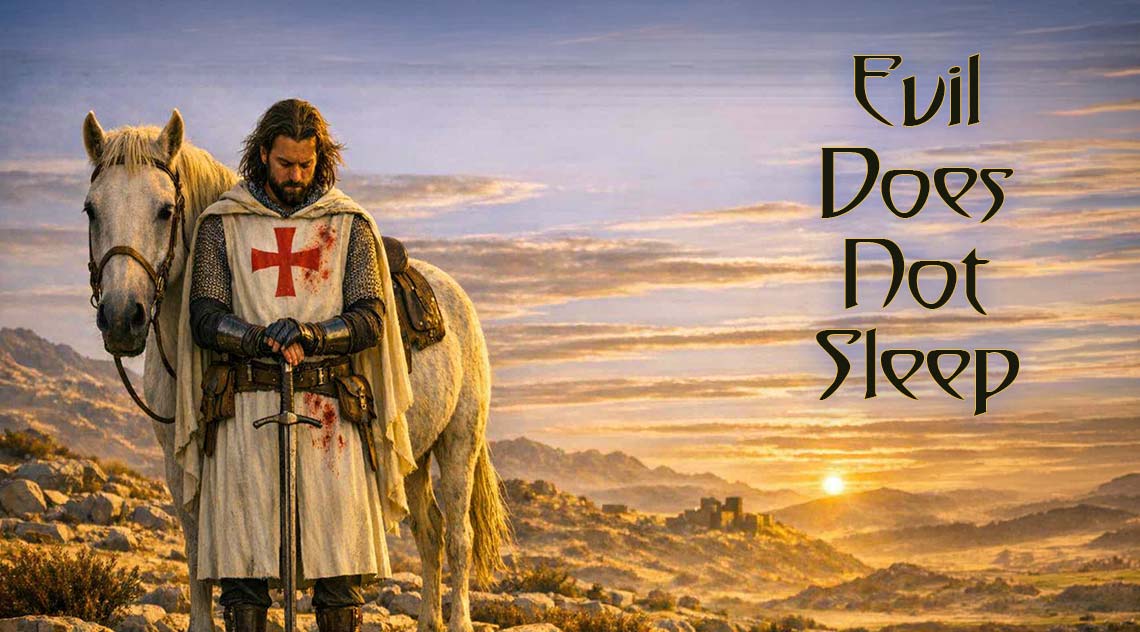
Peace endures only when someone stands between the innocent and those who would harm them. Today, the burden of resisting evil rests on a single nation, a burden never meant to be carried alone. Evil does not sleep, and neither can those who bear that responsibility.
Resources and Further Reading
Eastern Christianity, Wikipedia, wikipedia.org, Last accessed May 5, 2026.
Omne datum optimum, wikipedia.org, Last accessed May 4, 2026
Pope Leo places former illegal immigrant in charge of red state diocese by Charles Creitz, FOX NEWS, foxnews.com, May 1, 2026.
Pope Urban II, Wikipedia, wikipedia.org, Last accessed May 5, 2026.
Pope: The threat against the entire Iranian people is unacceptable, by Deborah Castellano Lubov, Vatican News, vaticannews.va, April 7, 2026.
The Fall of the Knights Templar, History, history.co.uk, Last accessed May 4, 2026.
The Knights Templar, by Staff, World of History, worldofhistorycheattsheet.com, October 12, 2024.