
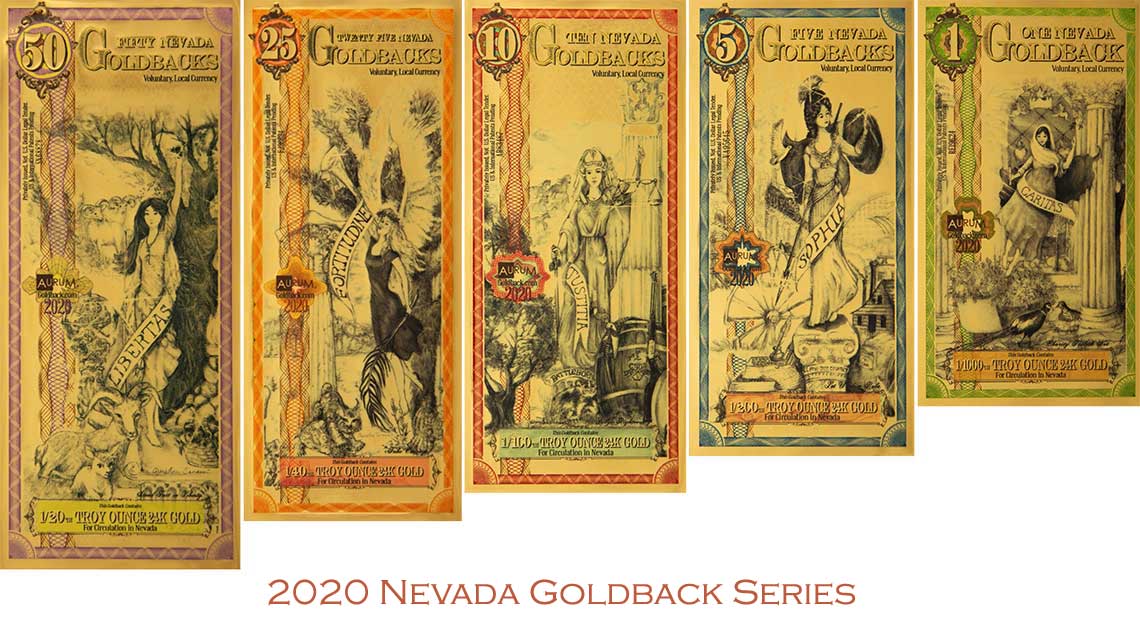
One of the most interesting and unique developments in response to inflation, fiat currencies, and the decline of the dollar’s value is the introduction of a form of “currency” known as Goldbacks. Like many things in history, the movement began in the West when we resisted the Federal Government. I have been a collector of things all my life, which has brought me a lot of pleasure.
Wikipedia’s definition of Goldbacks gives a good explanation of the product.
The Goldback is a family of gold commodities advertised as a local currency in five U.S. states and sold and marketed by Goldback, Inc. in Utah in 2019. Goldbacks contain a thin layer of gold within a polymer coating equivalent to 1/1000th of an ounce.
Wikipedia
Who Can Create Money
When I first saw the Goldbacks advertised, it was confusing because I could not understand how they pegged the value. I remember that under our Constitution, only the Federal Government was authorized to create money, so how could these be authorized and produced? Understanding this movement is quite a tale and one worth understanding.
I was right and wrong about who can create money in the United States, and this little refresher was helpful. When discussing money, we need to understand several clauses in the Constitution.
- Article 1, Section 8, Clause 5 – Congress shall have power to coin money, regulate the value thereof, and of foreign coin, and fix the standard of weights and measures.
- Article 1, Section 8, Clause 6 – Congress shall have power to provide for the punishment of counterfeiting the securities and current coin of the United States.
- Article 1, Section 10, Clause 1 – No state shall coin money, emit bills of credit, or make any thing but gold and silver coin a tender in payment of debts.
There is an important contradiction in these clauses. While Congress has the power to make money and regulate its value, it does not say that this is exclusive to the Federal Government. In fact, there is an implied State right to make money so long as that money is in the form of gold or silver.
This worked well until all our money became fiat, at which time a State (or bank) money issue became impractical. Sometimes, “coins” are created and issued by individuals and companies, but these fall into the collectibles category. Almost all coin dealers carry what is known as “silver rounds.” These are usually one ounce and sold to people who want to hold silver for emergencies. These are novelty coins, not currency or authentic coins. I like to think of it as “prepper” money.
The Dollar and Precious Metal Decoupling
Our first mass introduction of fiat money was “Greenbacks.” These were paper currency backed only by the full faith and taxing power of the Federal Government. They were essentially loans that would be replaced by real currency or coins after the end of the Civil War. For a nation accustomed to only hard money (gold or silver), they were accepted only reluctantly. But Greenbacks got us through the Civil War, and we slowly reverted to gold and silver-backed paper notes and hard currency in the form of gold and silver coins.
However, with federal spending over the years, our gold and silver backing for our currency became impractical. Continuing to back our currency with gold and silver would have made the devaluation of our currency more visible and problematic. Presidents from Roosevelt to Kennedy to Nixon incrementally removed all backing and sold the populous on the “value” of only having a fiat currency. We can have long and involved discussions about the why, but repetitive money printing for wars in Korea and Vietnam lit the fuse that blew up the dollar backing. Subsequent wars in the Middle East only continued the trend toward fiat money.
The actual devaluation of our currency over time has come from inflation, which has been brought on by excessive congressional spending. Whether for social programs, wars, or inefficiency, Congress’s excessive spending makes any return to a currency backed by something impossible. The Treasury supports this through the sale of Treasury securities, and the Fed issues the fiat currency needed to purchase securities and fund the economy.
Since the COVID era, the economy has become a closed-loop system in which money is created in any quantity needed to manage it. There is little reason for anyone to have confidence in the dollar; several rating agencies have noted this. In this environment, all forms of precious metals have some appeal to a portion of the population.
Intrastate Money
In recent years, some enterprising people have applied to individual States for the right to create gold and silver notes for circulation within that State. Restraining circulation within the State limits Federal interest or interdiction in the process. This agreement keeps the Federal Government at bay because of States’ rights and our republican government format. The notes are not legal tender outside of the state where they are authorized.
So far, companies have acquired the legal right to produce these private currencies in Utah, Nevada, New Hampshire, South Dakota, and Wyoming. Florida has also applied for permission to create the notes scheduled for production in 2025. Key to the success of Goldbacks has been legislation exempting them from sales tax. Without this exemption, the notes would not work.
Goldbacks
And now we have Goldbacks. They are part collectible, part experiment, and just plain interesting. The significant challenge was to make a note for circulation that contained gold or silver and would be longer wearing. This process involves the recent innovation of creating notes with gold and silver laminated into them. This process takes a lot of technology and innovation, but it has been conquered. The notes are more expensive because laminating 24-karat gold between two plastic sheets is not as cheap as printing millions of paper notes.
Goldbacks come in five denominations, and understanding the counting process is essential. The denominations are 1, 5, 10, 25, and 50, which sound familiar except for the 25, but that becomes an obvious choice when you calculate. Goldbacks are not denominated in dollars directly but in fractions of an ounce of gold. So, 1 Goldback has a value of 1/1000 of an ounce of gold. The other denominations scale from there, and you only need to know that a 5 Goldback is worth five times as much as a 1 Goldback.
When gold sells for $2,500 per ounce, the gold content in a 1 Goldback is worth $2.50. A 5 Goldback has $12.50 of gold; a 10 Goldback, $25.00; a 25 Goldback, $62.50; and a 50 Goldback contains $125 in gold. But here, the impracticability of Goldbacks as a currency comes to bear. Each note must get physically larger to control the gold quantity in the notes. So, there is no uniformity of size, much like the gold coins issued in years gone by.
We know these are impractical as currencies because of their floating value and production costs, but they are very interesting collectibles. Another clue is that the value can only be stated in terms of a dollar conversion value. But this is novel in that the note contains gold and is not exchangeable for gold.
Subjects and Themes
Our true currency has other protections, such as being produced on special paper and extensive and complex engraving. Goldbacks lack this protection, and I can see how they could be counterfeited. The engraved portion of the notes is similar to but much simpler than circulating Federal notes.
As with early US currency, allegorical subjects represent some historical cardinal virtue and some State meaning. Latin is popular, so you might need to brush up on dead languages.
For Nevada, these are Garitas, Sophia, Justitia, Fortitudine, and Libertas
For New Hampshire, these are Garitas, Veritas, Prospicentla, Fortitudine, and Libertas
For South Dakota, these are Pax, Industria, Harmonia, Laurea, and Libertas
For Utah, these are Prudentiae, Veritas, Justitia, Victoria, and Libertas
For Wyoming, these are Reverentia, Audentia, Fiducia, Fidelitas, and Libertas
Individual state Goldbacks vary in theme, but the one consistent note is the 50, which always has Libertas as the theme.
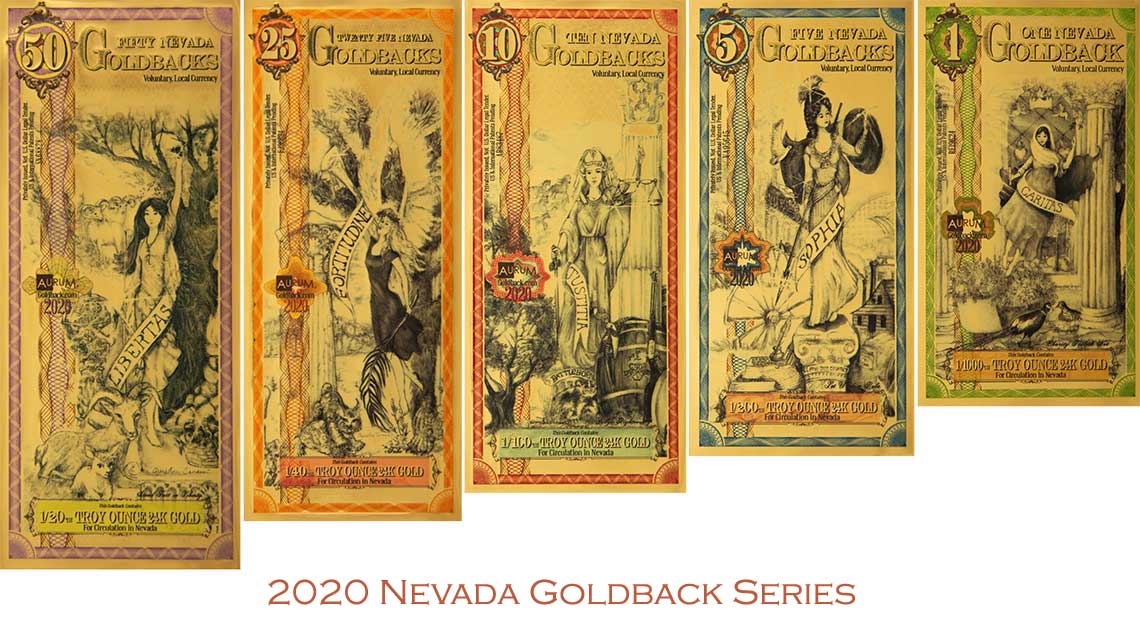
Click on the Image above to see an enlarged image.
Collectible Status
Viewing Goldbacks as a collectible is the only way that makes sense to me. they are a novelty in States where they are used for transactions and a minor way to hedge against inflation. The producers create enough variety to create interest and graded, perfect examples have a reasonable chance of retaining their value or even improving in collectability and value.
Not An Endorsement
This commentary is offered as my own thoughts about attempts to establish an alternative to fiat currency in the United States. It is not an endorsement of the sellers or creators of Goldbacks. They are one curiosity of our economy and society that should be understood and followed. Our creativity and free enterprise always find a way to get around problems; this is just one example.
Resources
Defy the Grid, defythegrid.com, Last accessed November 20, 2024.
Fiat money, Wikipedia, wikipedia.org, Last accessed November 21, 2024.
Finest Known, finestknown.com, Last accessed November 20, 2024.
Gold standard, Wikipedia, wikipedia.org, Last accessed November 21, 2024.
The Constitution’s Seven Money Clauses, By Dean Clancy, Dean Clancy, deanclancy.com, August 5, 2014.
With inflation, gold notes and cards find their way into America’s wallet, By Karen Brettell, Reuters, reuters.com, April 27, 2022.