
On January 1, 2025, we added a National Debt Tracker to our home page. We added it because nothing is more critical to our nation’s future than getting this simple measure under control. However, measuring debt, while not easy, is entirely different from committing to controlling it.
Unfortunately, we have seen with President Trump’s Big Beautiful Bill that even he and the current Congress may be more show than substance. Elon Musk walked out the door and has committed to financially supporting opposition to any Senator or Congressman who voted for the bill.
Our Nation’s Greatest Challenge
National Debt Information
Loading...
The battle lines are being drawn, and unfortunately, for now, they seem to be drawn between spending more or spending a lot more. Only in Congressional debates do you hear calls for reduced spending, but this fades when you get down to voting.
A Little Ray of Hope
For anyone who has watched the Treasury National Debt figures, they have seen a change. A small change, but a change nonetheless. Since we first started showing the figures, the year-over-year growth has begun to slow. Our debt is still growing, but at a slower pace.
A small ray of hope in all this is Treasury Secretary Bessent, who appears to maintain a level head regarding the issues surrounding the debt. Among recent Treasury Secretaries, he is the only one who has not been a career politician or academic. He brings real-world knowledge and experience. But even he knows that many things must change to keep the “Good Ship America” financially afloat. In a recent interview on CNBC, Secretary Bessent combined the practical with the hopeful when he defended the President’s agenda, offering the concept of controlling spending while achieving real GDP growth. Essentially, he is recognizing that Congress cannot stop spending, only slow it down. While I see a path out of this mess, I consider it a failure for President Trump and Elon Musk. Cutting waste is essential, but using those savings to spend in other areas is not a win.
Congress is Still Congress
I am as disappointed as anyone about the inability of Congress to make difficult decisions, and I am a Republican. Things must change on both the revenue and expense fronts, as well as the GDP growth front, to work our way out of this mess.
The American people will be disappointed by a tax hike, but they will be even more disappointed by a severe recession, mild depression, or continued erosion of the dollar and our purchasing power. Our problems need to be addressed from both ends and, in the middle, utilizing known solutions.
My hat is still off to Elon Musk, who has shown that fraud and waste can be identified and eliminated. However, Congressmen and Congresswomen still want to be reelected and remain popular in their districts. I was hoping that President Trump would tackle the debt, but that may only be possible after the midterm elections. Once he knows he has Congress’s backing for the remainder of this term, he can act to make bigger fiscal changes. But will he even have the courage to do it?
Our National Debt
Our National Debt continues to grow despite tepid efforts to curtail it. If Congress and President Trump were serious, they would freeze spending, selectively raise taxes, and deal with the political fallout. However, this is Washington, where logic is often disregarded or discarded.
The flattening of the debt growth has occurred despite Fed Chairman Powell’s adamant refusal to lower rates. I consider his refusal to be as irresponsible and politically motivated as his decision to reduce them going into the election. We know that the FED Board of Governors and employees donate roughly 90% to Democratic candidates and causes. His refusal to lower rates, even modestly, fuels the interest payments on our debt. More than anyone in Washington, he has the power to slow the growth of the debt.
Gold vs Debt vs Markets vs Money Supply
No matter how we slice it, the last few decades can be summarized as a cycle of “spend, tax, inflate, and borrow.” We are at the end of an ugly financial cycle that will take some miracle to survive. We see it everywhere, from grocery stores to financial markets. We do our best to ignore it, but the cycle of ignorance is coming into conflict with reality.
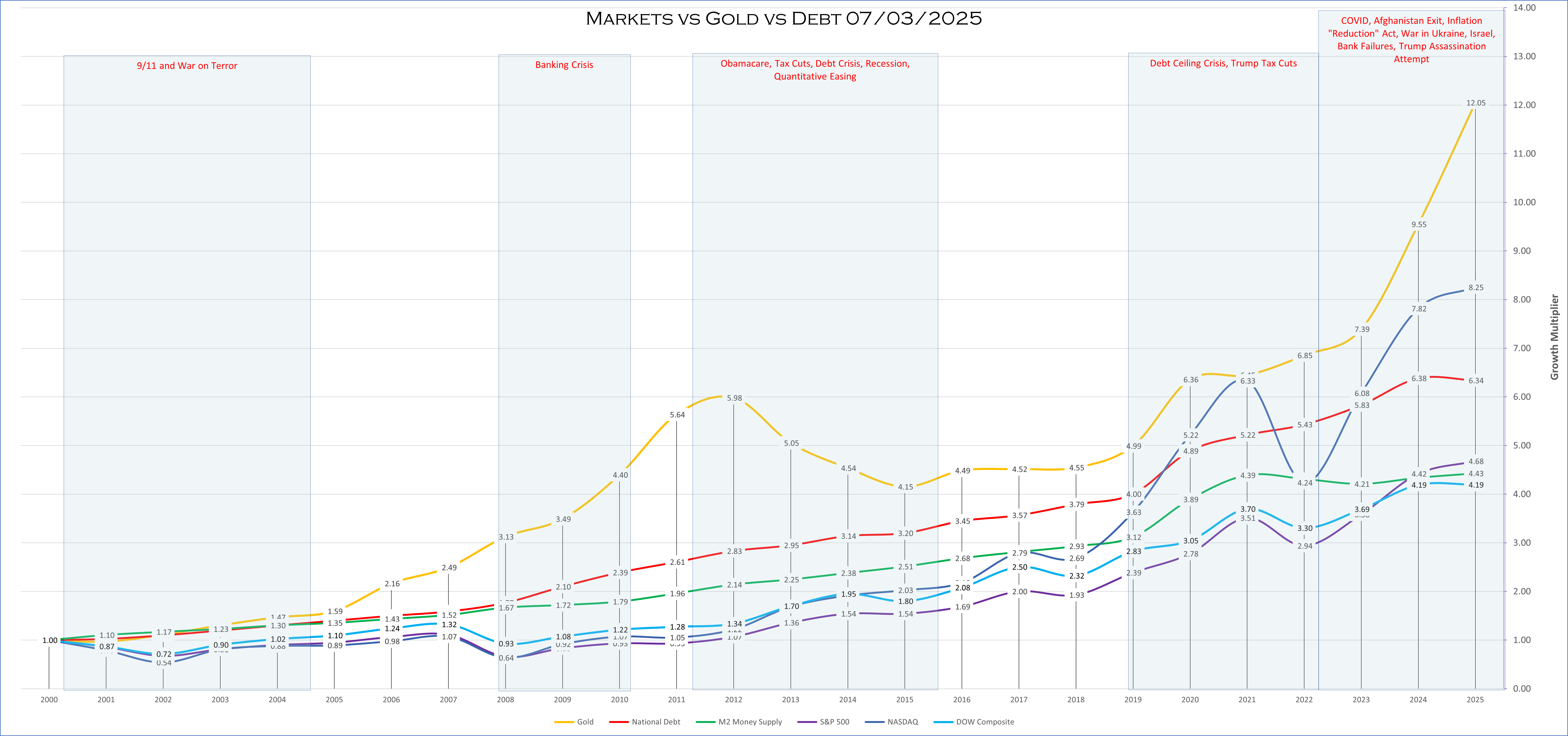
The chart above illustrates the movement of gold, the financial markets, our national debt, and the money supply since the year 2000. While all moved up, gold has outpaced them all and for good reason. We have spoken often about the BRICS group and their desire to move away from the dollar. Like it or not, they are making slow but steady progress with the help of the Bank for International Settlements. The movement is slow, but this is a long game, not a sprint.
Several events have been key to this change, and over the next few years, we will need to monitor them all to understand their impact on our way of life.
Central Banks and Gold
Under the Basel III accord, we are moving forward with more standardized accounting for banks worldwide. This is a positive development, but in recent years, we have taken some steps that have undermined our global standing and the security of the dollar as the world’s reserve currency.
- First, our Congress’s failure to curb spending and raise taxes hampers efforts to reduce the national debt. The DOGE group identified potential savings, but, as always, Congress missed the opportunity. I believe they need to step up after the midterms, or the dollar could be in serious trouble.
- Second, President Biden’s decision to confiscate Russian deposits undermines the century-old safety net for the dollar. Foreign countries have less incentive to hold dollars if they are not protected from confiscation. This was the “bone-headed” decision of the last century, and he may have killed the dollar’s reserve currency status with one ill-advised move.
- Third, under the Basel III accord, gold has become a Tier I asset for central banks. This places gold on equal footing with the dollar, and with the previously mentioned confiscation decision, gold becomes more appealing. Several months ago, central banks started reclaiming their gold, which had been held for safekeeping in New York and London.
- Fourth, in an uncertain world of sanctions, reciprocal tariffs, frozen reserves, regional wars, and political realignments, gold becomes even more appealing.
Perhaps A New Gold Standard
It seems to me that there is something afoot, some undercurrent around gold that is not making a lot of news. We are aware that central banks have been accumulating gold over the past five years, but it is accelerating in subtle ways that are difficult to track.
"Central banks have accumulated over 1,000t of gold in each of the last three years, up significantly from the 400-500t average over the preceding decade.1 This marked acceleration in the pace of accumulation has occurred against a backdrop of geopolitical and economic uncertainty, which has clouded the outlook for reserve managers and investors alike."
World Gold Council
According to the World Gold Council, 95% of central banks plan to increase their gold holdings over the next year, while 73% see a moderate to significant lowering of dollar reserves.
If a country prohibits or limits the export of gold, it can quietly build its reserves without international markets having any insight. There is speculation that China and the other BRICS nations are doing just that, and that their reserves now might exceed ours. In a recent article by David Russell on the website GoldSeek.com, it was noted that “gold has now surpassed the Euro as the second largest reserve asset.”
We are seeing that central banks want their physical gold so much that they created a transportation problem. Another tactic is being employed through the use of futures contracts. At any one time, the amount of futures contracts far exceeds the supply of physical gold. Some central banks are allowing their contracts to expire and demanding physical delivery of the underlying gold, creating a shortage. Gold is “going home” to its owners and will likely stay there.
Shifting Financial Sands
The United States faces a unique challenge with the dollar, which is both the world’s reserve currency and a fiat currency. We cannot buy gold through the Treasury or the Fed without admitting that there will be a dollar debasement or that gold is worth more than the dollar. We might covertly be swapping dollars for gold, but I have never seen any evidence of it, and I believe it would be difficult to hide. To make any real difference, we would need to buy thousands of tonnes of gold.
None of us knows how this will ultimately play out, but the next decade may see a realignment of countries producing more than one reserve currency. In my opinion, this may involve the integration of blockchain technology, stable currencies, gold, and new innovative settlement systems.
We all need to hope our leaders come to their senses and get our debt under control, or the new world financial order may be built without us.
Resources and Further Reading
Bessent ‘Won’t Revalue’ US Gold Reserves as Price Hits 16th New High of 2025, By Editors, BullionVault, bullionvault.com, March 19, 2025.
Central Bank Gold Reserves Survey 2025, World Gold Council, gold.org, June 17, 2025.
Gold Goes Full Reserve Asset As Basel III Elevates It To Tier 1 Status, By Frank Holmes, Forbes, forbes.com, May 12, 2025.
How The World Is Quietly Preparing for a Gold-Backed BRICS Currency, By David Russell, GoldSeek, goldseek.com, July 3, 2025.
Rio Reset: What to Expect at the 17th BRICS Summit – Exclusive Insights, By Editors, PRICIP, pricip.com, May 2, 2025.
Rio signal: BRICS+ plots a gold-backed escape from Dollar hegemony, By Stephen Innes, SPI Asset Management, FXSTREET, fxstreet.com, June 2, 2025.
The Rio Reset: Inside the BRICS Scheme to Hotwire the Global Economy, By Peter Reagan, Birch Gold Group, birchgold.com, May 23, 2025.