
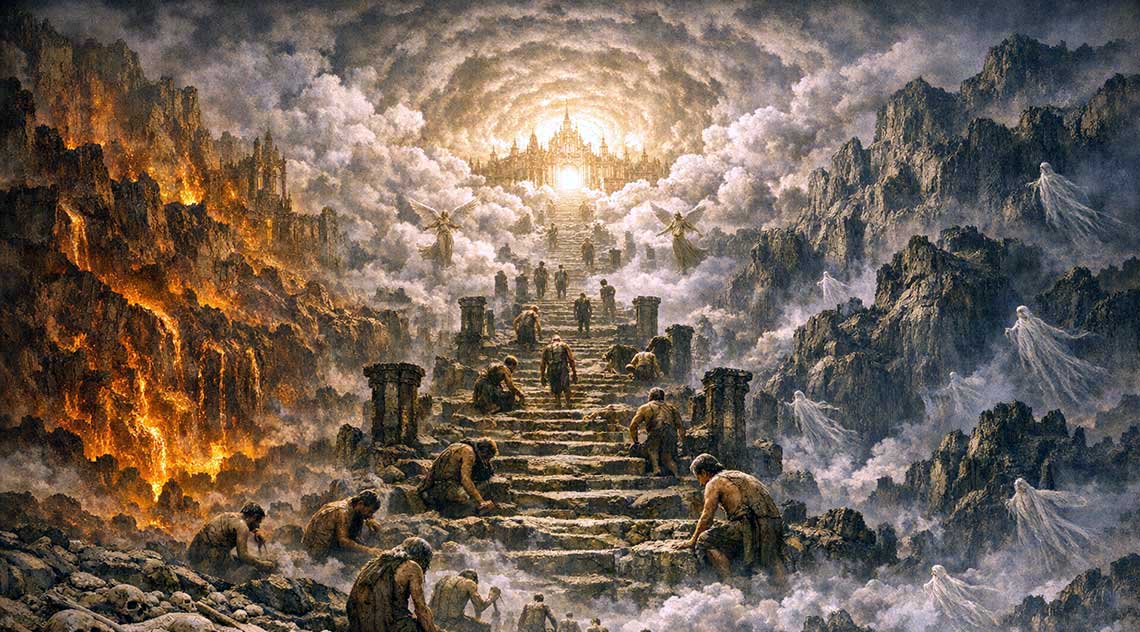
Purgatory is a doctrine of the Catholic Church affirming the necessity of post-mortem purification for souls destined for heaven, especially those who die in God’s grace but remain imperfectly purified. Rooted in Sacred Scripture, Tradition, and the witness of the saints, the doctrine underscores both the holiness of God and the faithful’s communal responsibility to assist the dead through prayer and sacrifice.
Nature of Purgatory
Purgatory is a state of purification. Heaven’s Hospital. Why do we need it? You would not show up to a wedding feast in your dirty work clothes, would you? Only the Holy can be in heaven. Can you imagine meeting Jesus with all your sinful baggage in tow? At the moment we die and face Jesus, we know the state of our soul. We read in 1 Peter 1:16, “for it is written, be holy because I (am) holy.” And in Matthew 5:48, “So be perfect, just as your heavenly Father is perfect.”
The concept of Purgatory is reflected in 1 Corinthians 3:13-15 “…each man’s work will become manifest: for the Day (Judgment Day) will disclose it, because it will be revealed with fire, and the fire will test what sort of work each one has done. If the work which one man has built on the foundation survives, he will receive a reward. If any man’s work is burned up, he will suffer loss, though he himself will be saved, but only as through fire.”
Purification and Sin
I did not understand the idea of the fires of Purgatory until I learned that the traditional way to purify silver was by smelting, or fire, which removes impurities. A soul without the remission of sin is still impure and is not ready to face God. Such a soul needs this purging of even the slightest sin or vice. It must undergo purification, the removal of all traces of sin. Even a forgiven sin still has remission. If you broke someone’s window and said you were sorry, and the person forgave you, that does not fix the window. This is why it is said that no sin is really private; it affects others.
Intercessory Prayer
Catholics are asked to pray for the “poor souls” in purgatory (intercessory prayer). Souls who have visited (appeared) from Purgatory to Saints (very rare) are often disfigured and suffering. They are helpless and cannot pray for themselves. St. Faustina (1905-1938), a Polish nun, helped a “poor soul” get to heaven. A soul that God granted this privilege sought help from her. It was someone she had known. The soul was ugly and in torment. St. Faustina offered prayers and Masses. Eventually, the soul returned radiant and grateful to thank her on her way to heaven.
St. Faustina received the Divine Mercy Chaplet from Jesus. It is a set of prayers to pray for the dying. Our Lord said to St. Faustina: “ Encourage souls to say the chaplet which I have given you…Whoever will recite it will receive great mercy at the hour of death…When they say this chaplet in the presence of the dying, I will stand between My Father and the dying person, not as the just Judge, but as the Merciful Savior….Priests will recommend it to sinners as their last hope of salvation. Even if there were a sinner most hardened, if he were to recite this chaplet only once, he would receive grace from My infinite mercy. I desire to grant unimaginable graces to those souls who trust in My mercy…through the Chaplet you will obtain everything, if what you ask for is compatible with My will.” *
Saintly Witness
Other Saints have talked about their visions of Hell and Purgatory. St. Gurtrude (1256- 1301) is known as the Saint of Purgatory for sharing the devotion of praying for the dead. She received this prayer during a vision of Jesus.…” Eternal Father, I offer Thee the Most Precious Blood of Thy Divine Son, Jesus, in union with the Masses said throughout the world today, for all the Holy souls in purgatory, for sinners everywhere, for sinners in the universal church, those in my own home and within my family. Amen.”
The Children of Fatima (1917) were given a vision of Hell to show them the degree of suffering the damned endured. The Virgin Mary told them that their prayers could save souls in danger of dying in mortal sin, but not those already in Hell. They not only prayed but fasted. They were 10, 9, and 7 years old.
Ecclesial Responsibility
St. Padre Pio (1887-1968) also encountered suffering souls. He was visited by a “poor soul” in distress. A former monk, “spirit,” told him he had been granted permission by God to visit him and ask for help in being released from purgatory. He asked Padre Pio to have a Mass prayed for him. Padre Pio did as requested, and the soul came back to thank him on his way to heaven.
Not all other worldly visitors were always friendly. The devil also attacked St. Padre Pio. Quite literally. He would battle him at night. His defense was prayer, especially the Rosary. He called it his weapon.
St. Padre Pio was a Capuchin priest of the 20th century. He had many gifts; one was the gift of reading souls. He often heard confessions for 12 hours at a time. He was sought out for his Holiness. But because he could read souls, he knew your sins before you said them. And if you omitted any, he would send you out, not absolve you, and tell you to come back when you were truly sorry for all your sins.
Besides the gift of reading souls, Padre Pio also received the gift of the stigmata. (The wounds of Christ) This is a rare gift. (St. Francis is said to have had the stigmata.) His hands had pierced holes in them for 50 years. You can find pictures of him offering Mass and holding up the Eucharist with his bandaged, bloody hands.
We, too, hold a great gift. Prayer. We can help souls get out of Purgatory and into heaven with our prayers. The greatest prayer a person can offer a “poor soul” is to offer the sacrifice of a Mass. This is done by registering with the church office a day to have a Mass offered for the person who has died. It is traditional to offer a small stipend for this act of kindness, but it is not required. Anyone can do this. Depending on the size of the church, the calendar may fill up quite quickly. Since Mass is offered almost every day of the year, many Masses are available. The Church announces at the start of Mass for whom the Mass is being offered, and they can be either alive or deceased.
The souls in purgatory have their own day on the church calendar. It is November 2, called All Souls Day. (The Commemoration of all the Faithful Departed.) All Saints Day is on November 1, which is why Halloween is on October 31, All Hallows’ Eve. (Those in heaven do not need our prayers, those in purgatory do, and those in hell cannot benefit from them.) Though it is not for us to judge someone’s final destination. Do not assume they are already in Heaven. And never give up on a sinner, your prayers may be the difference between Heaven and Hell.
*From St. Faustina’s Diary, paragraphs 687, 1541, 1731.