

Our nation is fortunate to have a tradition of intergenerational military service. One such case is that of Rear Admiral Richard Ellington Hawes, who served in the Navy during World War I and World War II. His son, also named Richard Ellington Hawes, served in the Navy and Marine Corps during the Korean War, Vietnam, and later tours of duty in Europe and Asia. The younger Hawes was a Colonel in the Marine Corps at his retirement.
Richard Ellington Hawes was born in Thomson, Georgia, on February 21, 1894. He attended the University of Georgia for two years before transferring to Mercer Law School. He was an outstanding baseball player and began a brief career in professional baseball in 1915.
His baseball career was interrupted in 1917 by the start of World War I and his enlistment in the Navy as a Fireman Second Class. He was discharged on September 29, 1918, but immediately appointed to serve in the U.S. Navy Reserve Force at the rank of Ensign. Only three months later, he was back in the regular Navy at the rank of Boatswain (Bosun), and he served in that capacity until 1923 when he was promoted to the rank of Chief Boatswain.
In 1929, he was promoted to the rank of Ensign by a Special Act of Congress in recognition of his service during the recovery of the submarines USS S-51 and USS S-4, which sank off the coast of the eastern United States in separate accidents. For his work in this salvage operation, he was awarded his first Navy Cross. After these salvage events, he entered the Deep Sea Diving School and qualified as a Master Diver.
His next advancement was commanding the USS Falcon in 1935, and by 1938, he was serving at Pearl Harbor, Hawaii. In January 1940, he became the Commanding Officer of the USS Pidgeon and was in the Philippines when the Pearl Harbor attack occurred on December 7, 1941.
Only three days later, the Japanese attacked the Navy Yard at Cavite, Philippine Islands, where he again distinguished himself by rescuing several vessels and servicemen and was awarded a second Navy Cross.
“For distinguished service as Commanding Officer of the USS PIGEON on December 10, 1941, during the Japanese enemy aerial attack on the Navy Yard, Cavite, Philippine Islands.- Despite the heavy bombing, strafing, detonations of air flak and warheads, and fires in the immediate vicinity, Lieutenant Commander Hawes, lacking the use of regular steering equipment then under overhaul at the Navy Yard, successfully towed the disabled submarine SEA.DRAGON clear of the dangerous area and, by his skillful maneuvering, saved both his ship and a submarine for further offensive war service.”
By this point in his career, he had acquired both the nickname “Spittin’ Dick” and a reputation for fierce loyalty to his men and to the Navy.
In June of 1942, he was reassigned to Oakland, California, to oversee the fitting out of the USS Chanticleer, a submarine rescue vessel. In November 1942 he assumed command of that vessel and was then back in the Asian Theatre. During 1942 and 1943 he repeatedly distinguished himself in his support of the war effort and was recognized by the commanding officer of the Seventh Fleet.
“Letter of Commendation: “For distinguishing himself by excellent service – as Commanding Officer of the USS CHANTICIBER., under the Commander Submarines, SEVENTH Fleet, during the period May 1943 to May 1944. As Commanding Officer of the USS CHANTICLEER, Commander Hawes showed outstanding ability in the direction of his ship in many assignments given her. His ingenuity in effecting ways and means to repair the various submarines assigned to the CHANTICLEER for refit is commendable. CHANTICLEER successfully carried an important and unwieldly cargo of planes through heavy seas, delivering them safely to port. On another occasion, Commander Hawes skillfully maneuvered his ship over to the spot of a crashed plane, moored, and had a diver in the water all within a space of thirty minutes from the time the plane crashed -“
His skills then led to a reassignment to Pascagoula, Mississippi, where he supervised the fitting out of a submarine tender, the USS Anthedon. He assumed command of the Anthedon and was back in the war by September 1944 where he again distinguished himself and received a Bronze Star Medal.
“A forceful leader, Captain Hawes exercised professional ability in organizing and indoctrinating the personnel of his ship in the repair and refitting of submarines and, during a period of eight months, supervised his repair crews in refitting thirty-four submarines in addition to effecting emergency and voyage repairs to twelve others. When two badly damaged hostile vessels were salvaged after being sunk for many months, he ably directed his crews in completely overhauling and repairing the enemy ships – “
At the end of World War II, he was reassigned as the Inspector of Navy Recruiting for the Fourth Joint Service Induction Area, which had its headquarters in Atlanta, Georgia. He served in this capacity until December 1, 1952, when he retired from service. His path from Boatswain to Captain was marked with outstanding service and courage during a critical moment in world history.
Captain Hawes was later promoted to Rear Admiral and retired to his hometown in Thomson, Georgia. He died on December 30, 1968, and is buried there.
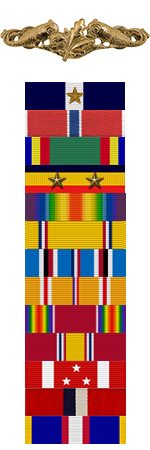
Shown here are the Insignia and Medals Rear Admiral Richard Ellington Hawes earned during his career. They include:
Submarine Supply Insignia
Navy Cross with Gold Star
Bronze Star Medal
Commendation Ribbon
The Presidential Unit Citation with two Stars
World War I Victory Medal
American Defense Service Medal
American Campaign Medal
Asiatic-Pacific Campaign Medal
World War II Victory Medal
National Defense Service Medal
Philippine Defense Ribbon
Philippine Liberation Ribbon
Philippine Independence Ribbon
In his hometown, there is an honorary plaque commemorating his service. In 1984, the Guided Missile Frigate USS Hawes was commissioned in his Honor.