
In August 2024, we published an article on this concept and Sir Isaac Newton. With all that is going on today in our nation and around the world, we thought a second look might be timely.
“If I have seen further, it is by standing on the shoulders of giants.”
Sir Isaac Newton 1675
The phrase “If I have seen further, it is by standing on the shoulders of giants” is famously attributed to Sir Isaac Newton, who wrote it in a 1676 letter to fellow scientist Robert Hooke. However, Newton did not coin the metaphor. Whether he knew it or not, he was echoing an older idea. Given Newton’s IQ, it seems likely he knew the source. It is also likely that Newton believed in and understood the value of iterative or incremental improvements in knowledge in all fields of study.
The Historical Shoulders of Giants
One of the earliest recorded versions of this metaphor dates back to the 12th century, where it appears in the writings of French philosopher Bernard of Chartres, as recorded by John of Salisbury in 1159. John of Salisbury wrote that Bernard said:
“We are like dwarfs perched on the shoulders of giants, able to see more and farther than our predecessors, not because of our own height, but because we are lifted by their greatness.”
John of Salisbury, English Philosopher
I prefer this version because it seems more descriptive and creates a stronger connection between individuals and their accomplishments.
Even earlier, a similar thought was expressed in 1123 by French philosopher William of Conches in his observations on Priscian’s Institutiones grammaticae, where he described modern scholars as:
“Dwarfs elevated by the accumulated knowledge of the ancients.”
William of Conches
While Newton’s version is the most recognizable today, the metaphor itself has deep medieval roots and is an intellectual nod to the power of collective, iterative, and incremental progress.
American Historical Implications
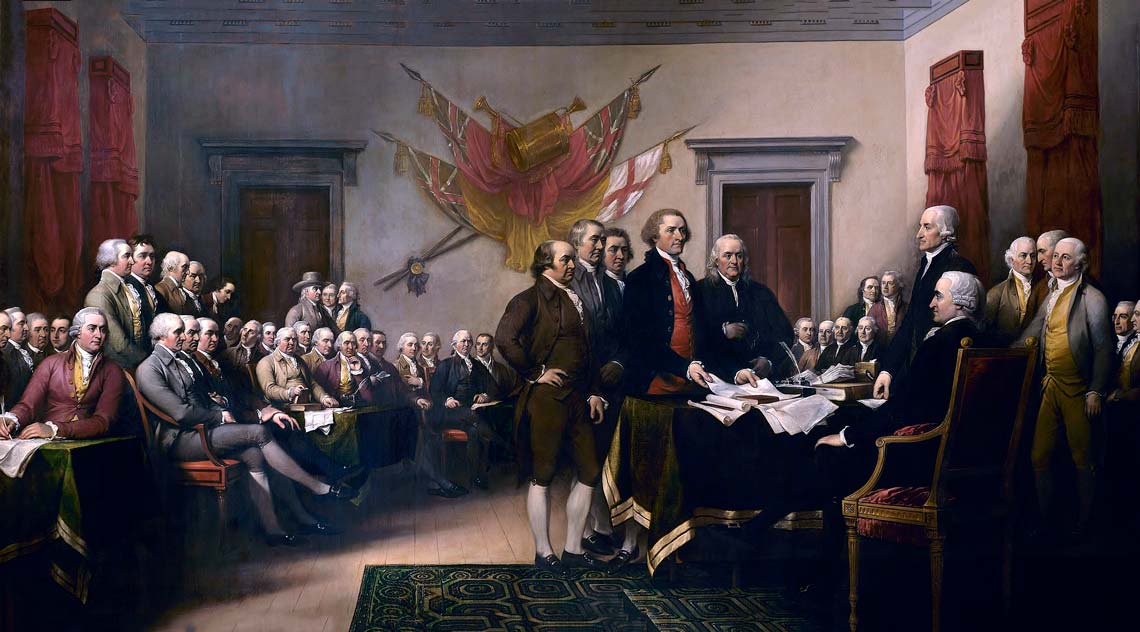
In America, we truly stand on the shoulders of giants. The collection of men who wrote the Declaration of Independence and our Constitution were giants of thought and action. These men knew that in challenging the King of England’s power and judgment, they were placing their own lives on the line. But they also knew right from wrong and stood in that storm to form a better nation.
But the Founders did not always agree. We should acknowledge that and, in many cases, “agree to disagree” for the sake of the Union.
Two of our Founding Fathers, Patrick Henry and George Mason, opposed the ratification of the Constitution, as did several other prominent figures. Their concerns centered on excessive centralized power and a fear of a repeat of European monarchies in terms of both strength and title. This echoes the current dissenters who want to participate in “No Kings Day.” The irrational fear-mongering of the late 1700s still echoes today. There are too many safeguards built into our Constitution to allow for that transition. Not the least of these is the sovereignty of the states.
In the early days of the nation, opposing factions emerged, including the Federalists and Republicans. George Washington, John Adams, and Alexander Hamilton were prominent Federalists. Thomas Jefferson and James Madison were among the prominent Republicans. In a bit of irony, Jefferson and Adams died on the same day, July 4, 1826, still at odds over the meaning and legacy of the Revolution and its aftermath. These great minds and men were already disagreeing before the ink dried on the Declaration of Independence. They were bound together by a common vision but driven apart by tactics.
Even a mind as great as Jefferson’s admitted to inspiration from others. Jefferson acknowledged help from George Wythe, William Small, and Francis Fauquier. All three were influential in Colonial politics and education. These men lifted him, inspired him, and believed in his intellect and worth. Even Jefferson considered them to be giants of intellect.
Washington admired more classical and historical figures, such as the Roman Statesman Cincinnatus, Julius Caesar, and the Greek hero Hercules. Washington emulated his role models and heroes, and at times seemed to adopt their best traits in times of hardship. When times were tough, he stood on their shoulders to see further.
John Hancock is often regarded as a lesser revolutionary figure because he did not serve in government after the United States’ final separation from England. But nothing could be further from the truth. Hancock famously created the Stamp Act issues when he declared that anyone purchasing British tea was “An enemy of America.”
"Some boast of being friends to government; I am a friend to righteous government, to a government founded upon the principles of reason and justice; but I glory in publicly avowing my eternal enmity to tyranny."
John Hancock
Hancock’s wealth helped fund the Revolution, but he was not someone who sought the spotlight, despite being very popular in Massachusetts. He served as President of the Massachusetts Provincial Assembly and the Continental Congress. In many ways, Hancock offered his shoulders for others to stand on during the Revolution.
Standing on the Shoulders Today
Today, we often see politicians and business leaders with the arrogance to believe their accomplishments are solely their own. These men and women see themselves as giants. Whether it is mathematics, computer science, government, law, or any other field of endeavor. Arrogance blinds them from seeing that all sit on the shoulders of those who came before them. Claiming anything else is false bravado. Without Newton and his insights, there would be no moon landing, no rockets, and no artificial intelligence.
We have the privilege of living in the greatest nation on earth, at the dawn of innovation brought on by unprecedented technology. We are still the land of opportunity, which is why so many fight to come here. But we must understand that we and all before us have stood on the shoulders of giants.
Resources and Further Reading
Fixing U.S Politics, By Katherine M. Gehl and Michael E. Porter, Harvard Business Review, hbr.org, July-August 2020.
Founding Fathers, By Joseph J. Ellis, Britannica, britannica.com, Last accessed June 15, 2025.
How 43 Giant, Crumbling Presidential Heads Ended Up in a Virginia Field, By Jennifer Billock, Smithsonian Magazine, smithsonianmag.com, February 12, 2016.
Isaac Newton, English physicist and mathematician, By Richard S. Westfall, Britannica, britannica.com, May 17, 2025.
John Hancock, Boston National Historical Park, National Park Service, nps.gov, Last accessed June 1, 2025.
John of Salisbury, Wikipedia, wikipedia.org, Last accessed June 13, 2025.
Signers of the Declaration of Independence, By Editors, National Archives, archives.gov, Last accessed June 15, 2025.
Standing on the shoulders of giants, By Gary Martin, Phrase Finder, phrases.org.uk, Last accessed June 15, 2025.
Standing on the shoulders of giants, Wikipedia, wikipedia.org, Last accessed June 15, 2025.
The Democratic Party’s AOC Nightmare Has Begun, By Peter Suciu, The National Interest, nationalinterest.org, June 10, 2024.
The Foundations Of America, According To AOC, By Scott Greer, Highly Respected, highly-respected.com, January 28, 2025.
The Three Great Early Influences on Thomas Jefferson, By Editors, History is Now Magazine, historyisnow.com, Last accessed June 13, 2025.
What Historical And Mythical Figures Inspired George Washington?, By Christopher Garon, christophergaron.com, Last accessed June 9, 2025.
William of Conches, Wikipedia, wikipedia.org, Last accessed June 13, 2025.