
When I was growing up in the 1950s and 1960s, my parents would listen to and then later watch Billy Graham’s Crusades. We were Methodists, not Southern Baptists, but my parents knew with Graham that some extraordinary things were happening, so they listened and watched. The Billy Graham Crusades, a global phenomenon that started in 1947 and continued until his retirement in 2005, reached millions worldwide. He was the most respected Christian figure in America for fifty-plus years, and his recognition was probably second only to that of the Popes.
Billy Graham’s legacy extends beyond his own lifetime. His marriage to Ruth Bell in 1943 and their five children marked the beginning of a family tradition of Christian service. All of their children are actively involved in Christian ministries. Franklin, in particular, has continued the work started by his father, while Anne Graham Lotz founded and runs AnGeL Ministries, a testament to the enduring impact of the Graham family.
Influential Leadership
Billy Graham’s evangelical leadership was a force to be reckoned with, setting him apart as the most influential Christian in America during his lifetime. His preaching of the gospel of Jesus Christ was a historic event, reaching more people than any other individual in history. His influence was so profound that he was recognized on Gallop’s list of Most Admired Men and Women an astounding sixty-one times.
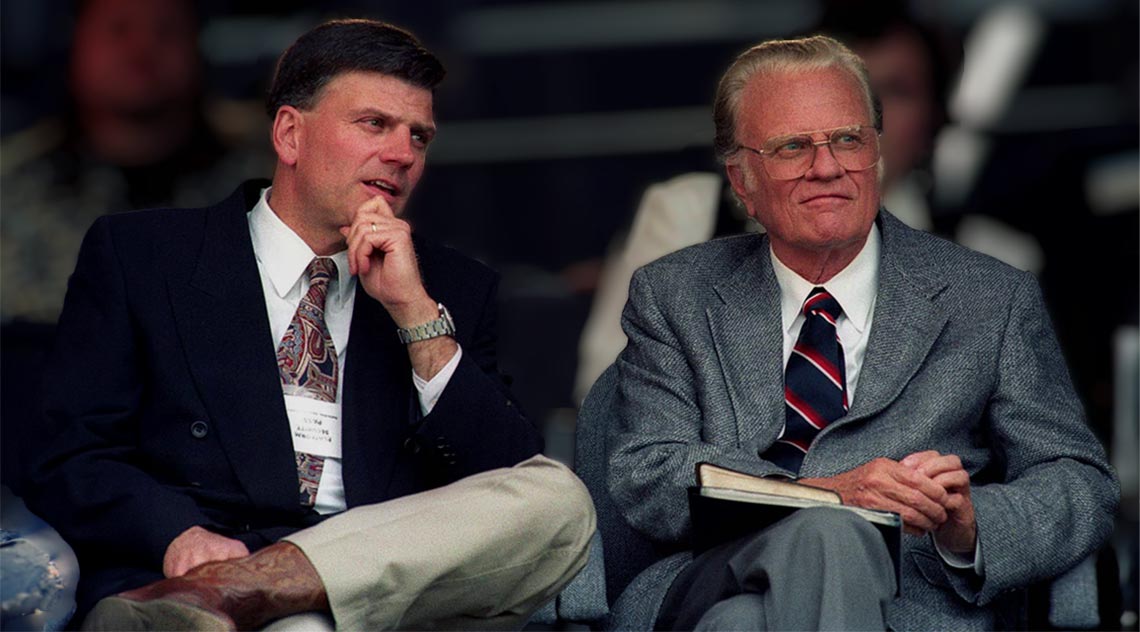
Billy Graham also became the confidant and minister to Presidents, most notably President Eisenhower. It is estimated that his live audiences numbered over 200 million people from 185 countries. Through live services, television, and radio, he reached billions of people. His unique talent for bringing religious and secular leaders together to find common ground on contentious issues is a testament to his leadership and influence. The image above shows Billy and his oldest son, Franklin Graham, in 1994 in Cleveland, Ohio. I have written about their impact on the youth of Cleveland in my series titled Amazing Grace. There are surprising revelations there about Billy Graham’s youth involvement.
Passing the Torch
Billy Graham’s legacy lives on through his son, Franklin, who has taken up his father’s mantle in different ways. Together, they created a legacy that continues to resonate today, a testament to the enduring impact of both men. While Franklin may be less visible than his father, his influence in religious and secular realms is no less significant. He serves in various capacities with charitable and religious organizations, focusing on relief efforts. He has also been vocal on controversial issues, aligning himself with conservative values and leaders.
Unlike his father, Franklin’s path was not as well defined. He holds an A.S. degree from Montreat College and a B.A. from Appalachian State University. He seemed to struggle with his path until he worked for Samaritan’s Purse, where he discovered a passion for mission work. It was not until 1982 that he was ordained into the ministry, not as a Southern Baptist but as a non-denominational minister.
In 1979, Graham became president of Samaritan’s Purse and vice president of the Billy Graham Evangelistic Association in 1995. He later became president of the Billy Graham Evangelistic Association in 2000. He married Jane Austin Cunningham in 1974, and they have four children and twelve grandchildren.
I can imagine that being the son of someone named to the “Most Admired Men and Women” list sixty-one times is more of a burden than we care to know. It is a tribute that he has found a balance between continuing his father’s legacy and cutting his path through life.
Not a Passive Leader
Franklin Graham seems to differ from his father in several ways. In my opinion, he is not as gifted in the pulpit as his father and does not have the same command level as his father. However, Franklin Graham is no “shrinking violet;” he endorses and openly speaks his mind on topics affecting religion, faith, politics, and society. In these areas, he stirred up some controversy among Democrats in the past few months.
In an article that appeared in Evangelical Focus in October of last year, Reverend Graham made his position clear on several controversial topics, including hatred, wealth, political endorsements, and abortion. That interview can best be summarized in four of his quotes.
“Many have money, a home, a bank account. But they’re still empty; they’re not fulfilled.”
“I think it’s important to try to vote for candidates that at least stand for our Christian values. This doesn’t mean that they are Christian themselves.”
“Donald Trump is a controversial person, but at the same time, when he was President, our country grew.”
“Abortion is legal in almost every Western country in the world. But as Christians, we believe abortion is murder.”
Franklin Graham
A Strong Position on Democrats
This interview was followed up by an article in the Wall Street Journal last week. Graham did not back away from his support of President Trump. His implicit endorsement stems from what he and other Evangelical Christians see as politicians working to turn religion to their advantage. Graham’s support comes from the same place as Constitutional scholars such as Alan Dershowitz, who believe Democrats have weaponized their power and are destroying the Country.
Graham went on to explain that since the 2020 election, he and many other Christians believe the Country has forsaken them in favor of secular beliefs and causes. President Biden added fuel to this fire when he declared Easter Sunday as “Transgender Day of Visibility,” a direct assault and insult to most Christians.
“Politicians have taken on moral issues, and they‘re saying these are now political issues and not moral issues – and I say ‘Wrong! This is our territory.’”
Franklin Graham
Graham included abortion, same-sex marriage, immigration, and energy policies among this group of moral issues. In his view, immigration and energy are moral issues because they affect the poor and their ability to provide for their families, and they are an issue at the root of Christian missionary work.
Familiar Territory
Franklin Graham learned from his father that to positively influence the world, there are times, like today, when you must stand against the destructive forces at work in the world, even if you must stand alone. Confronting evil takes wisdom, courage, and tenacity.
There are some parallels between the battles fought by Billy and Franklin Graham and the current antisemitism on our college campuses. The fight we are experiencing on campuses is reminiscent of the 1960s struggles but with some strange twists. In the 1960s, protests were in opposition to our direct participation in Vietnam. Outside and foreign influencers generate today’s protests over our support for Israel’s defense of its people and territory.
Graham’s fight is for the survival of Christianity against enemies, both domestic and foreign. Domestically, the far left wing of the Democratic Party is advancing a socialist, Marxist, secular ideology that threatens our very existence. Graham understands this and knows the erosion of our faith runs parallel with the erosion of societal values. He sees, correctly, a world where there is pressure on both Christianity and Judaism for their very survival.
Graham has consistently, forcefully, and equally criticized atheistic and theocratic governments. Whether you agree with him or not, like him or not, he stands behind his beliefs. Like his father, Franklin Graham will be on the right side of history and the right side of critical issues of our day. The Graham family has been a part of the moral and religious fabric of our nation for 106 years, and we need more like them who will stand up for principles. In many ways, Franklin Graham’s path has been more challenging and uncertain than his father’s, but he has navigated it well.
Resources
Billy Graham’s Critical Hour of Decision—and How God Used It to Change the World, By Nathaniel Sullivan, Word Foundations: Insights and Commentary From A Biblical Perspective, wordfoundations.com, 2018.
Billy Graham’s star was born at his 1949 revival in Los Angeles, By Cecilia Rasmussen, Los Angeles Times, latimes.com, September 2, 2007.
Evangelist Franklin Graham Says Democratic Politics Have Turned Against Religion, By Vivian Salama, The Wall Street Journal, wsj.com, May 12, 2024.
Franklin Graham, Wikipedia, Wikipedia.org, Last accessed May 17, 2024.
Franklin Graham Says Democrats Have Turned Against God, By Taegan Goddard, Taegan Goddard’s Political Wire, politicalwire.com, May 13, 2024.
How religion and politics will mix in 2024 – three trends to track, By Tobin Miller Shearer, The Conversation, theconversation.com, January 3, 2024.
There’s division in the world, hatred and killing. People need to know that this is not God’s plan; by Nicolai Franz, Evangelical Focus, evangelicalfocus.com, October 31, 2023.
Youth for Christ, Wikipedia, Wikipedia.org, Last accessed May 19, 2024.