
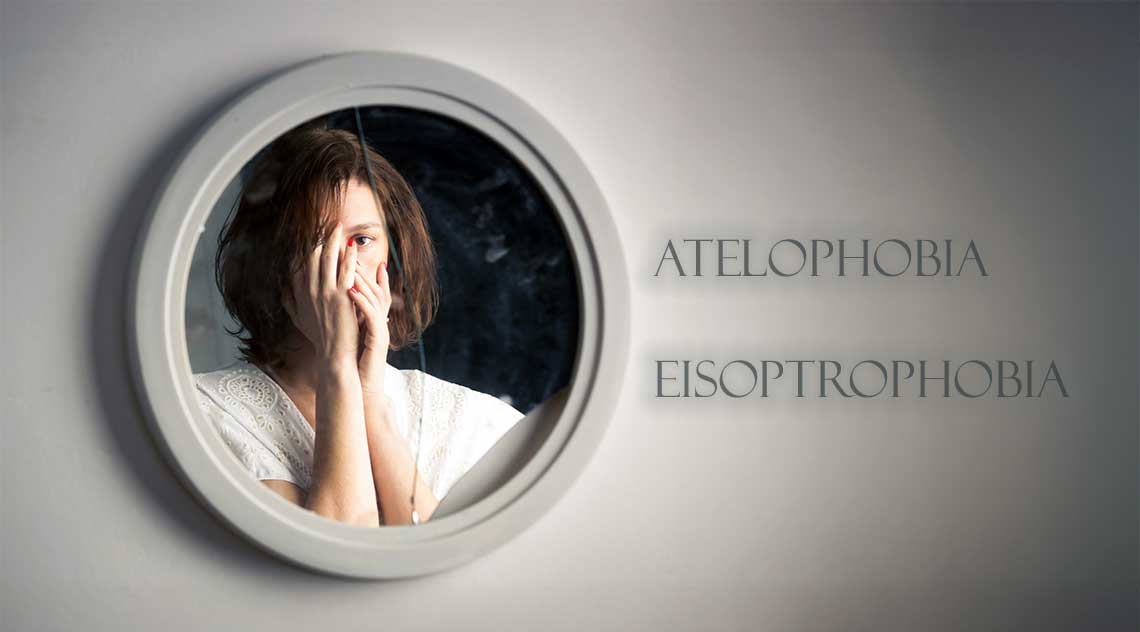
If you know these two words, you spend too much time in the dictionary or watching old movies. We ran into the word atelophobia in a Dean Koontz book, and knowing he likes obscure words, we looked it up.
Atelophobia is the fear of imperfection. You might think of a person with few imperfections, but when they look in the mirror, they only see the flaws in their appearance. I think of this as one problem that people suffering from bulimia might have, because atelophobia is an extreme. Atelophobia can also apply to the workplace, where an employee is extremely fearful of making mistakes and therefore does nothing.
“Adele’s atelophobia forced her to spend hours putting on her makeup in the mornings.”
“Joe could not be accused of having atelophobia since his whole life could be described as ‘close is good enough.’”
“Susan’s OCD tendencies went hand-in-hand with her atelophobia.”

Eisoptrophobia is another unusual word, and it refers to people with an extreme fear of mirrors. We ran into this word while researching atelophobia. I cannot say that eisoptrophobia will make my list of favorite words, but if heard or read, I will have some sense of its meaning. Eisoptrophobia, like many other phobias, can go hand-in-hand with OCD issues.
“As a young girl, Carrie thought she saw the reflection of a ghost in a mirror, creating a sense of eisoptrophobia in her everyday life.”
“He placed a mirror in front of the gorilla enclosure, and the silverbacks all reacted as if they had eisoptrophobia.”
“Many dogs cannot see their reflection in a mirror, making eisoptrophobia impossible in their lives.”
Putting these two together in a single sentence is a mouthful, but it can be done.
“Carol’s eisoptrophobia kept her from looking into mirrors, while her atelophobia made her constantly worry that avoiding them was just another flaw in her pursuit of perfection.”
“Paul’s eisoptrophobia forced him to remove every mirror from his home, while his atelophobia constantly reminded him that he had many unseen flaws.”
“Ed’s eisoptrophobia drove him to cover every reflective surface in his apartment, yet his atelophobia left him questioning whether his actions were an unforgivable imperfection.”