
When someone speaks about a conflagration, they talk about a massive fire or a significant conflict between warring parties. Usually, a conflagration refers to a fire that causes enormous damage to property or people. Some dictionaries delineate conflagration into categories with more helpful descriptors.
Industrial conflagration describes fires in industries like oil refineries.
Urban conflagration refers to a fire that destroys a neighborhood or urban block.
Ship conflagration seems obvious and refers to a very serious or uncontrolled fire on a ship.
When conflagration is used to describe a conflict, it usually refers to a lengthy war such as Vietnam or the Gulf Wars. However, it can also describe a regional conflict.
“The warehouse fire was so hot it became a full conflagration as it burned out of control.”
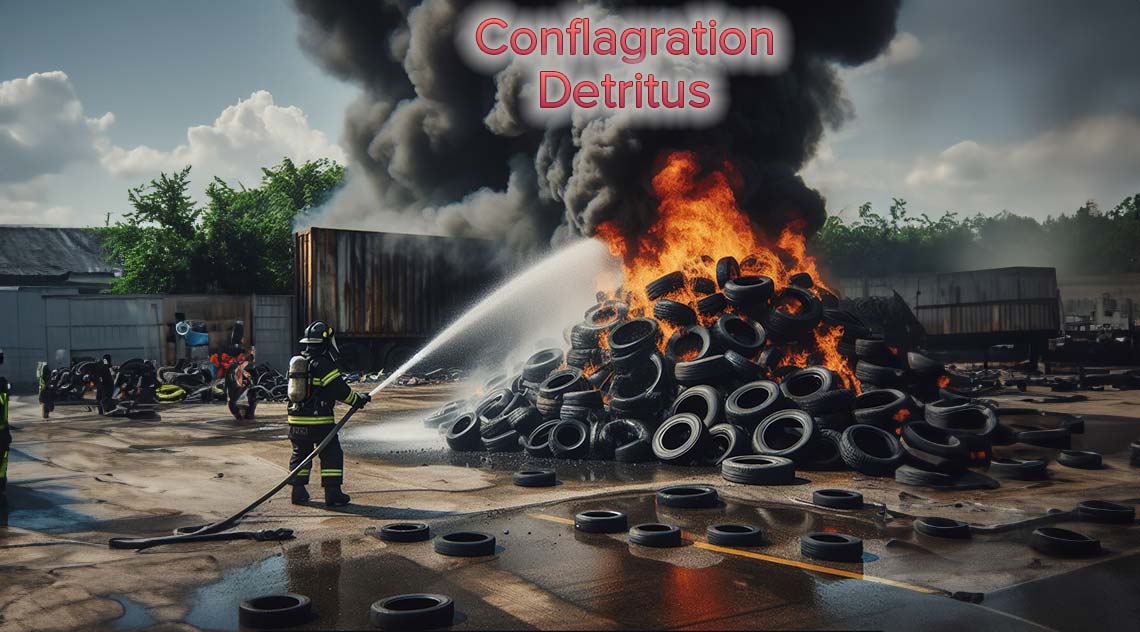
“When the tires caught on fire, they were described in the paper as a conflagration because nothing could extinguish the blaze.”
“The conflagration spread rapidly through the dry forest, casting an ominous glow in the sky.”
“The war unfolded like a conflagration, consuming nation after nation in its fiery path and leaving a trail of destruction.”

Detritus can have several meanings, but we are most familiar with its use to describe rubbish after some event. Detritus can also refer to remnants or odds and ends. This is one of those words that is handy and easily understood through examples.
“The bar floor was covered in the detritus from the fight that broke out last night.”
“When the campus encampments were broken up, no one could believe the detritus left behind.”
“As the roadway crumbled from the heavy traffic in many places, nothing was left but the detritus of the crumbling asphalt.”
“After the death of his mother, Joe was left to sift through the detritus of her life.”
And then putting both words together in a sentence produces something like:
“After the conflagration had been extinguished, the forest was reduced to ashes and detritus, a sad reminder of nature’s unpredictable fury.”