
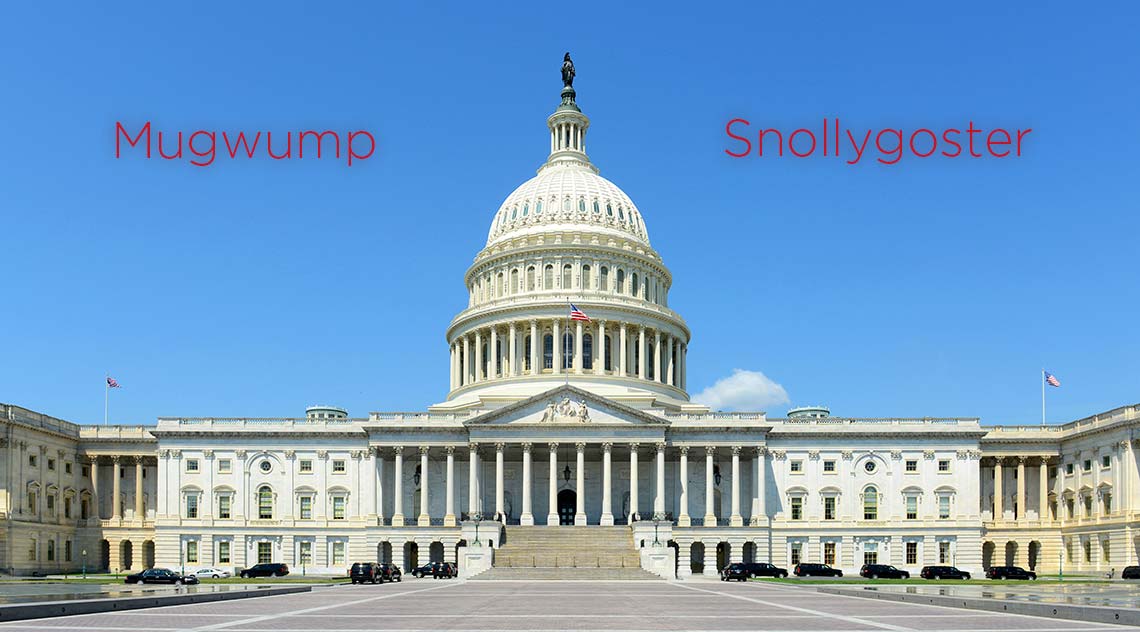
A mugwump is a politician who sits on the fence on issues and will not take a stance. It can also mean someone who takes the middle road on matters and is neither Democratic nor Republican. However, according to Britannica, the term originated in 1884 when Republicans who refused to support James G. Blaine as a candidate for the presidency and instead supported Grover Cleveland were labeled Mugwumps.
The word’s origin is believed to be Algonquin and a derivation of their term “mogkiomp,” meaning great man or big chief. When first used by Charles A. Dana in the New York Sun, it was used to portray an independent voter.
“Despite the heated debate, Mary remained a mugwump and refused to take either side in the political debate.”
“During the town hall meeting, Sam was criticized for being a mugwump, as he refused to support either side of the issue.”
“George became labeled a mugwump when he repeatedly refused to take a stand on the war.”

A clever or unscrupulous person can be labeled a snollygoster. When used politically, this term can refer to a person with ambitions for office regardless of party affiliation. It can also refer to a politician who cares more about the trappings of office than serving his or her constituents.
The term can be traced back to the late 1840s when it was used to describe politicians who wanted office. By the late 1800s, it had become a reference to Southern politicians who wished for office but lacked the ability to attain it or the skill to function if elected.
“The voters were wary of the candidates, suspecting that each was just another snollygoster who would say anything to get elected.”
“Many thought that Kamala Harris and Tim Walz were nothing more than snollygosters who wanted the power of the Presidency but would have lacked the skill to function.”
“Joe is a snollygoster with great ambition, but he will never survive the scrutiny of the Senate confirmation hearing.”
Using the two political terms in a sentence is not too difficult, with a bit of thought.
“Despite the snollygoster’s attempts to sway the undecided voters, the mugwumps refused to be influenced by the politician’s cunning tactics.”
“The snollygoster tried to manipulate the situation to his advantage, but the mugwump remained impartial and refused to be swayed by his tactics.”
“Despite the snollygoster’s relentless campaigning, the mugwumps remained indifferent.”