
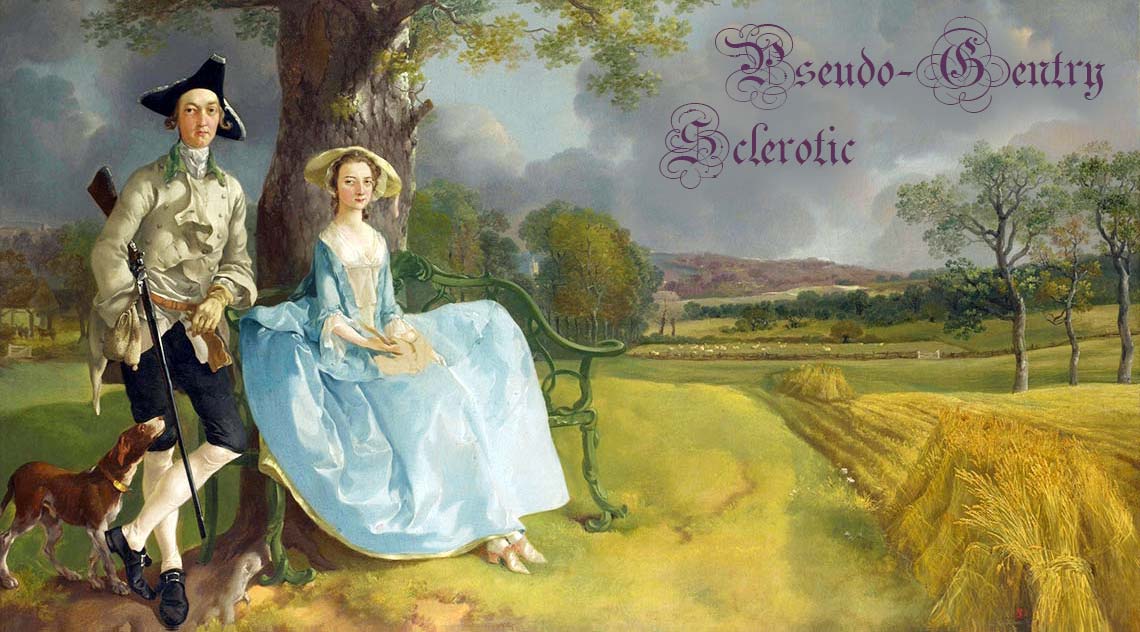
Pseudo-gentry or Pseudogentry is a term familiar to fans of Jane Austen. In the image above, Thomas Gainsborough creates a painting of a couple of the “Landed Gentry,” and land is a crucial distinction. The picture is titled Mr. and Mrs. Andrews (Robert and Frances Andrews) and dates to roughly 1750. In the painting, Gainsborough communicates many subtle things.
Mrs. Andrews is decked out in her finest, while Mr. Andrews is dressed down a bit but shows off his hunting prowess and land. The rolling hills and the land are crucial to understanding their pose. Much of the land passed to the couple as Mrs. Andrews’ dowery. So perhaps Mr. Andrews is the pseudo-gentry in the painting, while Mrs. Andrews is from a landed gentry family.
The pseudo-gentry was just a notch down from the landed gentry. They aspired to the lifestyle of the upper rung of society but lacked the means to attain that level. They might have owned land, but they lacked the resources to make a lifelong or generational commitment to keep it in the family. The concept originated with Jane Austen’s works to differentiate the various stratifications of wealth that existed in England at the time. I would assume that similar stratifications existed in all societies with monarchs and those who aspired to be in court.
However, pseudo-gentry did not join our lexicon until historians like David Spring and Alan Everitt used it to describe Austen’s characters. Their use of the term referred to individuals related to the landed gentry but not a part of that social class. Today, we might consider these the upper middle or successful working class. Some of these people mimic the wealthy and may even waste enormous sums of money pretending they are wealthy. Jane Austen might have been described as a member of the pseudo-gentry, a successful member of the working class, and related to a brother who was landed gentry. Since land went down through male heirs, she and her mother were left almost penniless while her brother enjoyed the accouterments of a landed gentry noble.
“In Jane Austen’s novels, characters such as the Woodhouses would fit the description of pseudo-gentry.”
“Many Hollywood ‘Stars’ are nothing more than pseudo-gentry who pretend to have wealth and class.”
“Today, many lawyers and doctors might find themselves in the world of the pseudo-gentry because they spend lavishly and save poorly.”

The word sclerotic originated in Greece and today most often refers to someone with multiple sclerosis. Multiple sclerosis is a neurological condition in which the immune system attacks nerves, causing inflammation and lesions.
However, sclerotic can have other meanings, such as people and organizations that are rigid in their thinking and reluctant to adapt to change or refuse to compromise on issues.
“Washington politicians are often trapped in this sclerotic bureaucracy where things happen at an exaggerated slow pace.”
“Ralph’s reluctance to accept change transformed his company into a sclerotic organization, and it ultimately went out of business.”