
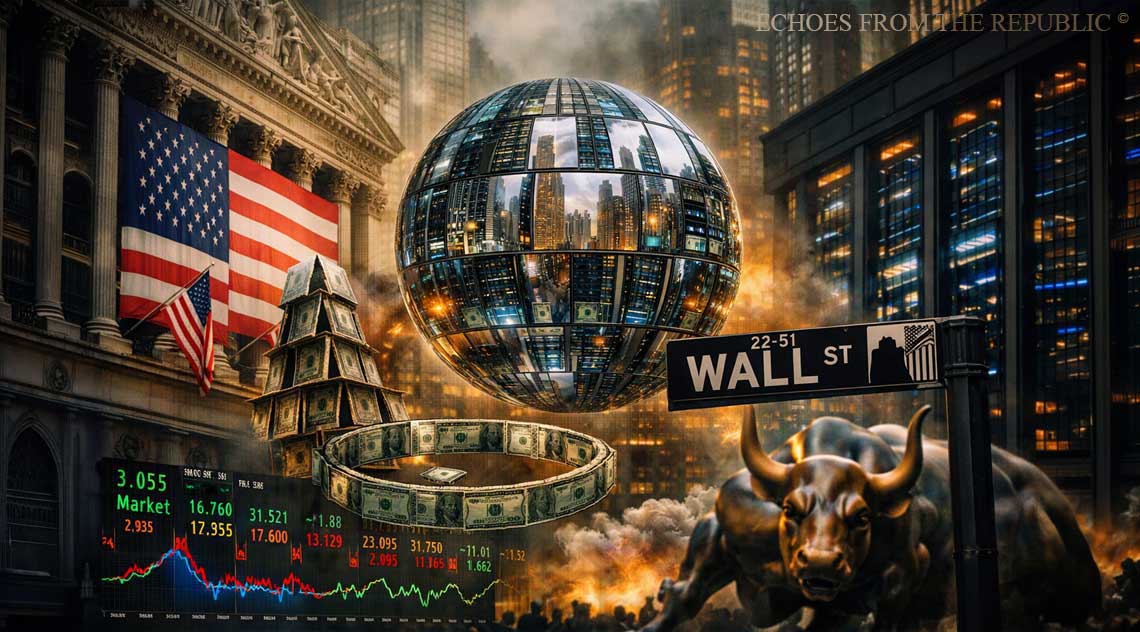
A few days ago, I authored an article titled America at the Fiscal Edge. This follow-up article examines what is happening on Wall Street, which closely parallels our national fiscal crisis. Enjoy, but understand that this is both a warning and an opinion.
The Sovereignty of AI
These days, the separation between Wall Street and the Halls of Congress is too narrow. It is so tight that it is difficult to tell where one ends and the other begins. With congressional delegates and their insider trading, tech CEOs constantly visit Congress and the White House. Where does one end and the other begin? The Supreme Court has also opened a door that I think is proving especially dangerous: unlimited PAC money in campaigns.
The proximity of major technology CEOs (“Tech Bros”) and their constant interactions with politicians have caused issues. The titans of Tech have now noticed Modern Monetary Theory and have created a financial ecosystem that only they operate within. It is a world where sovereign-scale money moves through structures so complex that even rating agencies struggle to map the flows. The danger is not simply that Congress and Big Tech sit too close together, but that both now compete in the same liquidity ecosystem. When companies issue bonds and enter IPO markets seeking trillions, they behave as if money is infinite. They begin to compete with nations for liquidity on a sovereign scale.
Wanting to appear relevant, members of Congress spout daily about reigning in Big Tech, AI, and the “Tech Bros.” But Congress was designed to be a deliberative body that sometimes thinks long and hard about issues, and the system around it moves glacially. A group as elderly as most in Congress also moves at glacial speed, while technology, particularly AI, moves at light speed. Never mind that most in Congress can barely spell AI; they believe they can regulate it. All they can do is reread notes staffers pass to them on topics like Agentic AI, data centers, circular financing, and the coming extinction of all humans. By the time they are presented, the notes are already outdated, but those reading them have no clue.
Disturbingly, the AI financing world is so large that it operates on a sovereign-debt scale. When any industry starts using the word “trillion” in its financing, we should all sit up and take notice. Until recently, the “T” word was reserved for countries, not companies.
Uncomfortable Parallels
An uncomfortable parallel to the AI revolution is a strange combination of the Dot Com Era and the Great Financial Crisis. Those eras look tame in comparison because they were understandable. The Dot Com days focused on delivering things that were already understood, just through a different delivery mechanism. The Great Financial Crisis involved the Wall Street crowd duping investors into purchasing artificially overrated securities composed of a mixture of unquantifiable risk; nothing new.
In my earlier article, we discussed another parallel, the circular nature of the Yen Carry Trade and how it benefits nations and sophisticated investors. It is a world with an implicit agreement: I will buy your bonds if you buy mine, and we will both pretend we have adequate reserves, are solvent, and guarantee that by holding the debt of other sovereign nations.
And now we arrive at another parallel: the size of the AI financing market and what has been described as the circular financing of the largest companies at the heart of this “revolution.” Mix this circular financing with the “T” word, and you have the potential for real fireworks in the markets if any link in the chain breaks.
The Big Difference
Analysts and TV “talking heads” often correctly note that the AI Revolution is different because circular financing has NVIDIA at its heart, with a real product, real sales, and real profitability. We can also take some comfort in knowing the Magnificent 7 are real companies with real products and earnings. Beyond AI investments, NVIDIA, Microsoft, Google, Meta, Amazon, Apple, and Tesla all “make something” tangible and have (had) distinct paths to profitability.
Companies like Microsoft and Apple have long been “cash cows,” so the idea that they could become dependent on market financing was unthinkable before the AI race. But in the mad dash to win the war for dominance in Artificial Intelligence, even these companies’ management has fallen under AI’s spell. And in a moment of fiscal insanity, they gave up their core strength, boundless cash flow, for the chance to “win the AI race” at a time when no one can define what winning the race means.
As with earlier bubbles, the term “irrational exuberance” captures much of what we see. Companies once defined by limitless cash flow and rock-solid balance sheets have shifted from debt-free to major debtors in the mad dash to build data centers. They remain powerful forces in technology and finance, but they have taken a step in the wrong direction.
Just as the first company to build a website does not own the Internet, neither will the first to build an AI data center own the world of Artificial Intelligence. And the first company to develop a true agentic intelligence model will not win that race. A race with no defined goal or endpoint cannot be won. It is a bit like trying to be the fastest gunslinger in the West; there is always someone faster. Just ask INTEL.
The Heart of the Problem
Sitting on the other side of this financial equation is a real-world issue: money is not limitless, even for the Mag 7. Or is it?
Circular Financing Everywhere
If the national debt crisis teaches us anything, it is that circular financing has become the way the modern world operates. Central banks do it openly. Sovereign nations do it quietly. Wall Street does it elegantly, in mysterious ways. And now the Mag 7 does it aggressively. Each segment of the world economy acts as if money were limitless, and each depends on the same global pool of liquidity.
The United States issues trillions of Treasury bills and assumes the world will buy them. Japan suppressed interest rates and exported liquidity through the carry trade, allowing investors to borrow cheaply in yen and invest elsewhere. Europe and China add their own distortions through ineptitude and obfuscation. Inevitably, these flows converge into a single global reservoir of capital. That reservoir is not infinite, yet everyone now behaves as if it were. The Bank for International Settlements has sounded an alarm for years about the size of global sovereign debt and the unknown amount of dollars tied up in derivatives, but its warnings are largely ignored.
Into this already strained system step the Mag 7, issuing corporate debt on a scale once reserved for sovereign nations. Their AI ambitions require data centers so large and so expensive that they have entered the same bond markets that fund governments. Microsoft, Apple, Amazon, and the others are no longer simply raising capital. They are competing directly with the U.S. Treasury for buyers. Every dollar that flows into a corporate bond is a dollar that does not flow into a sovereign bond. The cost of capital rises globally.
In their pursuit of AI dominance, the Mag 7 quietly built their own version of Modern Monetary Theory. They borrow or issue debt to build data centers and buy each other’s products to fill them. The data centers create AI capacity that other Mag 7 companies commit to purchase. AI capacity and capability inflate valuations. Higher valuations enable more debt issuance, but at higher spreads. The loop repeats. It is the same mechanism sovereign nations use to justify endless borrowing, only without a central bank, a national currency, or an army to backstop the system.
This is the heart of the problem. Circular financing and endless borrowing capacity work beautifully until one link breaks. But when every major player in the global economy uses the same circular model, every link matters. The world has drifted into a place where sovereigns, central banks, carry traders, and the largest tech corporations all behave as if they can endlessly create money out of thin air. They cannot do so forever. I believe this is the first joint Sovereign-Corporate example of Modern Monetary Theory in practice. Neither can call the other’s bluff without crashing their own piece of the puzzle.
The Growing Crescendo
Months ago, few doubted that the AI Revolution could be stopped and that the end of the world, or something like it, was right around the corner. But the more we see, the more we know that these end-of-the-world scenarios are more likely to be generated by the key players in the business to attract attention, lenders, investors, and, most importantly, governments. Governments have armies, a missing sovereign component for the Mag 7.
Money only grows on trees in the forests of those with sovereign taxing authorities and armies, and as capital markets run dry, the Mag 7 will turn there for financial support. Unlike other financial crises, we need to let the weaker parties fail when the cash runs out. Unlike other financial crises, the circular financing has been well documented for over a year.
And, unlike other financial crises, we can turn to the last surviving AI agent for answers.
References and Further Reading
A Guide to the Circular Deals Underpinning the AI Boom, by Cedric Sam, Rachael Dottle, Agnee Ghosh, and Kyle Kim, Bloomberg, bloomberg.com, August 19, 2026.
AI Circular Economy Map, by Will Francis, AI Circular Economy, ai-circular-economy.com, Last updated October 1, 2026.
Do AI Markets Face a Circular Financing Problem? Enterprise Applications Will Determine the Answer, by Eric Newmark, IDC, idc.com, June 4, 2026.
Is the Flurry of Circular AI Deals a Win-Win—or Sign of a Bubble?, by Johnathan Well, Wall Street Journal, wsj.com, October 22, 2025.
Michael Burry sounds the alarm again: AI is a circular financing web with Nvidia in the middle, by Rich Duprey, 24/7 Wall St., msn.com, September 2026.
The AI boom’s reliance on circular deals is raising fears of a bubble, by Rob Wile, NBC NEWS, nbcnews.com, October 6, 2025.