
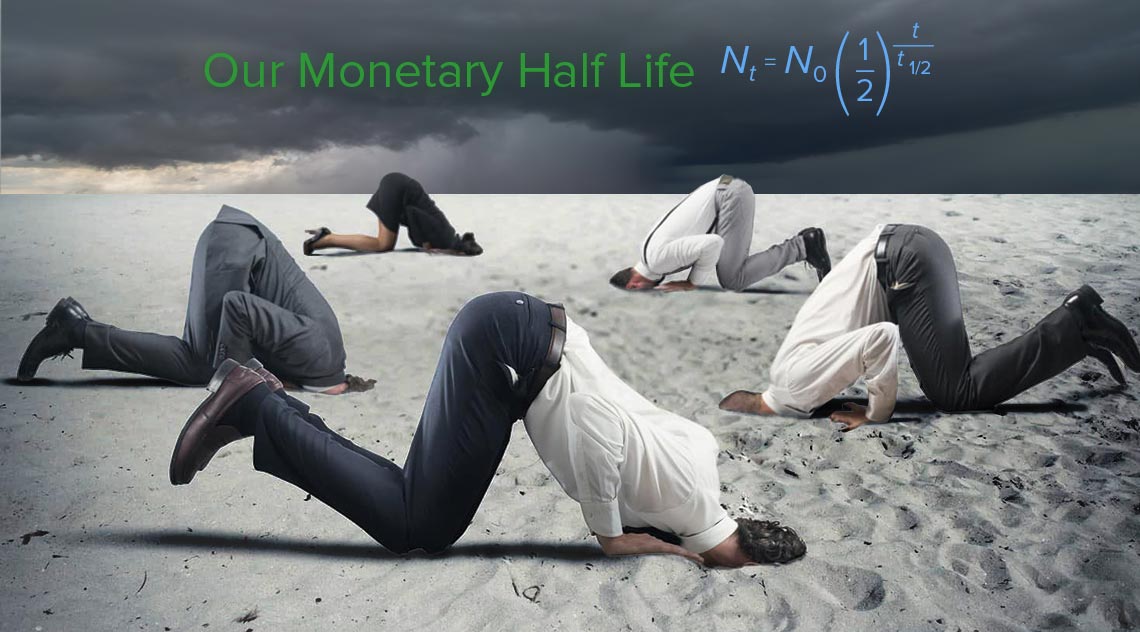
Our national finances are being mismanaged, but other countries are even more inept, giving us a false sense of security in the dollar’s strength. This delusive confidence gives us the short-term luxury of burying our heads in the sand, but for how long?
Financial Schizophrenia
I have friends with whom I discuss financial developments daily, and there are enough unusual developments in world markets to confuse even the most seasoned of us. If all the Ph.Ds. at the Treasury Department and the FED struggle with current economic and monetary conditions, neither we nor you should feel so badly. Financial and economic schizophrenia is the order of the day.
The Mayo Clinic defines schizophrenia as:
“Schizophrenia is a serious mental disorder in which people interpret reality abnormally. Schizophrenia may result in some combination of hallucinations, delusions, and extremely disordered thinking and behavior that impairs daily functioning and can be disabling.”
Niyant Vora
Everyone in the world, not just America, could be at the tipping point of a financial schizophrenia diagnosis if the markets and governments do not regain their sanity. Your and my opinions about the state of the economy are as good as anyone’s because everyone’s circumstances are different. Governments deal with broad averages, and we look at our wallets and prices in stores. When the Government and news pundits tell us everything is fine and we are paying much higher rates for everything, it is they and not you that need a realignment.
The Half-Life Concept and the FED 2% Target
Understanding the concept of “half-life” is not very difficult. We usually hear this when discussing scientific issues and the ratio of carbon-14 to carbon-12 atoms. The idea of half-life can apply to anything that degrades over time. Currencies (just like carbon-14) can degrade when they are mismanaged and allowed to lose value through inflation, money printing, and loss of confidence. Today, we have all three.
The United States dollar is under attack from many internal and external directions. Over time, these attacks weaken the dollar against other currencies. Saving the dollar in the short run is easy because other countries are mismanaging their currencies even more so than the United States. But this will only last if we get our fiscal and monetary policies in order. Fighting external forces damaging the dollar is hard enough. Fighting Congress, The Treasury, and the FED makes it almost impossible. Praying for dumber politicians in other countries is, at best, problematic.
If you have ever watched CNBC, FOX Business, or any other financial shows, you know that they constantly harp on the FED’s 2% inflation target, but why? As it turns out, a little inflation is a good thing in capitalistic economies because it gives both consumers and businesses the feeling of improvement in wages and profits. This encourages spending and investment. It gives us the illusion of growth for profits and wages in a controlled manner. But there is a mathematical reason also.
Like carbon-14, currencies lose value as pennies (atoms) flow from value to valueless through inflation. Unlike carbon-14 dating, the rate of decline is not as easily measured. There is no standard decay rate since human factors such as fiscal and monetary decisions speed up or slow the flow from value to valueless. As it turns out, the FED’s 2% inflation target is the needed standard decay rate for the economy if they can hit it.
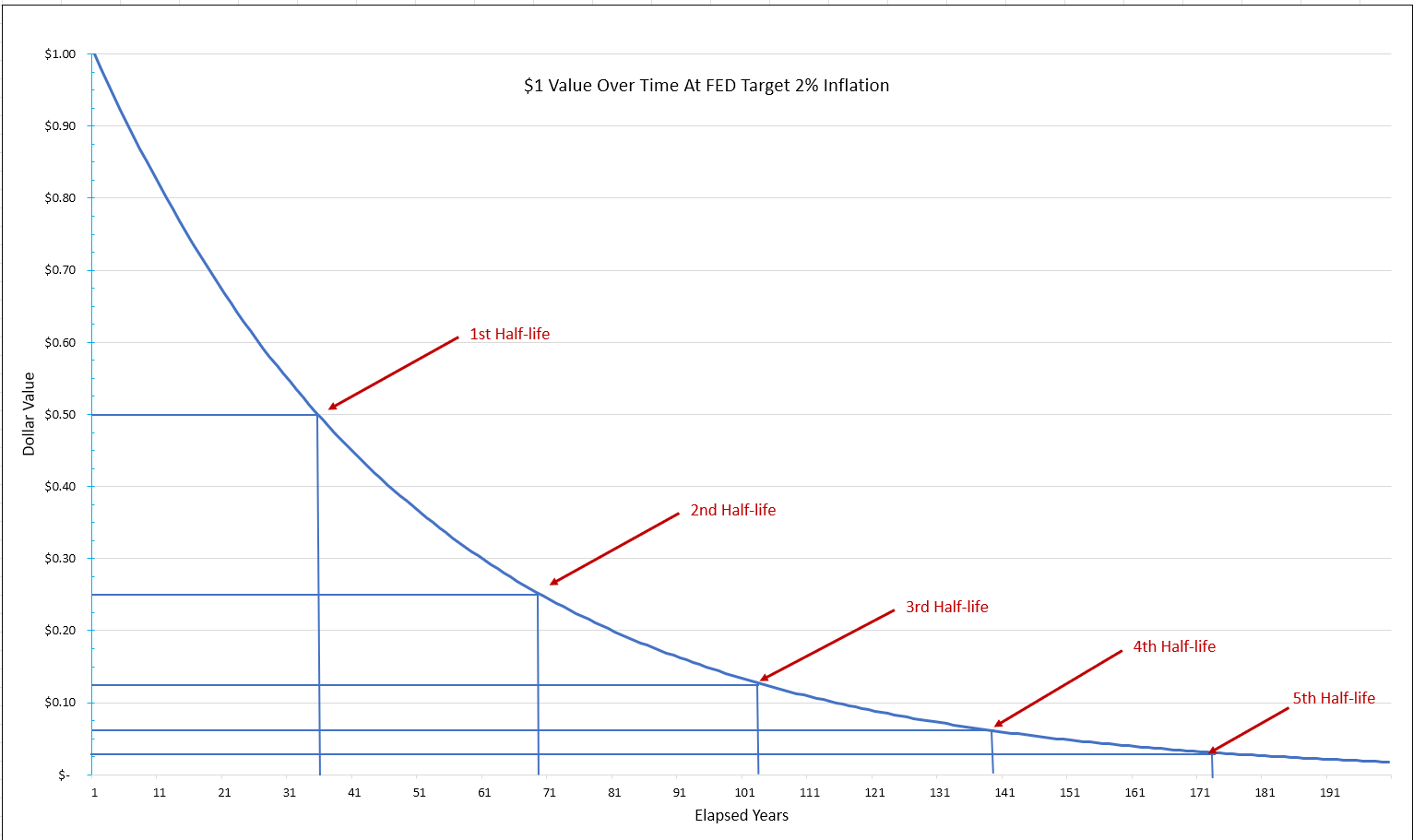
If the FED can maintain this constant inflation rate, some important things will happen. First, the currency value curve mirrors the decay curve of an element like carbon-14. At a rate of 2%, it takes thirty-four years for the dollar to lose half its value, almost seventy years to lose seventy-five percent of its value, and over two hundred years to lose all its value. This decay is so slow that it exceeds the life span of most people and indeed the term of any politician.
We can measure the dollar’s purchasing power against itself over time and begin to understand how politicians are shortening our currency’s half-life and eventually viability as a reserve currency. Unfortunately, politicians cannot control their spending, and once they know they can buy votes with appropriations, the FED’s target of 2% inflation is out the window. We only need to look at COVID-era spending to see what they will do under the guise of a crisis. To feel the pain, look at groceries, insurance, medicine, housing, and gas bills. Unfortunately, the pain is not over.
The Real Dollar Half-Life
Our first method of viewing the dollar is to take the 2000 dollar and show the loss of value just from inflation. From 2000 until 2021, the FED manipulated interest rates and inflation to reach its target of 2%. They came close at times but never stabilized at 2%. With this manipulation, the dollar had a half-life of nineteen years (the time it took to lose half its value). This process should take thirty-four years, and the politicians have shortened it to half that time.
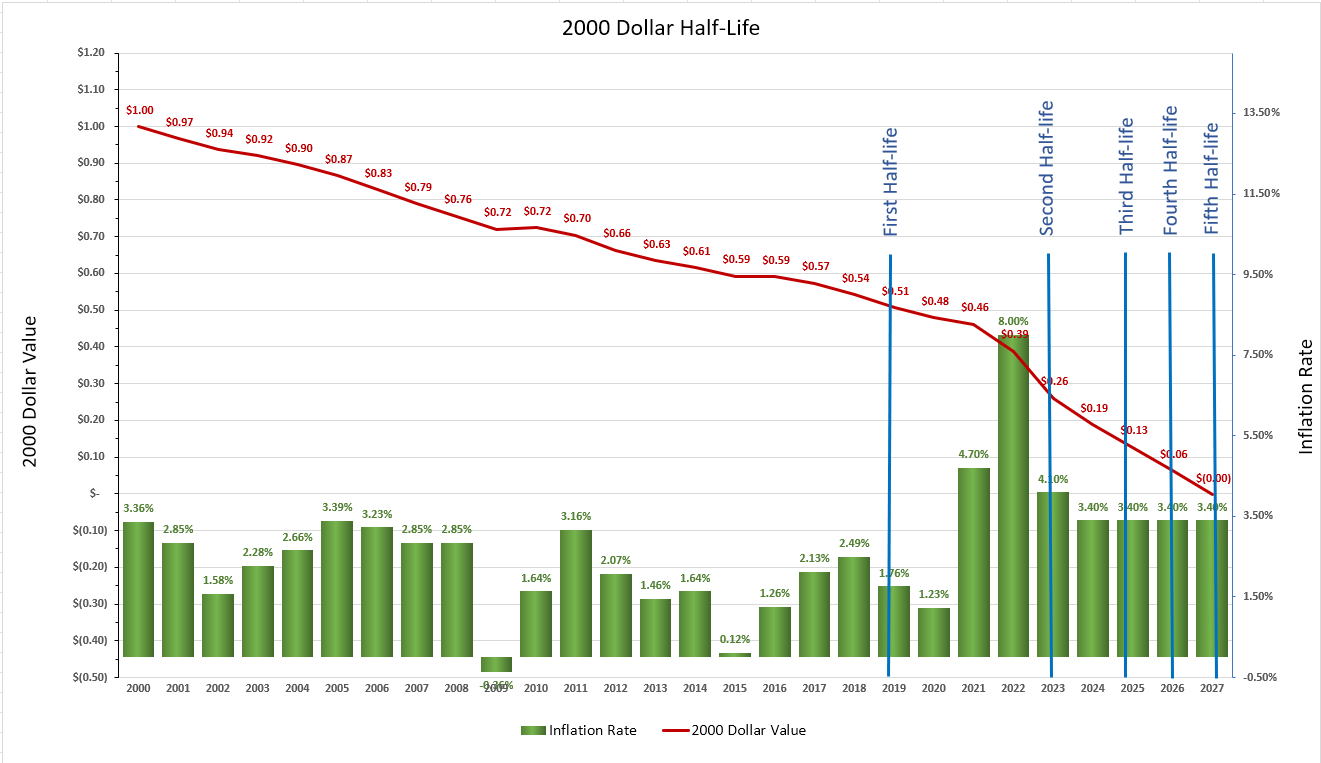
Then came the pandemic and Congress’ decision to pass out money to everyone and increase the national debt and money supply massively. With this policy change, how long did it take for the second half-life to occur? Just four years when it should have taken another thirty-four years.
Now that we have a higher level of national debt, there is no way to decrease it and the higher interest rates. How long until the third half-life? Just two years, not thirty-four. The fourth half-life will occur in only one more year. The fifth in less than a year. By 2027, thanks to Congress and the FED, the year 2000 dollar will be worth only a penny.
In other words, to have the same purchasing power, you will need to have at least $100 in 2027 for every $1 you had in 2000.
Unequal Pain for Many of Us
When I hear the pundits on television talk about how the economy is going from good to great, it shows the lack of understanding by those speaking. For seven-figured television personalities, things are going great. But this discussion is about dollars, not assets. At the upper end of our economy, those with assets (property in all forms) are fine because they get repriced with inflation.
But for many of our citizens, things are not going well. People and families just getting started in life, and those with few assets are being hammered with a declining standard of living. This is why loan delinquencies in all categories are rising. The almighty dollar is under attack, and it is hurting everyone, but some more than others.
Sheading Atoms (Pennies) From the Dollar
When Carbon 14 decays, there is an endpoint. When there are no more atoms to lose, the decay process stops. However, this is not true with finance, where the dollar’s value can be degraded infinitely over time as inflation and poor policy erode purchasing power. Congress and the FED compensate for this by printing more money. When your dollar is no longer worth a dollar, they give you another and hope your two dollars will now function as the old one dollar did. This process is like adding atoms (pennies) back so you feel good now, and they can degrade them in the future.
Some form of reset is necessary, and the FED knows it. The dollar does not shed pennies at a constant rate, but it does indeed shed them as it loses value. The rate of shedding them will be painful as the years go by unless the FED pulls a miracle. From 2000 to 2019, the purchasing loss rate was about $0.03 per year. Now, with massive debt and interest payments, the loss has doubled to about $0.06 per year, with only more pain to come.
How does this work from a practical standpoint? When the dollar is devalued, we feel it in purchasing power. The most straightforward example is when the first half-life is reached. In 2000, the purchasing power of the dollar in your hand was $1.00. At the end of the first half-life, in 2019, you had to take $2.00 from your pocket to buy the same goods. At the end of the second half-life, in 2023, you had to take $4.00 from your pocket to buy the same goods. In 2025, assuming the inflation rate does not improve, you will need $7.00 to buy the same goods.
At the end of World War II, European countries faced real economic hardship. Eventually, inflation drove the value of their currency to near zero. At that point, you would need an infinite number of dollars to purchase anything, resulting in hyperinflation.
Today’s Pain for All of Us
In an article titled Inflation for the Rest of Us, I measured the long decline in the dollar-gold ratio in December 2023 and compared the dollar value in a more extended view from 1932. Using this dollar-gold measure of purchasing power, the 1932 dollar is now worth, sadly, less than a penny, confirming the direction of these charts looking at only the dollar, not gold.
In times of extreme inflation, the only things that have held value are assets (tangible things) like real estate, gold, silver, and other commodities. Stocks can hold value because they reprice daily, but not consistently, since their underlying asset is corporations that may or may not navigate these choppy waters well.
When you vote in November, remember that both parties own the total picture, but President Biden owns the disaster of the past three years. All nations need strong currencies to remain free. It is as important as borders, a military, and a stable system of government. For a currency to remain relevant, it requires strong leadership, a strong military, and a consistent foreign policy. Unfortunately, we need shoring up in all areas.
It is Just Math
I am sure some, perhaps many, will argue with my conclusions because they do not fit the popular narrative on the economy.
Sorry! This is just math derived from publically available information, nothing more or less. Others will have different ways of analyzing the same information, but all the data used is locked in from 2000 until 2023 and part of 2024. The interpretation of the data is limited to part of 2024 through 2027. Even that data is conservative since I assumed the economic situation would not worsen!
Resources
Breaking Down the Federal Reserve’s Dual Mandate by Matthew Johnston, Investopedia, Investopedia.com, December 12, 2023.
China almost certainly owns more gold than the US – here’s why that matters, By Dominic Frisby, Money Week, moneyweek.com, March 3, 2022.
Gold Reserve Act of 1934: January 30, 1934, Federal Reserve History, federalreservehistory.org, November 22, 2013.
gold standard, Editors of the Encyclopedia Britannica, Britannica.com, April 12, 2024.
HOW MUCH GOLD CAN A U.S. CITIZEN OWN?, By Maurice Agudelo, Bigger Investing, biggerinvesting.com, Last accessed June 1, 2024.
How Much Gold Can You Own? Do Limits Exist?, By Frank A. Barber, Oxford Gold Group, oxfordgoldgroup.com, August 20, 2021.
How Much Gold Does The U.S. Government Have?, GSI Exchange, gsiexchange.com, Last accessed June 1, 2024.
Interpreting the Memoirs of Dorothea Buck-Zerchin: Understanding the Evolving Cultural and Linguistic Context of Mental Illness in Twentieth Century Germany., By Niyant Vora, Illinois Wesleyan University, core.ak.uk, 2019.
Op-Ed: How much gold do Americans own?, By James Ledbetter, Los Angeles Times, latimes.com, June 22, 2017.
Schizophrenia, Mayo Clinic, mayoclinic.org, January 7, 2020.
U.S. Inflation Rate by Year: 1929 to 2024 By Hiranmayi Srinivasan, Investopedia, Investopedia.com, May 2, 2024.
What Countries Have the Largest Gold Reserves?, By Sean Ross, Investopedia, Investopedia.com, March 19, 2024.