


If you are like me, you are glad the election is over. Win or lose, other concerns for our nation now overshadow the Presidential Election. Whoever won would inherit an economic mess, and how they deal with domestic and international finances over the next few years will influence generations of Americans.
As an ordinary investor, I am fascinated by this aspect of our lives, and daily reading about financial topics has become more than a hobby. After the election, we are experiencing the typical irrational exuberance from the winners and the markets. Then, the reality of our national debt and the Fed’s failure to control inflation will hit us squarely between the eyes. The mess we faced before the election will be managed differently by different politicians, but it has gone nowhere.
The bond market seems to signal that it does not believe inflation is under control. Or it is signaling that the deterioration in our international fiscal standing has significantly weakened. However, when the Fed recently started lowering short-term rates, the long-term bond rates did not come down. Since mortgage and other rates relate to these, consumers will read about lower rates but will not experience them.
Political Fiscal La-La Land
Here in America, we are saddled with politicians with little financial knowledge or understanding. These men and women make important decisions about collecting and distributing trillions of dollars. Our economic woes stem from the deception and manipulation of this uninformed group by those who do understand. As in general elections, the vote of an uninformed Congressman or Congresswoman counts the same as the most intelligent. It is a bit like giving your teenager your credit card and telling them not to spend too much.
Our enemies are moving more swiftly and nimbly in a coordinated mission to remove us from our position on the global stage. They see our weakness in this critical facet of our society. They understand that we do not always elect members of Congress based on intelligence and financial knowledge. The “beauty contest” nature of politics has been amplified by technology. (I will write more about this in another BRICS article later in November or early December.)
Returning our nation to sound fiscal and monetary policy will be difficult, as evidenced by the shifts in global financial currents. But this critical issue threatens to undermine all we do that is so positive.
Unfortunately, there was little difference between the presidential candidates’ fiscal plans and spending habits. President Trump may want to lower taxes, raise tariffs, spend more, and increase the deficit to fulfill campaign promises. He believes we can grow out of the mess, and I hope he is right.
But the wild card introduced is the creation of DOGE, the Department of Government Efficiency headed by Elon Musk and Vivek Ramaswamy. We have in these two geniuses both creativity and financial success. If they are successful, they could change the trajectory of our deficits. But they are about to hit the deep-state brick wall. I hope I am wrong, but others have tried to break through this impenetrable force field without success. Their best action may be mass firings and daring people to sue the government, but they must act quickly while they have the voters’ backing.
Has the Fed Become Politically Corrupted?
Technically, the Fed is not a government agency and should remain neutral in its decision-making. Our largest banks own it, and there is a strange arrangement where the Fed must regulate and oversee its owners. But I ran into a peculiar report last week that explains much about the Fed’s lack of neutrality in its decision-making.
Buried within all the data from OpenSecrets.org was a surprising chart that helps explain some of the Fed’s actions leading into the election.

This chart reveals that Fed employees gave modestly or rarely to political campaigns until the 2016 campaign cycle, when they began contributing heavily to Democrats. Janet Yellen was chairman and is obviously closely associated with the Biden Administration. This disproportionate giving continued through the midterm elections in 2018 and skyrocketed in 2020, all under the watch of Chairman Jay Powell. As the bloom came off of the Biden Administration rose, the contributions began to wane, but they are still tilted heavily toward Democrats and way larger than the pre-Yellen era.
When the Fed cut interest rates before the election, was it to help sway voters toward Vice President Harris? Almost 92% of contributions from individuals went to Democrats, so we know where their sympathies lie. I recommend that the DOGE take a long, hard look at the Fed now that it has lost its neutrality. Such lopsided giving says a lot about pressure from the top on employees to align with Democrats and about hiring practices.
What is Happening with Stocks
Stocks continued to show resilience into the election, even doing some serious rallying before election day. Immediately after President Trump won, there was a “Trump Bump,” and the rise continued. But that has settled back down late last week, and we may be settling back into a more moderate pattern between now and Inauguration Day.
On Sunday, November 17, 2024, President Biden authorized the use of our long-range missiles by Ukraine into Russia. This further threatens a more profound and broader war, even a World War III scenario. Why he would change his position this close to the end of his term is a mystery to me unless he is so bitter that he just wants to leave behind a mess.
What is happening with gold?
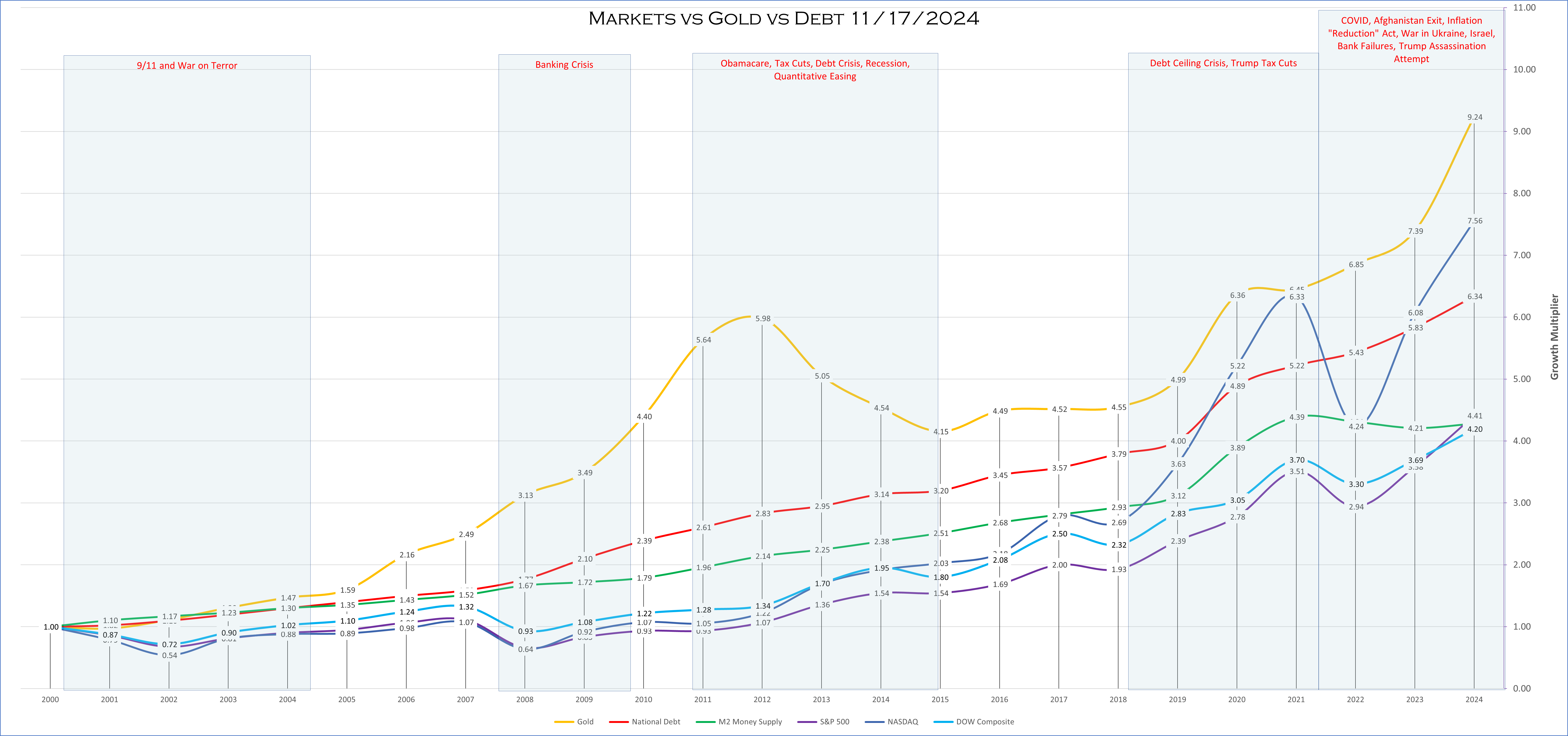
In the past few months, gold has continued to dominate the markets and briefly touched $2,800 an ounce in the week of October 27. Stocks have done well, but nothing has touched the upward movement in gold since 2000.
I believe gold has performed well because of deficit spending, political uncertainty, and central bank purchases. The continued push by the BRICS group to move away from the dollar and considerable purchases of gold by the central banks of those nations continue to consume the available supply.
Our large deficits and lack of sustainability in the face of large interest payments and ever-larger deficits must be addressed. The DOGE effort by Elon Musk and Vivek Ramaswamy is at the core of getting this back on track. Otherwise, the dollar’s value will continue to deteriorate at an accelerated pace relative to gold.
The Long View
The long view is for those of us who hit our peak earnings in the early 2000s. This view is most relevant to Baby Boomers and our investments and overlaps the other two periods discussed here. The long, upward movement of all assets, debt, and money supply can be easily understood here.
The Medium View
Nothing has changed significantly in our Medium View of Markets, which continues to show gold as the underperforming asset in this time period. However, gold has risen and is continuing to make upward moves.

The Short View
Our Short-Term View of markets now looks slightly more like the Long-Term View, with gold moving up rapidly. Briefly, before the election, uncertainty pushed gold to the same level as the S&P 500. Now that the “Trump Bump” is cooling off, we must continue looking at all markets.

Why Does All This Matter
Decades ago, our financial issues took place primarily on our shores. Today, our challenges are interconnected to all economies. The recent shift in political leadership and focus on tariffs as a significant revenue source may make major changes in how we look at all financial assets.
Strange and Unusual Times
The old Hill Street Blues admonition by Sergent Phil Esterhaus (Michael Conrad) has never been more appropriate, “Let’s be careful out there.”
We also should be mindful of wise words by Thomas Sowell when we analyze markets and try to make sense of them, especially in politically charged times.
“People who pride themselves on their ‘complexity’ and deride others for being ‘simplistic’ should realize that the truth is often not very complicated. What gets complex is evading the truth.”
Thomas Sowell
Wise words from one of our nation’s most essential observers and thinkers.
Resources
China’s gold market in October: unseen price records bring unprecedented gold ETF inflows, By Ray Jia, World Gold Council, gold.org, November 13, 2024.
David Stockman: It’s “Damn Near Impossible” To Avoid A 30-50% Market Correction, Adam Taggart and David Stockman, YouTube, youtube.com, Last accessed November 5, 2024.
Gold ETF Flows: October 2024: North America inflows go four-for-four, By World Gold Council, gold.org, Last accessed November 15, 2024.
Gold Market Commentary: Under pressure, By World Gold Council, gold.org, November 12, 2024.
The London Gold Fix: A Brief Guide, by gainesvillecoins.com, coinweek.com, August 3, 2022.
Various Charts and Tables, Open Secrets, OpenSecrets.org, Last accessed November 17, 2024.
Will Debt Sink the American Empire?, By Gerald F. Seib, Wall Street Journal, wsj.com, June 21, 2024.

