Most mornings, I turn on CNBC Squawk Box to take the temperature of the economy for the day. I do not stay long. The people on that set live on the arm of the “K,” not the leg. They have houses, stock and bond portfolios, and the comfort that comes with both. From New York, they cannot see Middle America. When they mention the people on the leg of the “K,” it is a footnote. Sure, they mention those who are not participating in the economic boom. Still, it is a passing comment, as if they lump all others into the “Hoi Polloi” category of undesirables.
The Yard Sale Economy
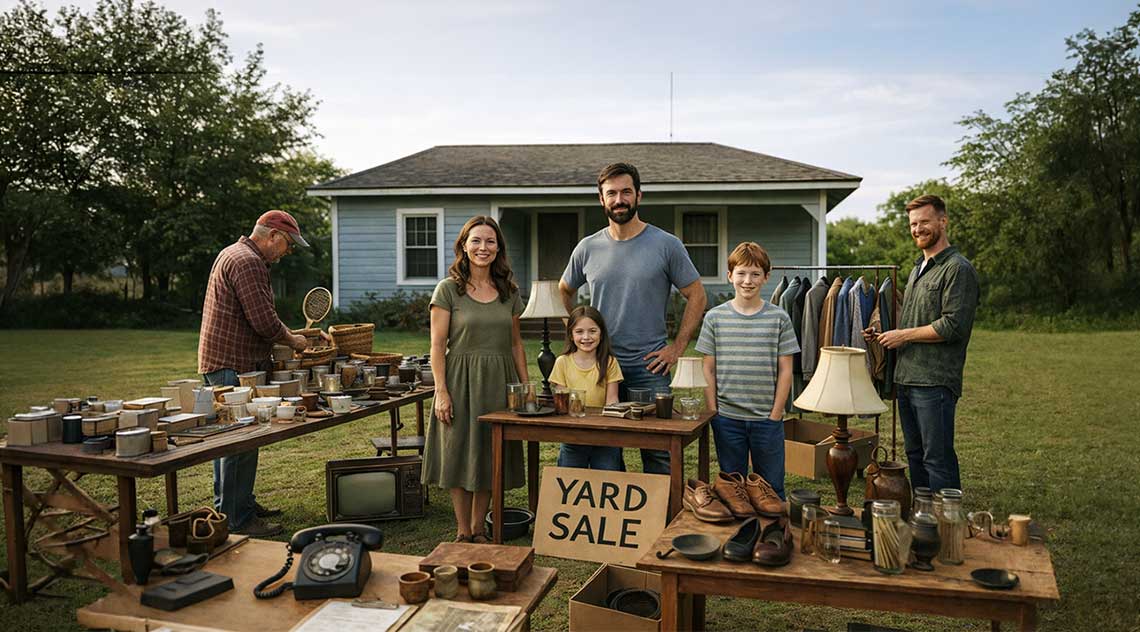
Out here, the real indicators are not on television. They are in front yards. Yard sales are back. Not the tidy, weekend‑hobby kind. The other kind. Tables full of clothes, dishes, tools, and whatever else can be spared. The kind that comes from walking room to room and asking, “What can we live without?” This is what economic stress looks like when it becomes real.
The Silent Tax
The signs were there before the war with Iran. Food prices were rising. For most, eating out drifted out of reach, restaurants thinned out, and people stayed home. Inflation is a tax on everything. It eats away at wages, savings, and the value of every dollar. Shrinkflation is the joke, but the joke is on us.
Washington helped create this situation. Presidents, Congress, the Fed, and the Treasury. COVID money and endless quantitative easing made everyone feel good for the moment. But these are short‑term relief, and long‑term damage. No single administration owns it. It is the product of decades of “leaders” who preferred to kick the can down the road and hope the collapse arrived on someone else’s watch.
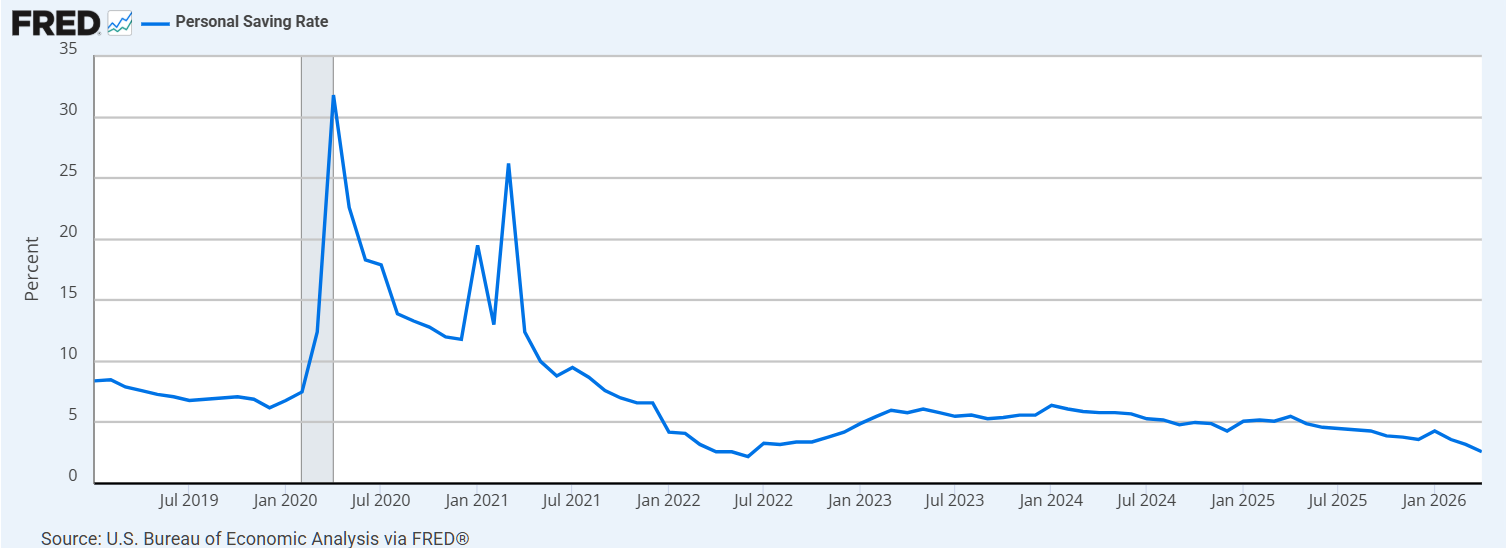
This Personal Savings Rate Chart from the Saint Louis FED tells the story better than any headline. We had a spike in savings during COVID, a collapse, and now a slow bleeding as the money runs out. But this was not evenly distributed. Natural savers put money away for rainy days, but many just spent.
Consumers Keep Spending, Until They Do Not
Whenever the economy comes up on CNBC or FOX Business, the segment ends the same way: “Consumers remain resilient.” That line has lost its meaning, and the commentators verify that they are out of touch.
There are more people on the leg of the K than on the arm. And the leg is giving way. Delinquencies are rising everywhere – mortgages, car loans, credit cards, payday loans, buy‑now‑pay‑later, and student loans. People are not buying more. They are paying more for the same things.

This Household Saving Chart shows the same collapse in dollar terms. When savings fall, spending becomes debt.
The Squeeze on Consumers
Savings have collapsed. Debt service is rising. The gap between what we make and what we spend is narrowing, and for many gone or negative. Car and truck loans are growing, and financing terms are stretching longer and longer. For many, savings are already gone, and that pressure forces possessions onto front lawns.

This Non‑Housing Debt Balance Chart shows the rapid rise. Student loans, credit cards, and auto loans are all rising.
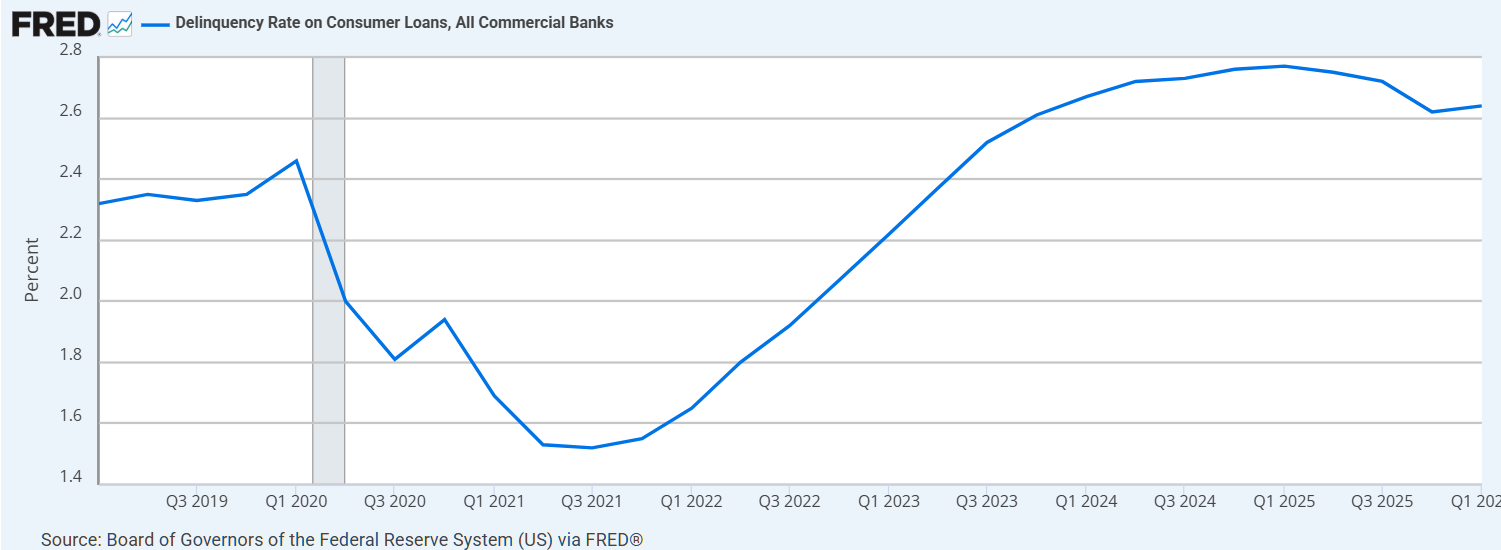
The Delinquency Rate on Consumer Loans Chart shows the consequence. Debt climbed as savings fell, and now the payments are coming due.
The 2008 Great Expectations
In 2008, the federal government guaranteed all deposits for the first time. My wife and I opened accounts at multiple banks until things settled down. It was nothing like the Great Depression, but close enough to understand the fear our parents felt. No one starved because the government stepped in, and most people barely noticed.
But a new expectation took hold: bailouts would always come. If consumers could not pay their student loans, we would forgive them.
Time passed. Congress reinstated repayment. Consumers panicked under the strain. A household with student debt is most likely to have other delinquent debt. Either the weight of repayment or the exposure of bad borrowing habits has pushed many households to the edge.

The Newly Defaulted Student Loan Borrowers Chart makes it plain. Those behind on student loans are also behind on auto loans, credit cards, and mortgages. The same households that once expected rescue are now behind on every kind of debt.
Second-Hand America
After 2008, yard sales appeared everywhere — gas station lots, empty fields, driveways. Not the “cleaning out the garage” kind. The “we need cash” kind.
We are, unfortunately, back in that territory.
There is one bright spot. Secondhand is booming. Some of it is a necessity. Some thrift. Some survival. There are no tariffs on used goods. The quality is often better. Goodwill and Salvation Army now share space with eBay, ThreadUp, Poshmark, and Craigslist. The informal economy is becoming the real one.
America is turning into one big yard sale. From New York, the data show the pressure; here on Main Street, the lawns show the response. The charts explain the math, but the driveways tell the truth.
All Is Not Lost
For all the strain, all the yard sales, and all the charts that slope the wrong way, this is not a hopeless country. We have been here before. We have lived through inflation, recessions, oil shocks, bank failures, and bubbles that should have broken us. They did not. They forced us to relearn what we had forgotten.
The first lesson is simple: debt is not income. Easy money made people feel richer than they were. Now that the bill has arrived, households are rediscovering the value of saving, the discipline of living within their means, and the difference between wants and needs. These are old lessons, but they still work.
The second lesson is that denial is different from resilience or toughness. Consumers keep spending because they must, not because they are thriving. The charts make that clear. The same people who stretch every dollar are the same ones who will rebuild their lives and the economy. They adjust faster than Washington, faster than Wall Street, and faster than the commentators who insist everything is fine.
The third lesson is that the informal economy is not a sign of collapse. It is a sign of adaptation and resilience. Yard sales, thrift stores, consignment shops, and second‑hand markets are not just coping mechanisms. They are reminders that value does not disappear when the price tag changes hands. Americans have always been good at making do, fixing what can be fixed, and selling what no longer fits. This is a lesson from earlier times that has been filed away until needed.
Fixing this going forward is not complicated, even if it is not easy. Households will rebuild savings the same way they lost them — one month at a time. Businesses will adjust to a more cautious consumer who is less impressed by convenience. Policymakers may even relearn the cost of short‑term relief and long‑term damage, though history suggests that lesson fades the fastest.
The path out is the same as it has always been: work, discipline, patience, and quiet determination that does not make television headlines. These charts show the pressure people are under, but they do not show the character of the people behind them. That part never makes it to a graph or a New York headline.
But all is not lost, far from it. The driveways with card tables full of yesterday’s stuff tell the truth about the moment, not the future. The future is built inside our homes, not on the lawns. Always in America, it is built in local communities that band together to meet every challenge head-on. America is built on individual success, but it is also built on the accumulated effort of all of us.
How We Vote Matters
For some, there will be a temptation to be mad at the Republicans and vote for the socialists in the upcoming election. This is the only decision that makes less sense than the decisions that got us into this mess. Infatuation with free handouts and refusal to address our national debt served as catalysts for our current mess. More of the same is never a good idea when you are digging yourself out of a hole.
How we vote matters. Demanding accountability and performance matters. But most of all, looking less to Washington and more to ourselves for answers really matters! Washington does not force us to borrow; it is a personal choice. We cannot expect our political representatives to do what we as citizens refuse to do.
Resources and Further Reading
America is about to become one giant yard sale, by Emily Stewart, Business Insider, businessinsider.com, April 10, 2025.
Americans are worried about money. So why are they spending more than ever?, by Betty Lin-Fisher, USA Today, usatoday.com, February 7, 2025.
Bargain Hunting: 2024’s Best Cities for Scouring Garage Sales, by Sav Maive, Lawn Love, lawnlove.com, July 30, 2024.
Early Sales, Economic Stress, and ‘Doom Spending’: LSU’s Dan Rice on 2024 Holiday Shopping Trends, by Dan Rice, Louisiana State University, lsu.edu, November 13, 2024.
Garage Sale 2017: A Leading Economic Indicator, by Anita Lienert, LinkedIn, linkedin.com, May 22, 2017.
Local used-goods scene reflects economy, by Staff, The Reynolds Center, businessjournal.org, August 7, 2013.
The Garage Sale as Informal Economy and Transformative Urbanism, by Margaret Crawford, margaretleecrawford.com, April 2023.
The Revolutionary Potential of Yard Sales: Rethinking the Informal Economy as a Transformative Practice, by Jennifer Hendricks, Hunter Urban Review, hunterurbannreview.comons.gc.cuny.edu, Spring 2024.