
Recently, I read an article about the need for states to pass laws banning companies from requiring employees to be microchipped, and I thought I was reading a scene from Star Trek or an excerpt from George Orwell’s 1984. I understand that we live in a world with increasing surveillance, artificial intelligence, digital footprints, and the rise of autonomous robots. But I thought this was a joke, not a real concern. It is the kind of thing you would see on a late-night rerun of a 1960s sci-fi B-movie.
"The saddest aspect of life right now is that science gathers knowledge faster than society gathers wisdom."
Isaac Asimov
But it is real and a genuine concern. Sure, some creeps are lurking around in AI, social media, and other tech, but this is creepiness on a whole different level. This is corporate and government-level creepiness.
Red States/Blue States
The latest state to pass legislation banning mandatory microchipping is Washington, so I assumed this was a Blue State issue. You know, the placard-wearing, rainbow-haired, nose-ring crowd looking for another government or corporate conspiracy to protest.
Blue states usually focus on immigration, voting rights, and various gender issues. In red states, the main concerns tend to be gun rights, voter ID laws, immigration, and free speech. We are searching for an issue that both Democrats and Republicans can support with joint legislation at the national level, and maybe this is it. Today, everyone is worried about privacy because of the digital exhaust produced by cell phones, computers, cars, credit cards, and other devices. Anything with a chip could threaten your privacy.
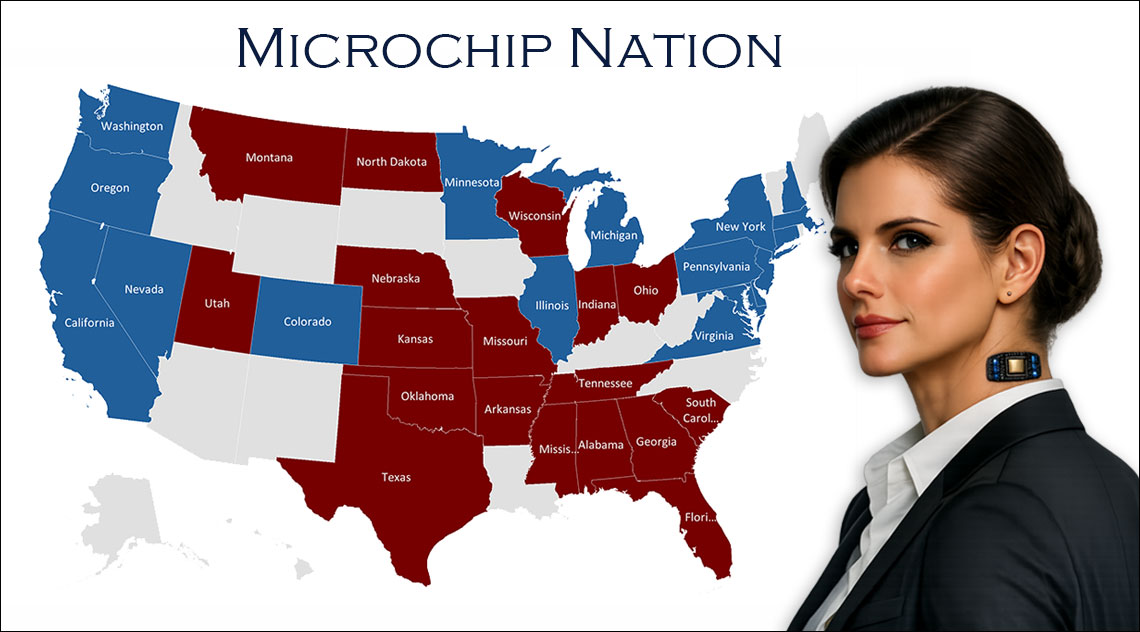
But to my surprise, of the thirty-six states that have passed legislation, eighteen are Red States, and eighteen are Blue. I can only assume that this is a shared paranoia about the future of mankind. This and UAPs may be the first bipartisan issues in decades. For once, we may have found a genuine purple issue, a rare creature wandering the wilds of American politics.
From Noble Purpose to Coercion
In situations like this, we must ask ourselves, “Why did a technology that barely existed twenty-five years ago become one of the most widely banned workplace practices in America?”
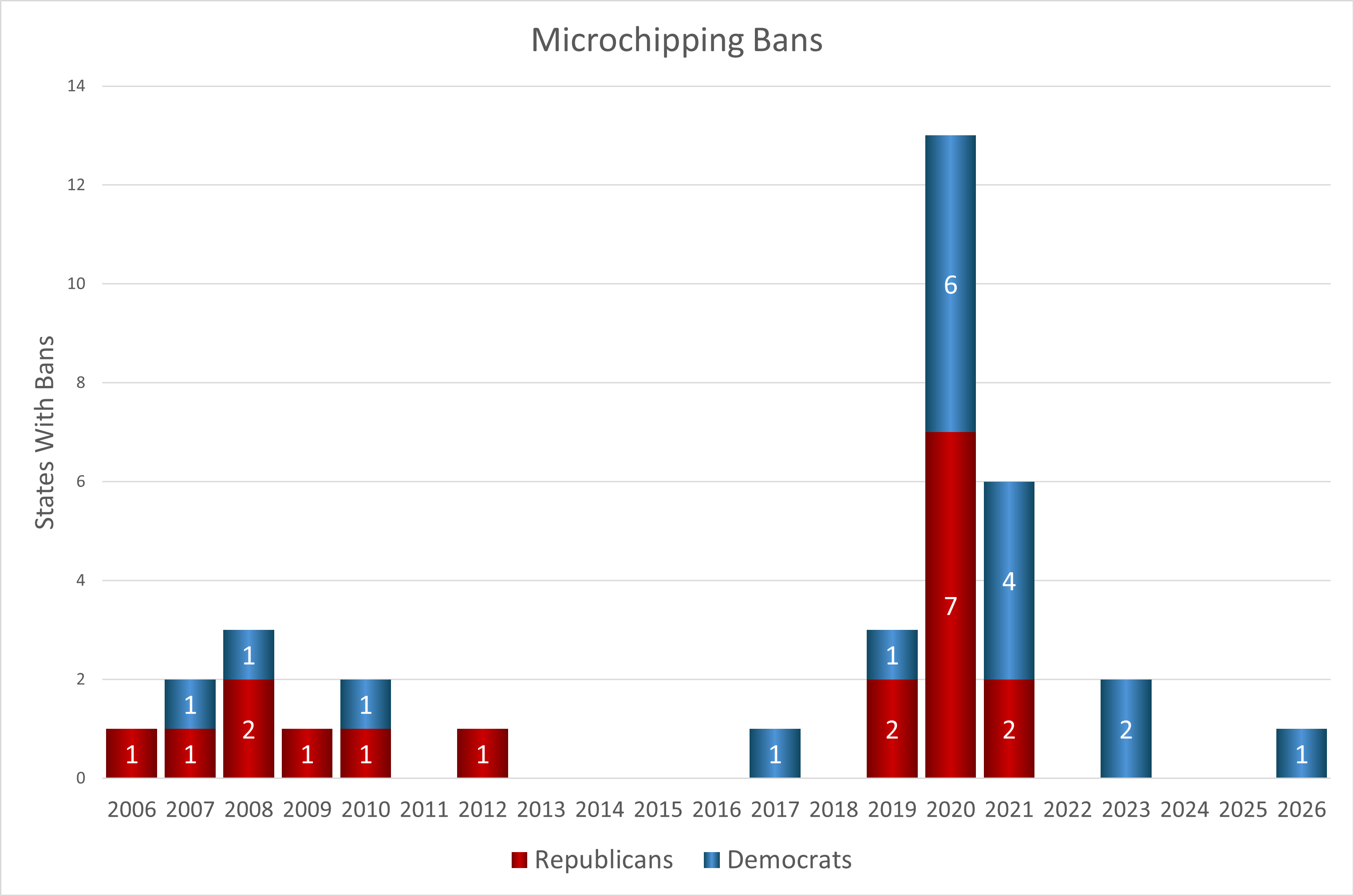
In 2004, the Food and Drug Administration approved an RFID chip for implantation in humans. The objective was to give healthcare providers and patients a way for doctors to track patients and access their medical records in an emergency. But noble causes often go astray as the law of unintended consequences comes into play. Concerned about abuse, Wisconsin adopted legislation in 2006 banning forced chipping. They were quickly followed by North Dakota and California in 2007.
The first recorded case of an employer encouraging employees to agree to RFID chipping was a security firm in Cincinnati, Ohio. This sparked some concerns, and over the next few years, a few more states joined the anti-forced-chipping movement. We should not be surprised at the legislation on the West Coast. For the United States, this is often the epicenter of technology, both good and bad.
The Cincinnati revelation led to concerns over privacy. It was believed that once implanted, a person could be tracked anywhere, not just on the job. RFID chips can be used for a variety of purposes, from location tracking to access control to identity verification, and, of course, movement monitoring.
Maybe it was the Great Financial Crisis and spending too much time prepping in our basements that led to our concerns becoming laws over the decades. The ban on forced microchipping began to spread. In 2008, Wisconsin, Missouri, and Oklahoma joined the ban. Georgia and New Hampshire followed in 2010, with Utah enacting a ban in 2012.
And then there was a long pause as the public realized that RFID-chipping people had lost steam. But then Montana and Arkansas joined seven years later in 2019, followed by Mississippi in 2020, and Indiana and Alabama in 2021. This coincides with the spread of COVID and concerns about everything. By 2026, thirty-six had codified some form of ban, either through direct or supplemental laws or regulations.
Why All the Fuss
Some companies have been offering to “chip” employees for years. Usually, this involves a small, rice-sized RFID chip placed under your skin in your hand. According to supporters, it can be useful for identification, security clearance, and even snack bar purchases. In theory, it is no more invasive than wearing an employee ID badge.
But talk and research into employee microchipping seemed to fade around 2011. Perhaps it was just too unusual for that time, and after some experiments, it seemed to fade. The opening lines from an article published in Science Alert on July 25, 2017, clearly summed up the concerns.
"We’re always hearing how robots are going to take our jobs, but there might be a way of preventing that grim future from happening: by becoming workplace cyborgs first."
Peter Dockrill, Science Alert
This was an era on the verge of cell phone and device addiction. Three Square Market (32M), is a small River Falls, Wisconsin-based supplier of snack stalls. Management saw benefits in productivity. In the same article, they highlighted productivity increases in “snack food purchases, opening doors, logging into computers, and sharing business cards.” But then the gamechanger and perhaps the death note for the chips, references back to “storing medical/health information.” I guess that snack food purchases and exposing your medical records are not on the same playing field. According to several sources employee “Chipping Parties” are not well attended. Those who attend may do so out of fear of losing their jobs, not out of a wish to be a cyborg.
And then references to chipping employees just seemed to disappear until late 2025, when Washington State decided to enact a law. Washington State’s law seemed to me to come from out of the blue, given the time lapse. Citing growing acceptance in Wisconsin and Sweden, the Washington legislature passed a ban on forced chipping to protect workers’ rights. But in Blue State fashion, twenty years after the chipping parties began, they are on the record.
COVID Era Paranoia
I hate to admit it, but I believe it is time for the ban on this technology from mandatory use to return to national discussions. Suspicion of coercion and the use of false data from the COVID era is widespread. Trust in government and major corporations is declining.
We already feel surveilled through our cell phones, cars, trucks, smart home devices, and email. We have cameras on almost every street corner in the country. If you have a smart TV, it can watch and listen. A smart refrigerator or robotic vacuum might be your unfriendly companion, the type you never invited in and cannot exactly send back.
Police use mobile license plate readers to check license plates, insurance status, and warrants quickly. Even in America’s smallest towns, this intrusive technology is widespread. Almost no privacy remains, and a chip buried under your skin crosses a line that feels just a bit too creepy. A chip that essentially turns you into a bar code is dehumanizing.
The RFID Problem
This becomes a purple issue because both sides of the aisle see danger. For Democrats, it involves bodily autonomy, worker rights, and anti-surveillance efforts. For Republicans, it concerns government overreach, religious concerns, and the slippery slope of too much government.
If you ever needed proof that Americans can still come together on something, it is the idea that no one wants a microchip inserted under their skin by their employer.
RFID chips and readers need to be very close; their range is only inches, not miles. This is not GPS, and it cannot track your movements across cities or farther distances today. In theory, if you walk into a store with RFID readers, tracking becomes possible. And if your vehicle can identify you, it has that long-range connectivity.
"Technology feeds on itself. Technology makes more technology possible."
Alvin Toffler
Today, it is not a major concern, but tomorrow could be different. Cell phones can become RFID readers, and anyone who gets close to your phone could be identified, and that information could be shared.
In many ways, we live in the dystopian times that science fiction writers could only imagine just decades ago. If the Israelis can monitor every traffic camera in Iran, and send out explosive communicators, more privacy controls are needed on a lot of our personal technology. In some ways, we live in a fictional world that science fiction writers could only imagine just decades ago.
Issues That Unite Us
It is no wonder that we do not trust data that over-identifies our movements and behavior. We have seen abuses of FISA courts and warrants, NSA mass data collection, and CIA data retention controversies.
When the public has already watched federal agencies stretch or break surveillance rules, the idea of a chip under the skin, even one with a limited range, becomes a symbol of a much bigger fear: that once the technology exists, someone will eventually misuse it.
"Being 'chipped' is a line in the sand — because the moment a chip goes in, freedom goes in the wrong direction.”
Robert Whitehead
Politicians, bureaucrats, and employers need to listen to their employees on privacy. Nothing unites Americans like the fear of becoming a cyborg against their will. If your employer wants to track your snack purchases, they can check the breakroom camera like everyone else. We may not be ready for everything in the future, but we are ready to ban it when it invades our bodies.
Most new technology we see makes our l lives better and Americans will tolerate a lot from employers, but not a needle and a chip. We are not banning a new technology; we are banning the feeling of being owned. Embedded microchips are not just a threat; they are the line in the sand.
Resources and Further Reading
California Prohibits the Forced Implantation of ID Chips in Humans, by Editors, Deeth William Wall, dww.com, October 24, 2007.
Employers can’t force workers to get microchipped, says new Washington bill, by Leo Heit, Washington, wheninmystate.com, March 13, 2026.
For The First Time, a US Company Is Implanting Microchips in Its Employees, by Peter Dockrill, Science Alert, sciencealert.com, July 25, 2017.
Lawmakers Consider Ban on Implanting Microchips Into Workers, by Joe Wilkins, Futurism, futurism.com, March 7, 2026.
Microchipped at work? Washington state bill aims to ban employers from using ‘dehumanizing’ tech, by Kurt Schlosser, GeekWire, geekwire.com, January 9, 2026.
Microchipped Employees: Workplace Privacy & the Future of Biometric Surveillance, DIM Publications, DataInsightsMarkets.com, Last accessed March 13, 2026.
Technology has created more jobs than it has destroyed, says 140 years of data, by Katie Allen, The Guardian, theguardian.com, August 18, 2015.
The Rise of Preemptive Bans on Human Microchip Implants, by Zhanna L. Malekos Smith, Carnegie Council, carnegiecouncil.org, July 9, 2024.
Three Square Market Microchips Employees Company-Wide, by Three Square Market, PRLOG, prlog.org, July 20, 2017.
Unsettling New Statistics Reveal Just How Quickly Robots Can Replace Human Workers, by Mike McRae, Science Alert, sciencealert.com, March 29, 2017.
WA lawmakers advancing bill restricting employers from microchipping workers, by Hana Kim, FOX 13 Seattle, fox13seattle.com, February 26, 2026.
Washington state moves to ban forced employee microchips, by Andrew Paul, Popular Science, popsci.com, March 2, 2026.
Wisconsin Company First in U.S. to Offer Employees Human Chip Implants with Payment Processing Implications, cdg-elements, cdg.us, Last accessed March 12, 2026.