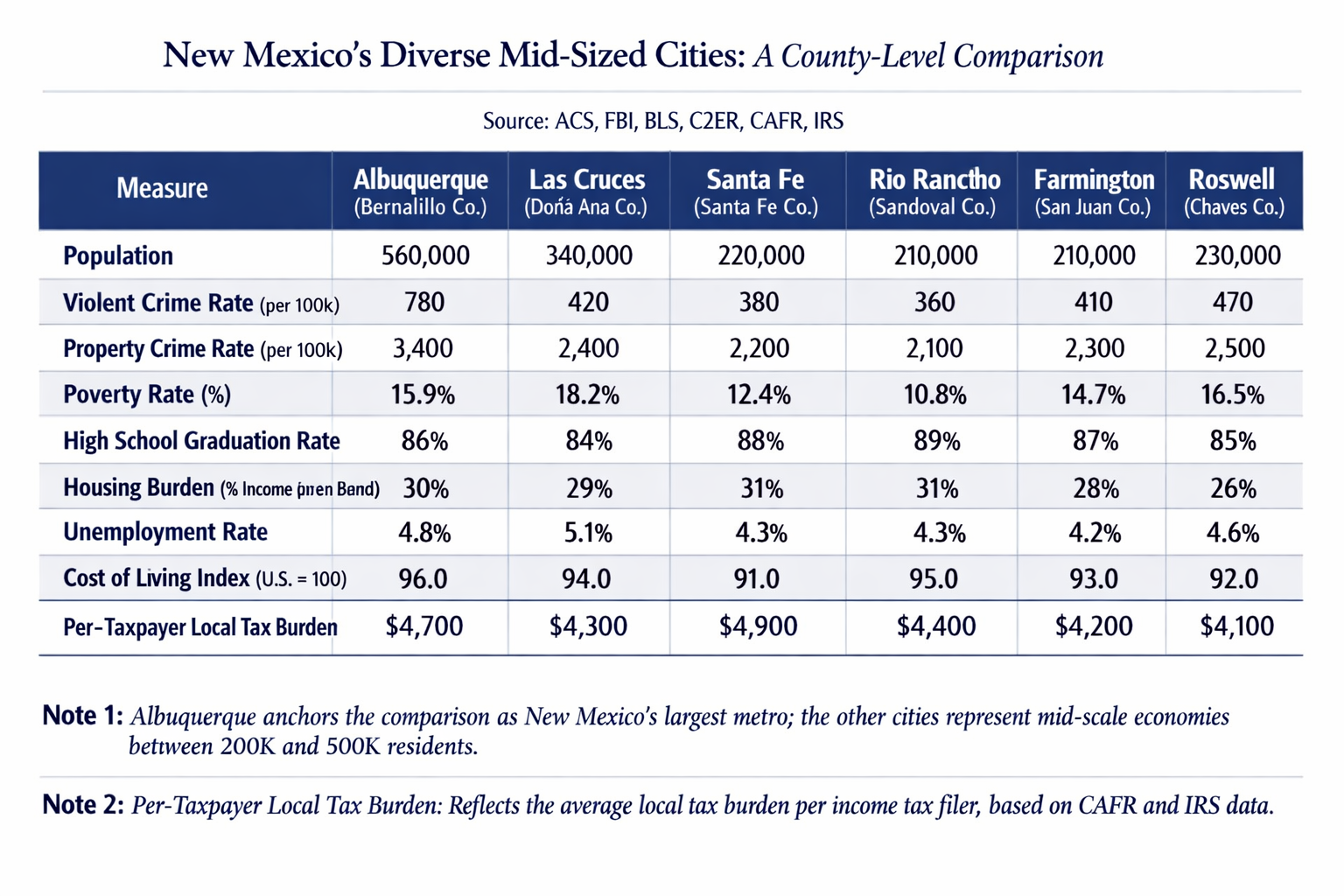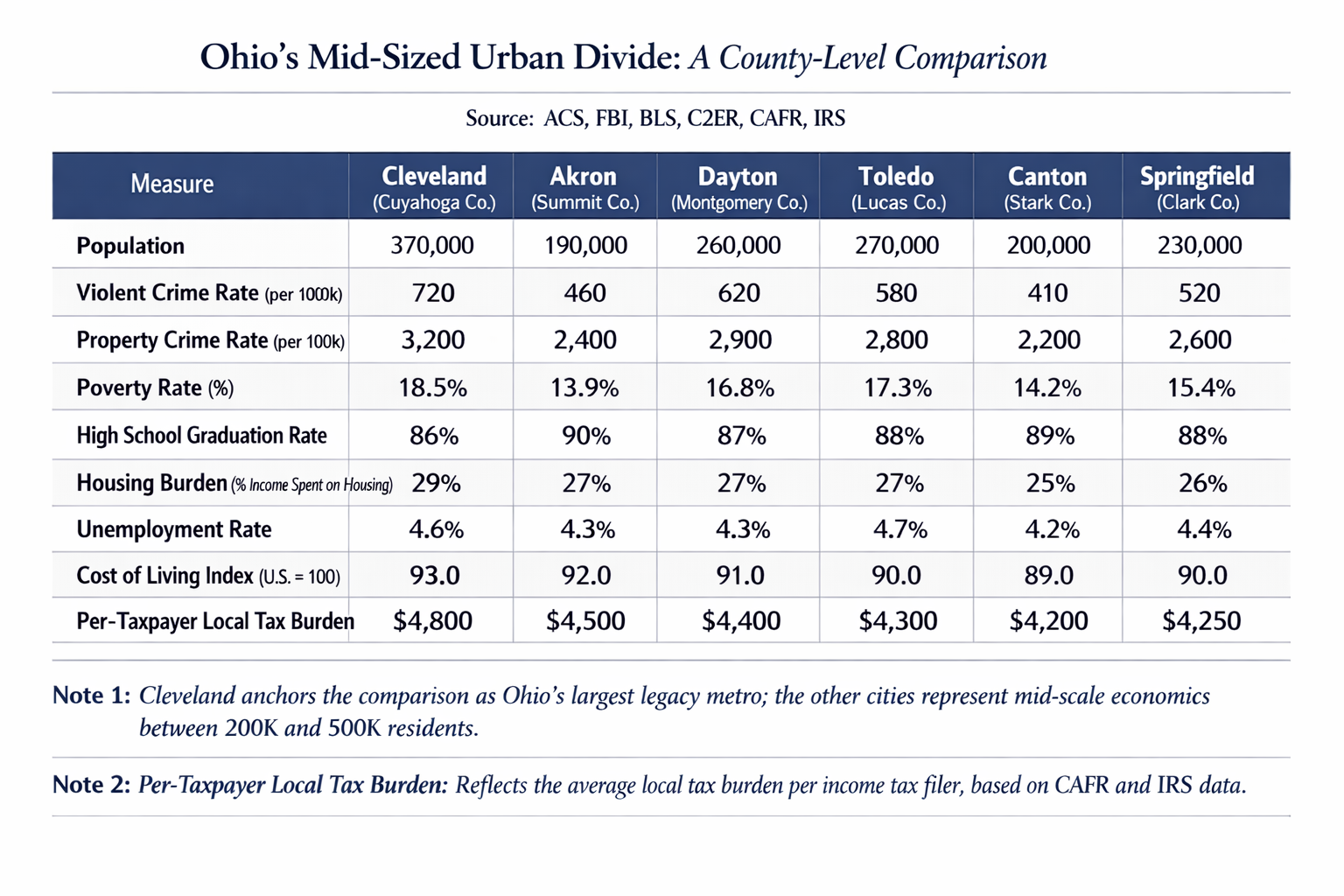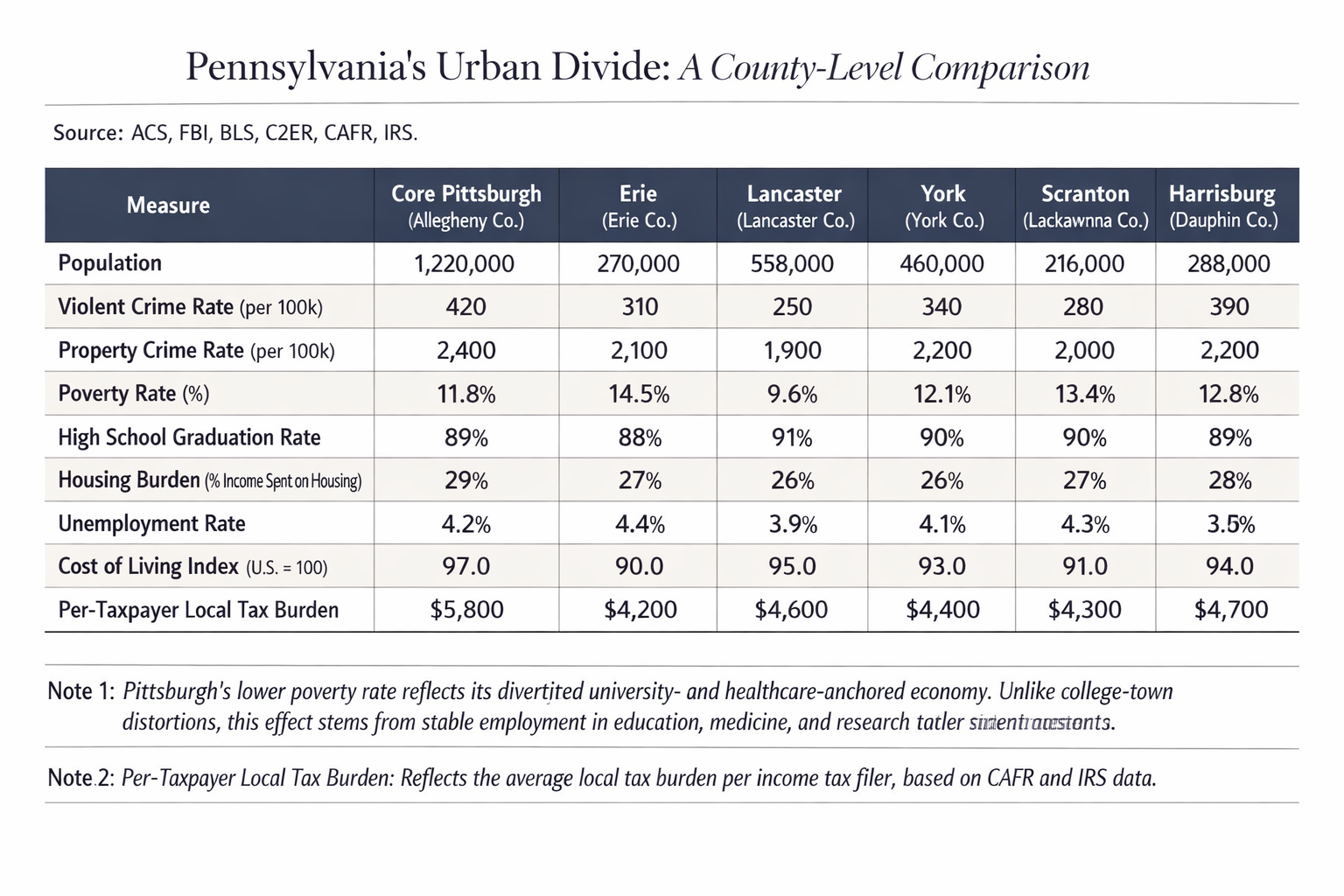

Ask the average American what Pittsburgh, Raleigh, Cincinnati, and Albuquerque have in common, and you will get nothing but blank stares. Beyond being American cities, they seem to have little in common. But there is an unusual connection that requires a bit of study. Each of these cities is large enough to hold the entire population of the United States. All 335 million of us, standing shoulder to shoulder, could fit in any of them.
We are not talking about cramming everyone in like sardines. If, on average, each person had five square feet of space, we would need about 1.7 billion square feet, or 60.1 square miles of land. Pittsburgh, Raleigh, Cincinnati, and Albuquerque all easily surpass this land area, as do dozens of other cities.
This point is not a stunt. It reveals how poorly we use the land we have.
Living Today on Yesterday’s Design
America is not overcrowded; it is poorly arranged for the modern world. We are not running out of land; we have been operating under a design principle dating back to the nineteenth and twentieth centuries, in which opportunity often meant moving to large cities. Our problems stem from poor design, not overpopulation. As our population declines from fewer births and technologies like Artificial Intelligence the problem will be more obvious.
We have created a country where we concentrate our problems in ever-larger population centers, making them unmanageable at scale. These centers rely on aging, failing infrastructure, and are managed by people who are ill-equipped to solve the problems. We staff cities and services with people selected for political performance rather than operational competence. When too many people lean on the same infrastructure at once, it breaks.
This is why America feels full, even though it is, in fact, mostly empty. This is why our cities fail precisely when they grow beyond human scale. This is why the country feels strained, even though the land beneath it is vast. Our failure is not demographic; it is functional.
We once knew how to build functional cities. Then we abandoned that knowledge as the world went digital and our economy shifted offshore. The result is a country that feels full yet functions poorly. As we reshore manufacturing, the next question is simple: what size city actually works? The four critical resources of the next century will be water, electricity, connectivity, and transportation. Electricity can be generated anywhere using modular nuclear reactors. Connectivity can be delivered via fiber and satellite links. Modes of transportation are evolving with the supporting technologies. Water is the only resource that still ties people to geography. Even that constraint becomes manageable when cities remain within a human scale.
To understand what size works, we must remember how Americans used to live and work.
Reintroducing the Community Paradigm
When we look back at communities from previous centuries, we see they were built around natural resources. Water, coal, timber, transportation, and labor pools determined where they were built. The size of cities and towns was limited by the same resources that constrained factories and mills.
Today’s cities still depend on resources, but the resource map has shifted. While water and transportation remain essential, electricity and bandwidth have become the other foundational resources. Building cities that are safe, livable, affordable, and well-governed is just as important.
None of our cities require the density that makes infrastructure fragile and governance difficult. It is just the opposite. Smaller cities solve many of the problems we treat as unsolvable in our largest cities.
Moving toward a model of smaller, specialized cities offers the benefits of community without the ills of megacities. We no longer need to concentrate population around ports or rail hubs. Work moves digitally, and services often travel over fiber. In-person education is important for social skills, but it can also be delivered digitally to students when needed.
The constraints that have shaped the past fifty years must be replaced with a new form of community. Many of today’s problems stem from this loss of community, and we need to replace the impersonal with the personal again. America is not failing because it is full. It is failing because it is still designed for a world that no longer exists.
Big City Maladies
When we compare America’s largest cities with those in the 300,000 population range, a pattern emerges that is impossible to ignore. Crime rises as population density increases. Housing prices soar when too many people compete for too few homes in a limited footprint. Corruption grows with budget size because large cities concentrate money, power, and opportunities for abuse. The cost of living spikes as infrastructure strains under loads it was never designed to carry.
These are not just moral and political failures. They are also caused by structural failures that inevitably accompany scale. They are the predictable outcomes of forcing millions of people into megacities that no longer function at a human scale. We know this is a failure on many fronts because of one simple measure: taxes.
Any business that grows benefits from economies of scale. Sharing resources jointly brings efficiency. If two people use a single piece of equipment equally, the cost is split, and both are more efficient. But with the government at any level, the opposite is true. Otherwise, the most cost-efficient cities with the lowest taxes would be our largest cities, New York and Los Angeles. Instead, the opposite is true. As our cities grow, they become ever more inefficient and costly.
Our megacities are becoming unaffordable because their scale breaks down the systems that support daily life. There is no solution that will fix them as they are, other than breaking them down into more manageable sizes.
- Scale can lead to dysfunction, which leads to a concentration of poverty.
- Scale can lead to failing schools, which leads to lower educational outcomes.
- Scale can lead to anonymity, which leads to crime, which leads to economic decline.
If scale is our challenge, better design at a smaller scale is a major part of the solution.
The Georgia Example
Since I live in Georgia, I will use it as an example, but this is a story repeated fifty times across fifty states. Atlanta is Georgia’s largest city, with a population of 2.070,000 in the core metropolitan counties of Fulton, Clayton, and DeKalb.
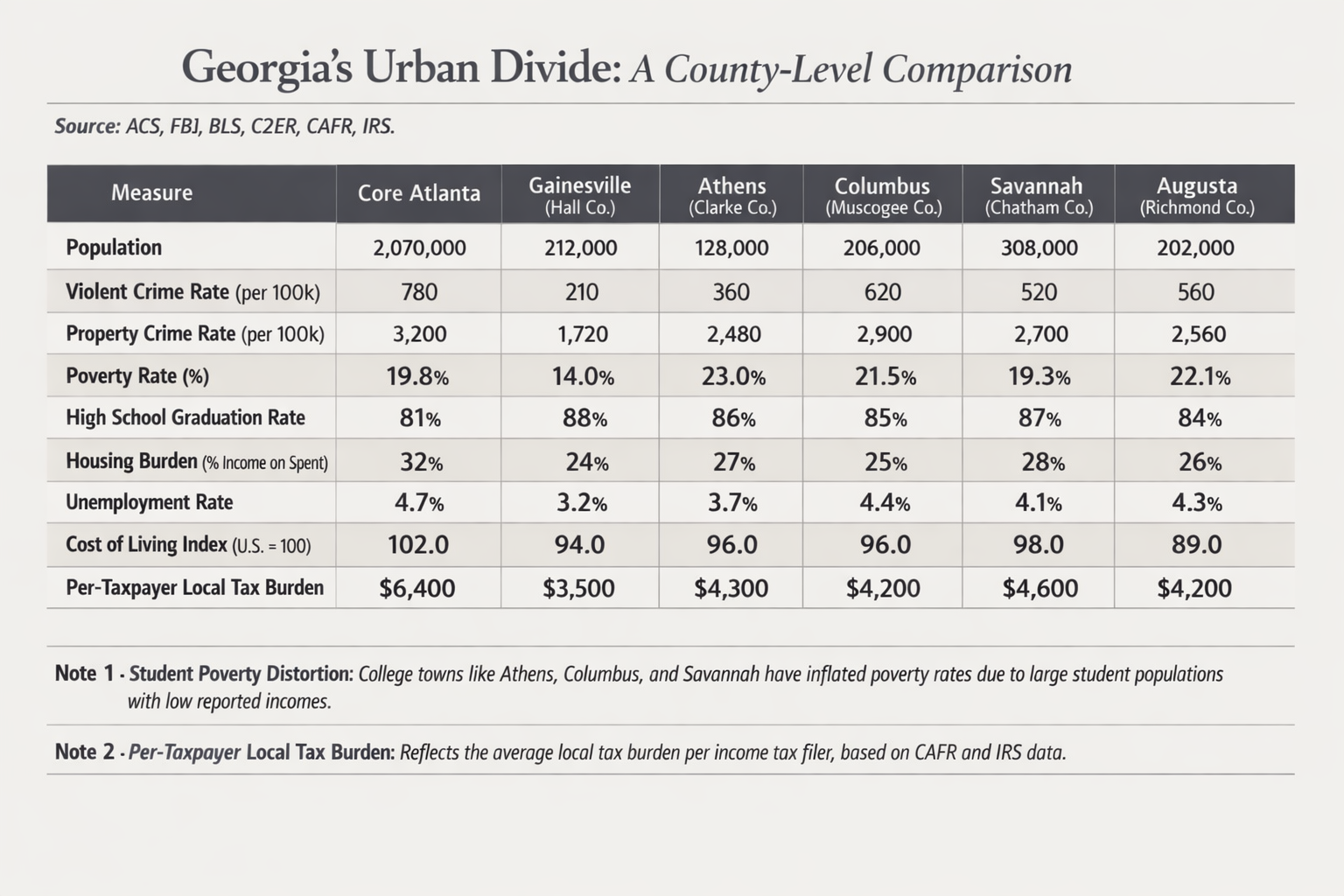
Georgia is unique among the states we examined because of the dominance of the Atlanta metropolitan area. Georgia is a state with one major city, Atlanta, and the rest of the state. This population divergence creates sharp contrasts between the metro areas and the medium-sized cities. This makes examining these issues easier.
The core of Atlanta is diverse, with some counties extremely wealthy while others are more typical. We looked at just three of the many counties that are sometimes lumped into the definition of “Atlanta.” Fulton, Clayton, and DeKalb counties offer a representative mix of the population along economic lines, and we think they can be accurately described as the core of the Atlanta Metro area.
Atlanta exhibits all the symptoms we described, including higher crime and poverty. It has lower high school graduation rates, a greater housing burden, higher unemployment, and a higher cost of living. To top that off, it has a much greater tax burden, clearly illustrating the diseconomy of scale we discussed.
Corporate Incentives, An Answer
For the past 150 years, companies have clustered in large cities because transportation, capital, and natural resources were available there. But that was a world built primarily around physical resources. Labor and infrastructure followed because of job availability. For workers, there was a trade-off between jobs and lifestyle.
We live in a different world today, where technology can remove the constraints of the past. Yet companies still cluster in major cities because of tax incentives and, let us face it, simply following old habits. A clear example is companies and people relocating from high-tax states (New York, Illinois, California) to low-tax states (Florida, Texas, North Carolina). They are repeating past mistakes and bunching up in cities like Miami and Dallas when they could be building new cities with new infrastructure.
People go where the jobs are. Corporations decide where the jobs go. For fifty years, our tax structure has rewarded companies for concentrating in megacities, even as those cities have become less livable, less affordable, and less functional. If we want Americans to live in places that work for them and for companies, we must align job creation with those places. That means using tax incentives not to prop up failing megacities but to seed opportunity in mid-sized cities where life is safer, cheaper, and more sustainable.
A Scale We Can All Live With
America is not broken because it is crowded. It is broken because we have arranged ourselves according to a map that no longer reflects the world we live in. We built our economy around megacities when they were necessary. They are no longer necessary. The digital world dissolved the old constraints, but our policies, incentives, and habits never caught up.
Data from Georgia, Pennsylvania, North Carolina, Ohio, and New Mexico all point to the same conclusion: cities with populations below 300,000 consistently outperform megacities in safety, affordability, governance, and quality of life. They are large enough to sustain opportunity yet small enough to remain functional. They are the scale at which infrastructure, schools, and communities work.
If we want America to work again, we must build at the scale at which America works best.
That means aligning corporate incentives with more humane living. It means rewarding companies for locating where people can afford homes, where infrastructure is not collapsing, and where communities still recognize themselves. It means shifting growth away from the megacities that are failing under their own weight and toward existing and new mid-sized cities that function well.
We have spent more than fifty years trying to fix cities that are too big, too corrupt, and too worn out to be fixed. The next fifty years must be spent building cities that never break in the first place.
We do not need to rebuild America everywhere. We need to rebuild it at the right scale and in the right places. And that begins with a new design principle: building where people can thrive, not where history once required them to gather.
Our next article will outline how to build cities that never break. It will explain how tax incentives, modular infrastructure, and modern planning can create a new American map built around people rather than historical accident.
Resources and Further Reading
Agglomeration Economics and Urban Scale Research, by Multiple Authors, National Bureau of Economic Research (NBER) www.nber.org Various dates.
American Community Survey (ACS) – U.S. Census Bureau, U.S. Department of Commerce, census.gov, census.gov, Updated annually
City Fiscal Conditions Report, by National League of Cities Research Team, National League of Cities, http://www.nlc.org, nlc.org 2023.
Comprehensive Annual Financial Reports (CAFRs), by Various Authors, City and County Governments (Example: Atlanta CAFR) atlantaga.gov, atlantaga.gov Published annually.
Cost of Living Index, by Council for Community and Economic Research (C2ER) coli.org Updated quarterly.
Infrastructure Policy and Funding Reports, by Congressional Research Service (CRS) crsreports.congress.gov Various dates.
International City/County Management Association Research, by ICMA Research Division, ICMA, icma.org Various dates.
Local Area Unemployment Statistics (LAUS), Bureau of Labor Statistics, U.S. Department of Labor, www.bls.gov, Updated monthly.
Metropolitan Policy Program Reports, by Multiple Authors, Brookings Institution brookings.edu, brookings.edu, Various dates.
National Incident‑Based Reporting System (NIBRS) by Federal Bureau of Investigation — U.S. Department of Justice, cde.ucr.cjis.gov Updated annually.
Regional Development and Urban Policy Studies, by Multiple Authors, Organisation for Economic Co‑operation, and Development (OECD) www.oecd.org Various dates.
State of the Cities, by National League of Cities Research Division, National League of Cities nlc.org 2024.
Statistics of Income (SOI), Internal Revenue Service – U.S. Department of the Treasury irs.gov, Updated annually.
Strong Towns Essays and Case Studies, by Charles Marohn and Contributors, Strong Towns, strongtowns.org Various dates.
Urban Land Use and Policy Research, by Lincoln Institute of Land Policy, Lincoln Institute, lincolninst.edu, Various dates.

Addendums
At the beginning of this article, we mentioned four cities with landmasses large enough to hold our entire population. Pittsburgh, Raleigh, Cincinnati, and Albuquerque are in states that exhibit traits similar to Georgia’s, though less pronounced. But the scale issues are evident in these tables. Anyone with time can examine their state, and the patterns are likely the same. Scale does not produce ever-greater results when we are talking about cities and people.