
I have been thinking about the present moment and how difficult it feels for many people. Whenever the economy becomes uncertain, I find myself looking backward. For Americans, there is no more defining period of hardship than the Great Depression. Few of us lived through it, but our parents or grandparents did, and their stories still echo across generations. They remembered it differently depending on age and circumstance, but no one forgot it.
My First Exposure
My introduction to the Great Depression came through my parents and the story of my paternal grandfather. I have mentioned him before, but the details of his death and my father’s abrupt passage into adulthood are inseparable from that era. The story was retold often, perhaps to honor him, or perhaps as a warning.
My grandfather’s dry goods store collapsed when a local bank failed. There was no FDIC and no safety net. Banks were failing everywhere, and his loss was one among many. To keep the family afloat, he took a job as a shoe salesman across North Georgia and parts of North Carolina. At fifty‑seven, he began again.
In May 1930, he left on a sales trip and stopped in Gastonia, North Carolina. He caught a cold that turned into pneumonia, and there was no recovery. My grandmother received a telegram telling her he was in the hospital and instructing her to bring a coffin in two days.
So, my father, fourteen years old, boarded a train carrying that coffin. One week, his father was fine; the next, he was gone. Childhood ended on that ride. He became the family’s breadwinner overnight.
My mother’s family lived a similar story. Her father worked as a carpenter and farmer, and survival was a daily calculation. They had been poor before the Depression, so the decline was less dramatic, but no less real.
When I hear someone say they are having a hard day, these stories return. I was born in 1947, when the recovery from the Depression and the war was well underway. By comparison, we have never known true hardship. The Depression generation was a different breed of resilient. They endured World War I, the Spanish Flu, the Great Depression, and, for many, World War II. Our children and grandchildren have never known a day without shelter or food. Hardship has become a diluted word in a time of plenty.
Fortunately, historians like Studs Terkel preserved the voices of that era. His book Hard Times remains essential reading for anyone who wants to understand the Great Depression.
Our Shared Vision
The Great Depression became a shared national memory, passed down for nearly a century. One description from Hard Times captures the scale:
“Here were all these people living in old, rusted-out car bodies. I mean, that was their home. There were people living in shacks made of orange crates. One family with a whole lot of kids were living in a piano box. This was not just a little section, this was maybe ten miles wide and ten miles long. People living in whatever they could junk together.”
Peggy Terry, Oklahoma City, Hard Times
There were “Hoovervilles,” and veterans were marching on Washington for unpaid wages. Troops met the veterans under Douglas MacArthur and Dwight Eisenhower. They turned back. It was an era of shared sacrifice.
Hobos rode boxcars in search of work and food. There was no national relief system. The working class distrusted debt, but that did not save them. Many lost homes, farms, savings, and dignity. Default carried shame, a concept that has faded.
The popular image of Wall Street was men leaping from windows. The truth was less dramatic but no less grim.
“I do not know anybody that jumped out of the window. But I know many who threatened to jump. They ended up in nursing homes and insane asylums and things like that. These were people who were trading in the market or in banking houses. They broke down physically, as well as financially.”
Sidney J. Weinberg, Goldman Sachs, Hard Times
For every broker, there were hundreds of thousands of ordinary Americans out of work. That is the image history preserves. But there was another side.
Not All Suffered Equally
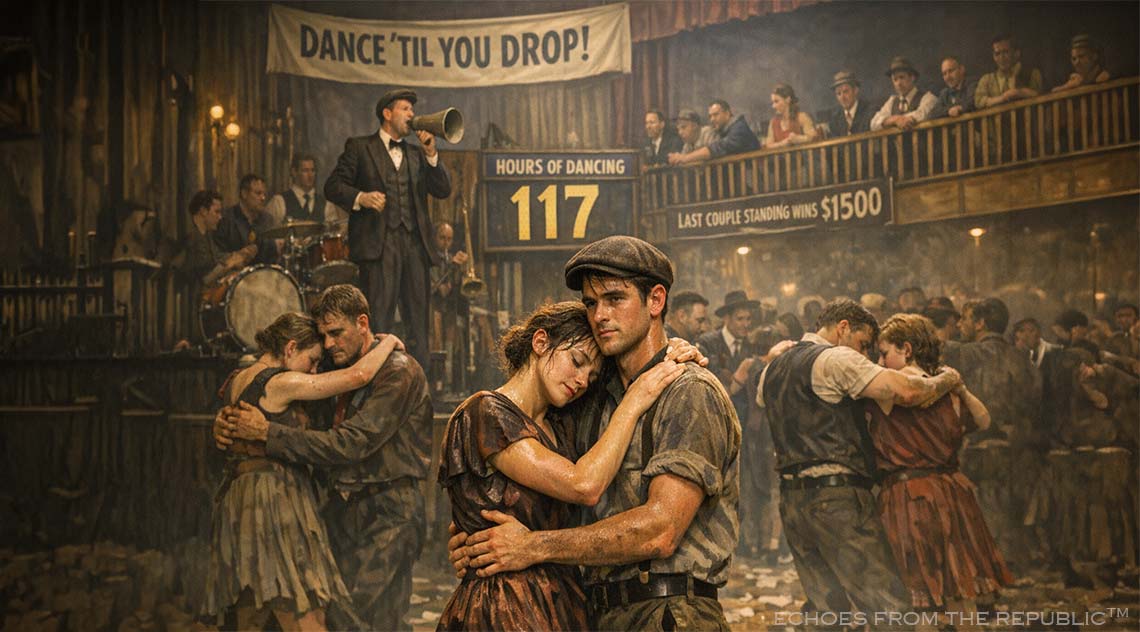
The Great Depression was both a collapse and an endurance contest. People like my parents and grandparents kept moving forward because stopping meant sinking. For many, the times resembled a dance marathon. The rules were punishing, the judges indifferent, and the prize money mostly imaginary.
Survivors interviewed in Hard Times made it clear that the experience was uneven. Jesse Livermore, the short seller, anticipated the crash and made an estimated $100 million. He later lost everything and took his own life, but his story illustrates the extremes.
Others prospered by stepping aside at the right moment or by sheer resilience.
“I always associated the Depression with one of the best things I ever did for Sears, Roebuck. I founded All-State Insurance in ‘31, which was the depth of the Depression. It proved an enormous success.”
Robert F. Wood, Sears Roebuck, Hard Times
People and companies survived by selling essentials, offering cheaper substitutes, buying distressed assets, or working in emerging industries like aviation and communications. Government workers fared better. Groceries, tobacco, liquor, inexpensive amusements, utilities, and shipping all thrived. Movie theaters, radio, magazines, and donuts remained in demand, often as a distraction from reality.
Some built fortunes: Joseph Kennedy, Jean Paul Getty, Howard Hughes, William Boeing, Walter Chrysler. Stores like Publix, Dollar General, Dollar Tree, and Family Dollar trace their origins to this era.
The Depression not only broke people: it separated them. The same forces that crushed millions lifted a few. That pattern did not die in the 1930s. It simply changed shape. It is the early form of what we now call a K‑shaped economy. Wealth diverged then, and it diverges now.
Parallels to Today
The parallels are difficult to ignore. We are emerging from a pandemic, stepping out of one war and into another, and watching speculation reach new heights. Railroads, aviation, and oil were the disruptive technologies of the Depression. Today, it is artificial intelligence.
Leading up to the Great Depression, stock speculation was out of control, and people believed that there was no such thing as a crash. Today, the Federal Government has kept the dance alive through bailouts and handouts. Generations have never seen a true recession, much less a depression. As a people, we are less resilient and do not know if we could survive a true collapse.
FDR responded with work programs such as the CCC, TVA, and WPA, along with a host of other three‑letter agencies. The contrast today is stark. Now people expect assistance without the work component that once built self‑respect.
In addition to AI, hidden risks now take the form of hedge funds, derivatives, private credit, and private equity. Many stocks trade at valuations that exceed those of 1929. Times differ, but mathematics do not.
History might not repeat, but it can echo loudly enough to feel familiar.
Social Safety Nets and Credit
Are we in a second Great Depression, disguised by credit and government support? If the parallels are real, the question becomes whether we are repeating the cycle or masking it. This reminiscence from Hard Times seems to foretell our current predicament.
“Today nobody is permitted to starve. Now they think it is coming to them. As a matter of fact, it was the government that brought this idea to the people in the Thirties. The people did not ask the government. They ask the question they cannot answer themselves: Why am I the goat? Why me? They want pie in the sky. . . .”
Dr. David J. Rossman, Psychiatrist, Hard Times
Massive safety nets now keep money flowing. In 2008, the government rescued firms deemed too big to fail. During the pandemic, money was distributed broadly, regardless of need. Now there is talk of AI companies being too big to fail, and a precedent is set.
In 1929, people suffered, adapted, and avoided future risks. They became more resilient and cautious. Government programs later shifted the culture toward dependency. Today, companies expect bailouts, and individuals expect relief checks. We now lack the resiliency to suffer, survive, and later prosper. We also lack the ability to recognize risk and to measure our tolerance.
Shooting Horses Metaphorically
The 1969 film They Shoot Horses, Don’t They? is less about horses and more about human desperation. During the Great Depression, an old or sick horse was put down, sometimes after collapsing in the street. It was thought to be practical yet brutal.
In the film “They Shoot Horses, Don’t They?,” Gloria, one of the marathon dancers, becomes exhausted and feels discarded. Near the end of the contest, she begs her partner to kill her. Her death mirrors the supposed mercy shown to horses. It is a harsh metaphor, but the point becomes clear: ending suffering does not erase grief.
Economic charts can show collapse and recovery, but they cannot show the weight of uncertainty, scarcity, and fear. That part of the story lives in the human psyche. That is where the allegory becomes real. So long as the Federal Government keeps the money presses running, it is possible to disguise the dire state of our individual and national finances. The fiscal dance will continue until we are all exhausted and there is no more credit to be had, individually or nationally. We will have no one to blame but ourselves.
My parents lived an economic dance marathon. So did millions of Americans. They kept moving because stopping was not an option. If there is a lesson for today, it is that learning resilience is often a long, unglamorous slog. It is exhausting and often unappreciated. Yet resilience is what carries people through the long nights when the band will not stop playing, and the dancers continue to move.
Resources and Further Reading
6 People Who Made Big Money During the Great Depression, by Viveka Ragavan, LinkedIn, linkedin.com, December 19, 2023.
Hard Times: An Oral History of the Great Depression, by Studs Terkel, Pantheon Books, 1970.
Similarities between The Great Depression of 1929 and now, by Md Rezaul Akhlak, The Business Standard, tbsnews.net, April 23, 2020.
The Great Depression vs. Today: Are We Repeating History? By Pctechclark, Medium, medium.com, February 25, 2025.
The Great Depression: what are the parallels between now and then?, by John Stepek, MoneyWeek, moneyweek.com, January 2018.
The Scary Parallels Between The Great Depression And Today, by Steve Burns, New Trader U, newtraderu.com, May 27, 2023.
They Shoot Horses, Don’t They?, by Horace McCoy, Simon & Schuster, 1935.
They Shoot Horses, Don’t They?, Film by Sidney Pollack, based on the book by Horace McCoy, ABC Pictures, Palomar Pictures, 1969.
What Businesses Prospered During The Great Depression? by Bonnie Schimdt, AnxietytoZen, anxietytozen.com, March 16, 2026.