
Our periodic look at markets and metals hardly seems adequate given the speed of change in monetary circles. So much is happening in the world of stocks and precious metals that keeping track of the changes day-to-day is a must for investors at all skill levels. So, for the rest of 2026, we plan to visit these topics more frequently. We changed the title of this series to reflect the market’s shift toward commodities. Silver seems to have moved from gold’s poor sibling to a personality of its own, for good reasons.
The rise in gold and silver prices we noted in December 2025 has moderated somewhat, but the trends still seem to favor higher prices. Like others interested in these markets, most feel they are gazing into a vast trillion-dollar void where nothing is certain. There are as many conspiracy theories as ever, so about all one can do is hold on to what you believe, study, and, if you invest, do so with a lot of caution and professional advice. History is the best advisor here, not Wall Street.
Catalysts
As strange as it may seem, global political and market shifts often pivot on single events. Shots fired at Fort Sumter in South Carolina signaled the beginning of the American Civil War and a massive issuance of paper money to fund it. The execution of Archduke Ferdinand and the events that triggered World War I and a German defeat, which in turn set in motion the economic events that triggered World War II. In all of these wars, debt was viewed as a bad thing, and post-war taxes followed to repay it.
But with the Vietnam War, everything changed, and Washington politicians learned they could finance the debt and never repay it in full. Since then, we have tried to defy the historical reality of “guns and butter,” only to find ourselves backed into a corner where our choices are inflation, devaluation, sovereign debt debasement, or all three.
It could be that history is repeating, and the world of paper fiat money is running into real credibility problems. If so, it is a worldwide shared sin. For us, our slide began with Vietnam and President Nixon’s closing of the gold window. But all countries are in the same leaky boat, and precious metals are telling the same story for all. We are at a juncture where the historical role of gold and silver cannot be ignored.
We know that history has shown that all governments eventually spend beyond their means; it is the original sin of kings, dictators, and democracies. The form of government matters, but it is secondary to human nature and the desire to hold power. Blaming one party for the state of the dollar is comforting, but it is also wrong. Democrats expanded the welfare state; Republicans expanded the debt state; both enjoyed the applause. Nixon severed the gold link, Reagan made deficits normal, Bush borrowed without blinking, Obama doubled down on intervention, and Biden crossed a line with asset seizures. It is a bipartisan habit now, and habits like this do not break on their own.
Market Stepchild No More
For decades, Wall Street has maintained that gold and silver were sterile assets, relics of earlier centuries, hardly worth noticing. But in 2020, with the election of President Biden, we accelerated the countdown to the next economic cycle. The spread of COVID served as the catalyst for massive government handouts and a shift from independence to dependence among citizens and non-citizens. The seizure of Russian assets by the Biden Administration will go down in American monetary history as one of the worst financial decisions in the nation’s history, past, present, and maybe future. This irrational move undermined foreign nations’ desire to hold dollars and fund our debts. This sets the stage for the complete monetization of our debt, a precursor to deeper fiscal worries and a debt death spiral.
Those on Wall Street may have thought gold and silver were irrelevant, only to learn that history repeats. From Gaius Sempronius Gracchus of Rome to the kings and queens of Europe to today, human nature and financial cycles are predictable. People like free stuff; free stuff leads to a decline in work; the decline in work leads to more and more subsidies, which eventually lead to financial collapse.
Through the centuries, only gold (and, to a lesser extent, silver) has held value in direct opposition to politicians. It is impervious to the stupidity of rulers and always rises above the financial schemes of tyrants.
What We Know
Amid all the speculation and discussions, there are things we actually know.
- Over the past two months, we witnessed rapid, unprecedented moves in the prices of both gold and silver, with gold topping at $5,596 and silver topping at $121.
- Then, in February, there was a dramatic and rapid reversal of prices, with gold returning to just below $5,000 and silver beginning to settle in around $75.
- There is a dislocation between the price of paper markets (futures contracts) and physical metals.
- Increased margin requirements are starting to squeeze many speculators out of the paper markets.
- The CME is using its “technical interruption” explanation to halt trading whenever gold and silver move too rapidly, or the risk of long contracts asking for delivery threatens inventory. They are being shortsighted and confirming the manipulation of markets and driving buyers and sellers into the hands of our monetary adversaries.
- Gold has already been reclassified as strategic, and the Basel Accord III gives central banks the leeway to use it as a tier 1 (safest) asset.
- In some countries, silver is being reclassified as a strategic asset, a critical mineral, and exports are being restricted in countries like the United States, China, and Mexico.
- Gold is mined, but silver is a byproduct of other mining and likely to stay in short supply. The push for more supply can be attributed to factors beyond silver miners.
- Our foreign adversaries have been working for years to replace the dollar as the world’s reserve currency.
- The Bank for International Settlements is working with several nations to provide an alternative to the SWIFT system, now known as mCBDC Bridge.
- The Biden seizure of Russian assets forced several nations, both friend and foe, to look for an alternative to the dollar as a reserve currency.
- China is positioning the Yuan to be somehow linked to gold in the long term. We know this because of their massive purchases of gold, the expansion of the Shanghai Gold Exchange, and the development of a gold settlement system.
Most importantly, numbers do not lie, even though the media and Wall Street can ignore them. We have maintained this chart for three years, and the shift in sentiment from gold and silver being irrelevant to the most relevant assets is clear. This chart shows it has always been in plain sight, just ignored.
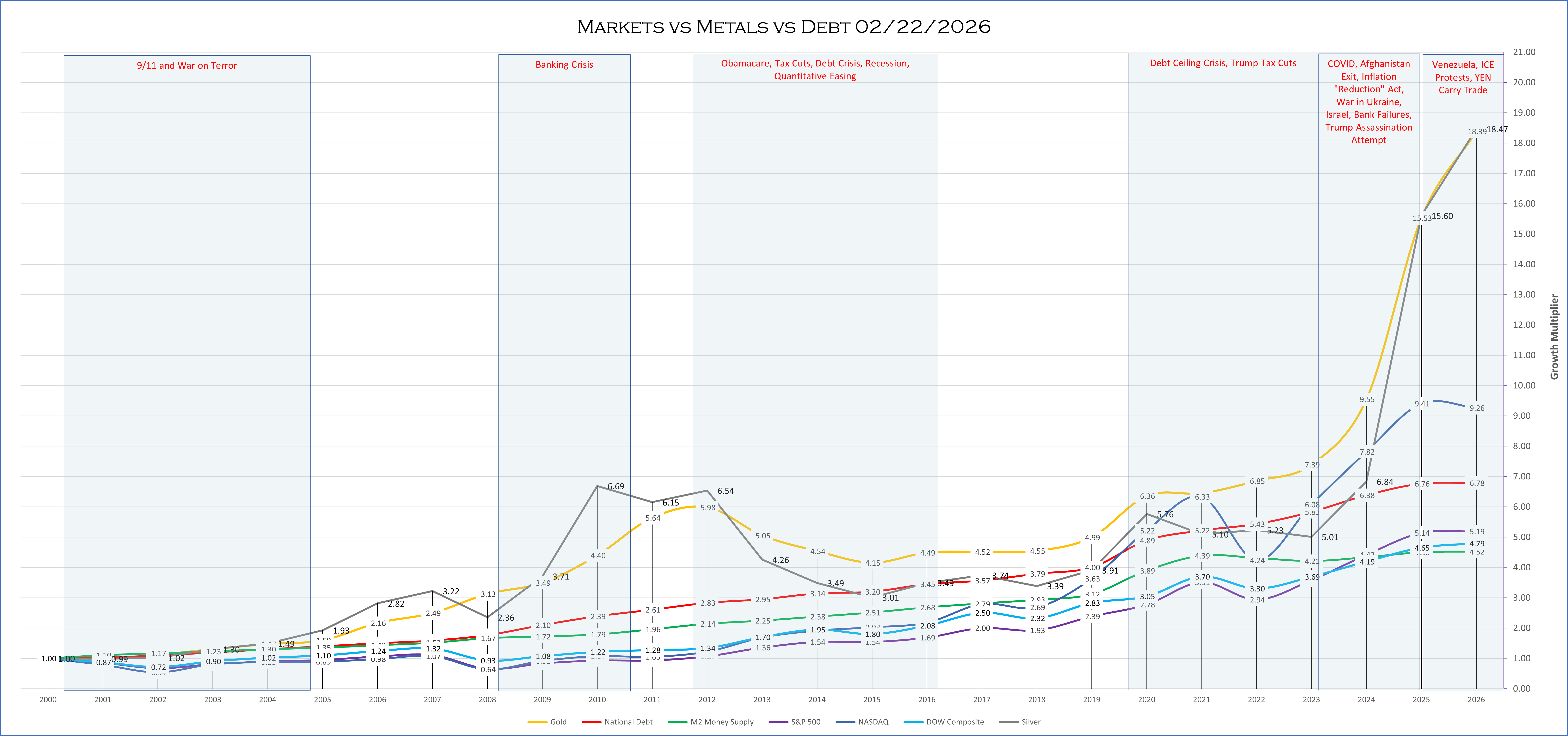
The shift in sentiment has been there since at least 2000. Wall Street focuses on a handful of stocks and dividends to tout the superiority of stocks, but nothing has outperformed gold and silver. The evidence has always been there, just ignored. For those on Wall Street, the money to be made is in stocks, bonds, and futures.
Gold is money. Silver can be money, but more importantly, a key component in technology and military applications. From solar panels, electric vehicles, chips, and AI data centers, there is not enough silver to meet demand. Nothing conducts electricity like silver, and it has come into the spotlight.
What We Can Speculate
Then the speculation about what is happening is absolutely wild. Daily headlines emphasize the fluidity of the issues and world monetary systems.
- Some believe that countries (China, Russia, India) are purchasing and hoarding gold and silver in anticipation of either world monetary shifts.
- Some believe the United States is quietly hoarding gold through large bank purchases.
- There is a real silver shortage caused by overspeculation in markets where paper contracts to real silver were at a ratio of 356:1 and an increase in requests for physical delivery.
- The quantities of gold and silver being purchased, delivered, and stored are beyond the resources of individuals or corporations, and it is more likely that central banks and governments are purchasing them.
- Central banks are purchasing gold and silver in quantities much larger than is being reported, and with export restrictions, the actual reserves of nations are unknowable.
- The United States wants to revalue its gold reserves, and it is now in its best interest to have gold valued as high as possible.
- The United States is hinting at the issuance of stablecoins as a method to create dollar demand.
We could go on for many more paragraphs on each of these issues, but this is what to watch for the remainder of 2026. Given the scope of these potential changes, this will be an interesting year financially and geopolitically.
Our Adversaries
When our adversaries trade dollars for gold, they are making a vastly different calculation:
- They are exchanging what can be created at will for what cannot be created on command.
- They are moving away from a world of promises toward something that holds its value.
- They are turning uncertainty into sovereignty and, in the process, nudging the balance of power in their direction.
- They are linking their fortunes to what cannot be printed and getting ready for the moment when those promises must be settled in substance rather than sentiment.
- And they are making sure they are not caught flat-footed in the world to come.
These are complex topics, as political as they are financial. Yet financial and monetary issues shape nations and world events. We must hope that our actions against Iran and its sponsorship of terrorism succeed, so that the people in the Middle East can focus on peace and prosperity rather than terrorism. 2026 will indeed be an interesting year on many fronts.
Monday, March 2, 2026, will be a pivotal day in world history, both financially and politically. For the first time in decades, we will have a clear picture of friends and foes, both domestically and abroad.
Resources and Further Reading
2026 Silver Run: When the Paper Game Collapses and Silver Returns as a Strategic Asset, by Viga Liu, TradingKey, tradingkey.com, January 19, 2026.
China reveals its plan to challenge the US dollar for dominance. Could it ever work?, by Stephanie Yang, CNN, cnn.com, February 3, 2026.
China Turns Gold Into a Weapon Against the Dollar’s Reign, by Khac Phu Nguyen, Yahoo Finance, finance.yahoo.com, October 9, 2025.
Gaius Sempronius Gracchus, Wikipedia, wikipedia.org, Last accessed February 25, 2026.
Gold Holds Above $5,000 as Dollar Weakens and Geopolitical Risks Rise, by Khac Phu Nguyen, GuruFocus, gurufocus.com, January 27, 2026.
Gold-Backed Yuan: China’s Strategy to Challenge Dollar Dominance, by Muflih Hidayat, Discovery/Alert, discoveryalert.com.au, September 30, 2025.
mBridge and the Future of Finance: From BRICS Experiment to Global Dialogue, by Tuhu Nugraha, Modern Diplomacy, moderndiplomacy.eu, September 23, 2025.
Paper Promises vs Physical Reality: The Silver Market’s Breaking Point, by Money Medals News Service, Edited by Joshua D. Glawson, MoneyMetals, moneymetals.com, February 19, 2026.
Project mBridge reached minimum viable product stage, Bank for International Settlements, bis.org, Last accessed February 23, 2026.
Silver: The Dislocation of Paper and Physical Markets, BY Cyrillle Jubert, GoldBroker, goldbroker.com, February 2, 2026.
Silver’s Strategic Shift: USGS Designation and a Massive Supply Deficit Reshape the Precious Metals Landscape, by MarketMinute, FinancialContent, markets.financialcontent.com, February 5, 2026.
Singapore Ships 11 Tons of Gold to US as Markets Diverge, GoldSilver, goldsilver.com, Last accessed February 22, 2026.
The Demise of the Paper Gold System: Physical vs Paper Markets, by Muflih Hidayat, Discovery/Alert, discoveryalert.com, October 11, 2025.
The Liquidity Squeeze: 356:1 Leverage and the “Allocated” Illusion, by Editors, Especially Silver, especiallysilver.com, Last read February 24, 2026, Printed late 2025.
The Silent Revolution: BIS Project mBridge is Weaponizing Money and Bypassing SWIFT, by Milan Ignjatovic, BankiBook, bankinfobook.com, September 3, 2025.
In deciding how to produce the indexes we use in these articles, we decided to take the “Occam’s Razor” approach and not solve the world’s problems in one set of numbers. Economists and market fans all have favorite methodologies, and we can find fault in all of them. Investors are both fickle and not very good at investing, so arguing that some can do better than any one index is true, but they can also do much worse.
The biggest criticism in our charts might be that we do not compound the returns of the stock market indices for dividends. This is true, but I also believe this is only theoretical and that the value of dividends and their compounding should be reflected in stock prices and indices.
William of Ockham was right, so “Entities must not be multiplied beyond necessity” is our mantra. These charts measure the relative movement of the element in raw terms. If the DOW is at 100 today and at 125 the next time it is measured, it has moved 25% and would show first as 1 and then as 1.25. There are a million interconnected, undigestible, and indistinguishable reasons.