
I come from a family of educators and university administrators, so I often encourage young people to pursue some form of higher education. However, I also have the perspective of someone in college in the late 1960s. In those days, I had no idea of a professor’s political leaning because they and we believed it was a personal decision that had nothing to do with teaching. I would not have known the political leaning of my American History professors or any professor in any discipline.
Like many others, I see news commentators talk about how liberal our colleges and universities have become. But I assumed here in the South that we might have shifted left, but nothing like the Ivy League schools. What started as a look at my Alma Mater, the University of Georgia, sparked a curiosity about all Georgia colleges and universities. It became like Alice going down the rabbit hole into some alternate universe. A place where a different version of reality exists, divorced from voters, parents, and reality.
The Georgia Voting Map
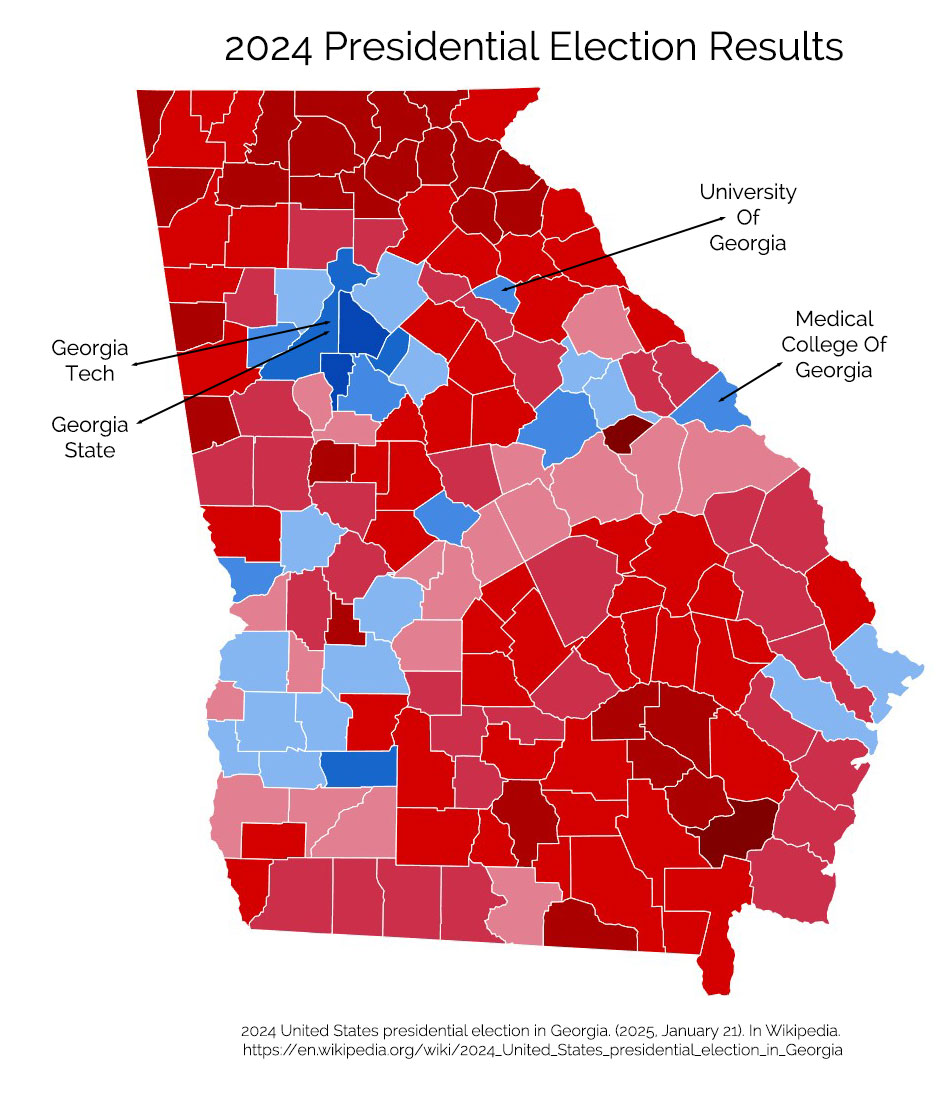
It does not take a genius or a lot of analysis to understand that Georgia is only considered a swing state because of the large voting bloc in the metro Atlanta area and a few other pockets of liberal voters around the State. Many of these pockets of liberal voters are centered around the State’s public research universities. It is not a coincidence that all the counties with major research universities are liberal; the schools dominate the population, economy, and vote as the schools grow to crowd out businesses and residences. When university faculty and employees become political activists, they drag student voting into the mix. Students also know that disagreeing with some professors on political matters can affect grades.
My alma mater, the University of Georgia in Clarke County, is one of those pockets. However, Clarke County is the smallest county in Georgia by land mass, which makes the University of Georgia dominate the county even more. On this map, Clarke County is the only liberal county in a deep red sea.
With the notable exception of the metro Atlanta area, Georgia is Republican territory, a deep red state. Many Georgia counties vote more than 70% Republican, and some over 80%. We suffer from the West Coast syndrome, where metropolitan areas are primarily liberal, but the dominant land mass is conservative.
Georgia is the largest State by land mass east of the Mississippi and has 159 counties. In the 2024 Presidential Election in Georgia, 132 counties voted for President Trump, and 27 voted for Vice President Harris. The popular vote was much closer, but only because of the metro Atlanta vote. In our most conservative county, Brantley, 91% voted for President Trump. In the most liberal county, Clayton, 84% voted for Vice President Harris.
We live in a polarized world, not one where giving and taking leads to a consensus opinion on political issues. Our State universities are making this worse by providing a one-sided view of our nation and politics and intentionally contributing to this polarization.
Knowing Your University
In many States, the contrast to today is painful as professors and administrators push left and far-left agendas on young and impressionable minds. University professors have moved to the left politically in a slow march that has taken decades. We can look back and realize we were lulled to sleep by this slow march, like the water dripping as a form of torture.
“Isn’t it funny how day by day nothing changes, but when you look back, everything is different…”
C. S. Lewis
This change in our campuses came into focus last year with national campus protests for Palestine and occupation of administrative buildings, visual antisemitism without pushback from administrations, and violent protests against President Trump. If there is a leftist cause, any cause, today’s public college students and their professors are on the front line of the dissension. However, opinions are not balanced with only the far-left-leaning faculty and administrations.
Never mind that the tuition at some of these schools makes them affordable only to the wealthiest among us. Young minds are often pliable; America’s public university faculty and administrators know it. University administrations are masters of catering to the needs of politicians and donors while pushing campus agendas that would be antithetical to many parents and taxpayers.
Here in Georgia, the Hope Scholarship program is both a curse and a blessing. The program provides tremendous money for education but also breeds inefficiency and fosters arrogance. With the Hope program, university administrators are no longer accountable to parents for curriculum and tuition costs. The program has provided help with attendance for many, but it has widened the gap between black and white student attendance. Since the money comes from Georgia’s lottery, one valid criticism is it gets poor lottery players to subsidize the tuition of wealthier students. This lack of accountability to parents allowed college administrators to spend uncontrollably until the tuition fund was beginning to be depleted. Now, rather than paying for a student’s tuition, I can only pay part of the tuition. This issue is symptomatic of the politicization of our campuses, and administrators now must pander to Washington for funding, turning administrators into lobbyists.
With the most recent Presidential election fresh in everyone’s mind, I decided to look at my university and my State. I was curious about the fairness of ideologies on campuses. With the vast amount of data and open records available on the internet, anyone can do this analysis, and I would encourage you to do so.
Just How Far Left
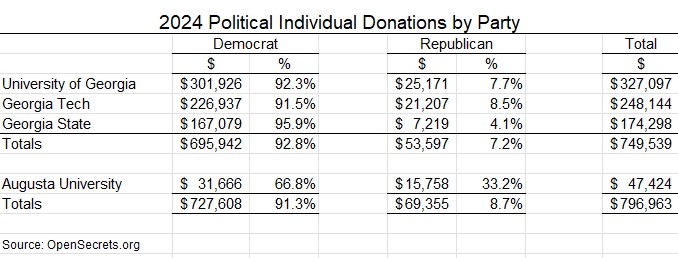
In the 2024 election cycle, the Open Secrets database reports that at the University of Georgia, faculty and employee contributions to political causes totaled $359,944; of this total, $301,926 (92.3%) went to liberal or Democrat candidates or causes. This one-sided giving significantly increased starting in 2016 but ramped to $952,732 in 2020. The last time contributions were tilted toward conservatives or Republicans was thirty years ago, in 1994.
Don’t tell me where your priorities are. Show me where you spend your money, and I’ll tell you what they are.”
James W. Frick
For the Georgia Institute of Technology, this Democrat/Liberal slant was 91.5% in the 2024 election. Georgia State University posted the most polarized totals, with contributions for Democrats/Liberals of 95.86% in 2024.
Only at Augusta University (Medical College of Georgia) was there a more balanced view of the elections. After a flurry of Democratic donations in 2016 and 2020, the donations were more “balanced.” By 2024, there seemed to be less interest in the election, with total donations of $47,424 (66.8% to Democrats). Donations from the faculty of the other three schools dwarf their contributions.
Influence From The Top
An old saying frequently quoted on leadership states, “If you don’t like what you see at the bottom, look to the top.” Organizational culture usually originates at the top of the management hierarchy.
This should point to either the Board of Regents, the President of each school, or both in public colleges and universities. Those are another whole discussion, but a problem worth noting. Someone chooses the direction for hiring and sets the stage for hiring practices. Administrators and people of influence can directly signal what they want through their actions and who they reward or promote to further influence faculty and students. Or they can take a “hands-off” approach to the oversight and abdicate the responsibility to the individual colleges. The Georgia Board of Regents appears overwhelmingly conservative, and Republican based on their donations.
Parents can effect this change by sending their children to colleges and universities that align with their worldviews and political views. You can also influence their lives for the better by reading and understanding the environment your child will be exposed to in school. The last thing any parent wants is to send their child to college only to have them come home with vastly different values. Better educated, yes; radicalized, no.
From what we have seen in recent years, public and private universities have advanced people to positions of management and influence who lack the courage to stand up against what they know to be either illogical or wrong. Public universities probably have a more challenging time standing in this storm but have greater responsibility. Here in Georgia, if our objective is to have our universities reflect the views and positions of our citizens, then all three of our major universities fail. State universities should not have that latitude and should strike a greater balance in faculty, teaching, and oversight.
There are far-left private universities in every State, but they can choose to be liberal. However, we might question State sponsorship of scholarships and research when it fails to reflect our population’s core beliefs.
The Whole Picture
The complete view of political leaning in our major State universities in Georgia requires a little more research and analysis, and we will explain it in more detail in the second installment of this discussion. But if you live in a conservative county in Georgia and you think you can send your child to one of our colleges or universities and have them only educated, not indoctrinated, you need to do more research.
I have stayed in touch with UGA all my life and have realized it is more liberal today than when I was in school. But it took much more reading and investigation to realize how much it had changed. Other universities in Georgia offer a more balanced view of the world and politics, and these are all worth a look.
My overarching perspective of our State’s public universities is that politics academically compromise them, and that our lottery system has allowed them to become complacent in their responsibility and responsiveness to our State’s voting public. Where we are in this continuum is not an accident, not a coincidence.
Understanding Your State
This type of analysis is valuable no matter where you live. The information is readily available and free, so there is little reason not to look. Without knowing the facts, we cannot affect the change and fairness we seek in higher education. I encourage everyone to do the same analysis and to understand the long-term effect on our youth in their State. Please do not send a child to one of these left schools without knowing you are sending them down the rabbit hole.
In our next installment, we will examine the voting patterns of the faculty and staff of Georgia’s three most prominent research universities over the past thirty-five years.
Up next – A look at historical donations and trends from faculty and staff in Georgia’s three primary research universities.

The Balanced Education Myth 1
The Balanced Education Myth 2
The Balanced Education Myth 3
The Balanced Education Myth 4
The Balanced Education Myth 5
The Balanced Education Myth 6
Resources and Further Reading
2024 United States presidential election in Georgia, Wikipedia, wikipedia.org, Last accessed January 21, 2025.
Colleges prepare for new legal and political terrain under Trump, By Lexi Lonas Cochran, The Hill, thehill.com, January 8, 2025.
Democratic Politicians Are in Denial on the Education Crisis, By Michael R. Bloomberg, Wall Street Journal, wsj.com, January 31, 2025.
Don’t Tell Me Where Your Priorities Are – James W. Frick, By Jessica Wei, Due, due.com, March 21, 2023.
Hope Program Increases College Attendance, but also Widens Racial Gap, By David R. Francis, National Bureau of Economic Research, nber.org, December 1, 2000.
University of Georgia, Open Secrets Database, opensecrets.org, Last accessed January 20, 2025.
What Is The Largest State East Of The Mississippi River, By Raymond Strasser, About River, aboutriver.com, December 15, 2023.
Note
The information in these articles on the Balanced Education Myth was developed using the data readily available on the website opensecrets.org. Not all colleges can be found on this website, indicating they had no donations or omissions by OpenRecords.org or their data sources. However, we believe their records to be either complete or as complete as possible.
It is possible for a conservative faculty member to bypass the data collection process by donating through a spouse or other source. Given the consistency of the data across all colleges and universities we believe this to be a minor source of error if at all.