

In this, my final installment examining the political leanings of Georgia’s universities, I want to address a curiosity of mine that has arisen from the recent news about the highly publicized battle between President Trump and Harvard.
Harvard is often held out as the worst of the worst when measuring political bias, antisemitism, and woke culture. I have little doubt that Harvard is a problem, but is my alma mater operating in that same sphere of bias?
As I mentioned in my opening article, I come from a family of educators and university administrators. I would not have known the political leaning of any of my professors in any discipline of study, even though I was around faculty and staff all my early life.
Georgia Versus Harvard
As a lifelong Georgian, it is difficult to think that this discussion has relevance. I have spent some brief time studying at Harvard, but it was decades ago. I would have known that Harvard (Massachusetts) was more liberal just by interactions, mannerisms, and dress. The level of unfriendliness alone was a stark contrast to the South, even when I briefly studied at Harvard in the 1960s. I came away from Harvard understanding that in the 1970s, the only common link between Harvard and the University of Georgia (UGA) was the football game they played in 1929 at the dedication of Sanford Stadium in Athens.
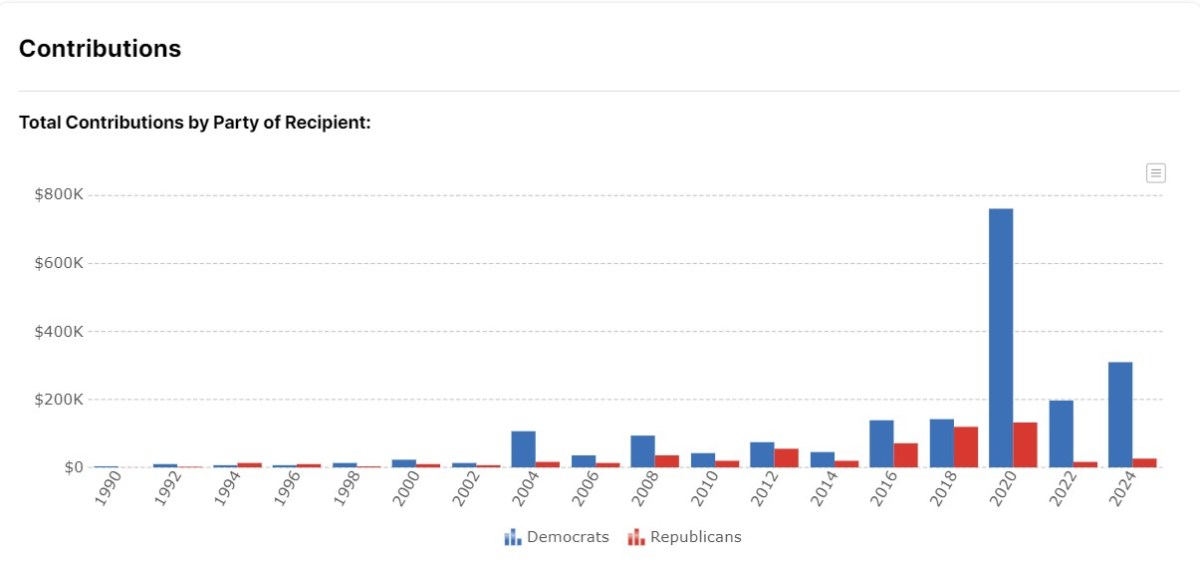
However, over time, things have changed, and the UGA of today increasingly resembles Harvard in its politics. In the 2024 election cycle, the Open Secrets database reports that at the UGA, faculty and employee contributions to political causes totaled $359,944; of this total, $301,926 (92.3%) went to liberal or Democratic candidates or causes.
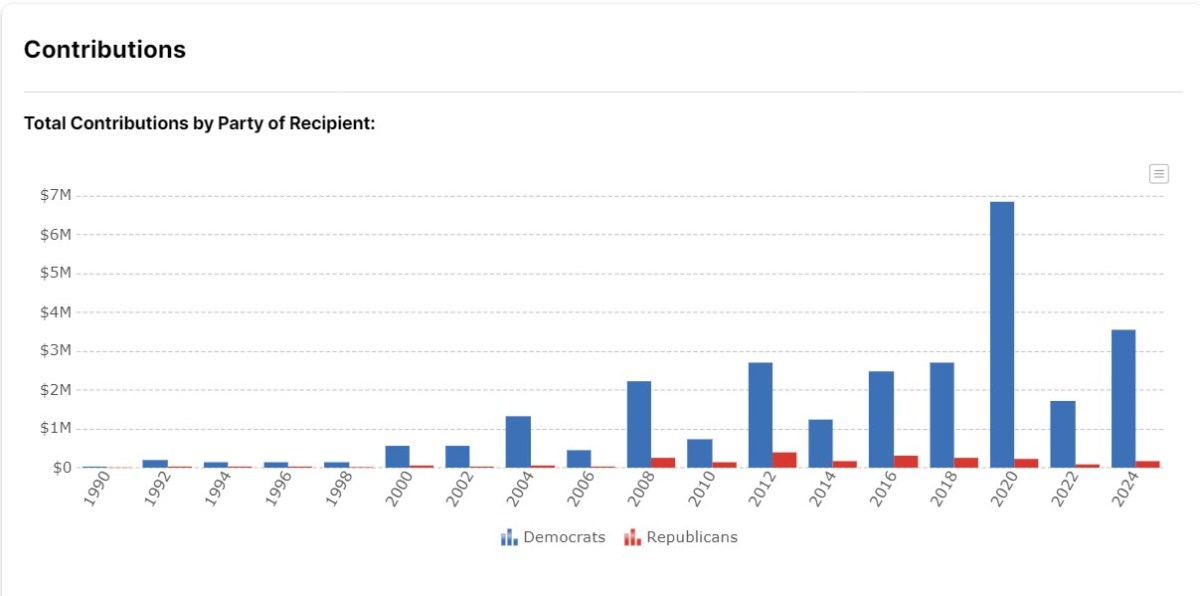
At Harvard in the 2024 election cycle, faculty and staff contributed a total of $4,643,545, substantially more than the University of Georgia. Of that total, $3,563,880 (94.8%) went to Democratic candidates and causes. So, Harvard is more left-leaning, but not by much. The most significant difference is in dollars donated, with Harvard faculty and staff donating roughly ten times as many dollars.
"Don’t tell me where your priorities are. Show me where you spend your money, and I’ll tell you what they are.”
James W. Frick
The push by President Trump for changes at Harvard seems justified if we want our children to receive a balanced perspective of our nation’s political landscape. What mystifies me about these two graphs is the similarity in contributions through the years, with both schools increasing and decreasing their contribution levels in tandem. However, this pattern is repeated with every university I researched.
Harvard’s Vulnerability
I believe that Harvard is fighting an uphill battle. President Trump is approaching these issues in a logical, methodical, and fact-based manner. He has thousands of hours of video footage, financial records, congressional testimony, and the support of the electorate on his side. It would seem that Harvard is playing a losing hand and needs to cut their losses and make changes.
The Trump administration is asking for changes to hiring practices that would provide a more balanced view of issues from faculty and administration, and a more rigorous enforcement of rules concerning antisemitism. They also want a more vigorous screening of foreign students, a key funding source.
At stake is Harvard’s operating budget, not its endowment. The endowment provides operating funds to the university, but Federal grants make up almost fifty percent of the university’s $6.4 billion budget. In the most threatening move of all, the Trump Administration could restrict Harvard’s access to Federal student aid.
Harvard’s most significant vulnerability may be its most advertised asset, its endowment. This $52 billion nest egg is only of value if it is wisely invested, protected from losses, and generates income for specific purposes. For example, endowment funds donated for scholarships cannot be diverted to other uses.
Another vulnerability is the nature of its investments. It is one thing to say we have a $52 billion endowment, and quite another to have easy access to the funds. Investments are typically made with a longer-term view of returns in mind, and liquidating them can result in financial losses. Harvard’s endowment may prove to be asset-rich and income-poor, but that is yet to be seen. It has been estimated that a major portion of the twenty percent of the endowment available for operations is tied up in hedge funds, private equity, and real estate. These are largely illiquid assets and might prove to be Harvard’s Achilles’ Heel.
But the biggest threat to Harvard’s endowment would be a loss of its tax-exempt status. Nothing scares a university more than the loss of its tax-exempt status. Major donors expect tax write-offs for their contributions, and if they cannot obtain this at Harvard, there are thousands of other organizations eager for their donations.
Understanding Your State
For all universities, the revelations that websites like OpenSecrets.org have brought must bring some reservations to their management and boards. Organizations tend to take on the thoughts and actions of those at the top, and therein lies the problem.
Almost all universities, both public and private, have adopted a remarkably similar political stance over the past two decades. As citizens and parents, we have a responsibility to our children and grandchildren to find schools that teach a balanced view of our nation’s greatness. We have our faults, but there is no better place to live, and our colleges and universities lack this balanced view of our history.
As an alumnus of UGA, I am embarrassed by the hard left shift in the faculty because I no longer believe they teach from a neutral platform. I would encourage everyone to know more about the political leanings of your colleges and universities and to guide your children and grandchildren to the few who are more balanced.

The Balanced Education Myth 1
The Balanced Education Myth 2
The Balanced Education Myth 3
The Balanced Education Myth 4
The Balanced Education Myth 5
The Balanced Education Myth 6
Resources and Further Reading
2024 United States presidential election in Georgia, Wikipedia, wikipedia.org, Last accessed January 21, 2025.
Colleges prepare for new legal and political terrain under Trump, By Lexi Lonas Cochran, The Hill, thehill.com, January 8, 2025.
Democratic Politicians Are in Denial on the Education Crisis, By Michael R. Bloomberg, Wall Street Journal, wsj.com, January 31, 2025.
Don’t Tell Me Where Your Priorities Are – James W. Frick, By Jessica Wei, Due, due.com, March 21, 2023.
Hope Program Increases College Attendance, but also Widens Racial Gap, By David R. Francis, National Bureau of Economic Research, nber.org, December 1, 2000.
University of Georgia, Open Secrets Database, opensecrets.org, Last accessed January 20, 2025.
Harvard University, Open Secrets Database, opensecrets.org, Last accessed June 25, 2025.
What the Trump Administration’s Plan to Cancel All Harvard’s Federal Funding Means for the University, By Solcyre Burga, Time, time.com, May 27, 2025.
Harvard has an endowment of over $50 billion. So why do federal cuts of a few billion matter?, By Kara Scannell and Eric Levenson, CNN, cnn.com, April 18, 2025.
Note
The information in these articles on the Balanced Education Myth was developed using the data readily available on the website opensecrets.org. Not all colleges can be found on this website, indicating they had no donations or omissions by OpenRecords.org or their data sources. However, we believe their records to be either complete or as complete as possible.
It is possible for a conservative faculty member to bypass the data collection process by donating through a spouse or other source. Given the consistency of the data across all colleges and universities we believe this to be a minor source of error if at all.