

With many things in this world, change’s combined and cumulative effect has lasting consequences. This is especially true with education, politics, and money. Last week, we looked at the State of Georgia’s three primary research universities and the individual faculty and staff support for political candidates and far-left movements in recent decades. But what has been the cumulative effect of those contributions and the total effect on all State colleges and universities?
“What we perceive as coincidence is part of a larger, interconnected pattern that we might not fully understand, but that should not dissuade us from searching for connections and meaning.”
Robert C. Whitehead
The Effect of the Big Three
Over the period analyzed, contributions to Democrats outstripped those to Republicans by more than $4 million. Before the George Bush era, these universities were apolitical. Something happened in the first Bush era that shifted them far left, and they began working to influence elections through protests, money, and student indoctrination, not teaching students about our nation’s core doctrine and values.

The most significant year of donations was in 2020, with the contentious Trump/Biden election. In 2020, faculty and administrators contributed $1.9 million to Democrats, equal to all Democratic contributions for the prior twenty-eight years. If this happened through some miraculous epiphany, it would indeed be a miracle because the apparent dislike of President Trump did not carry over to the elections in 2022 and 2024. It also seems unlikely that this movement would have happened spontaneously across all colleges and universities in the University of Georgia system.
I thought I would find that the prominent three research universities were predominantly liberal, but smaller schools within the public system were more conservative. The smaller schools are in counties where voters are overwhelmingly conservative, and they are less dominant in the economy. But to my surprise, this shift in thinking is only slightly more conservative. In the 2020 contentious election between President Trump and Joe Biden, the contributions of the big three universities were 87.1% for Democrats. When you include the other smaller schools, the total decreased to 84.6%. Directionally, the charts still look the same; I assume some miracle of modern academia and politics.
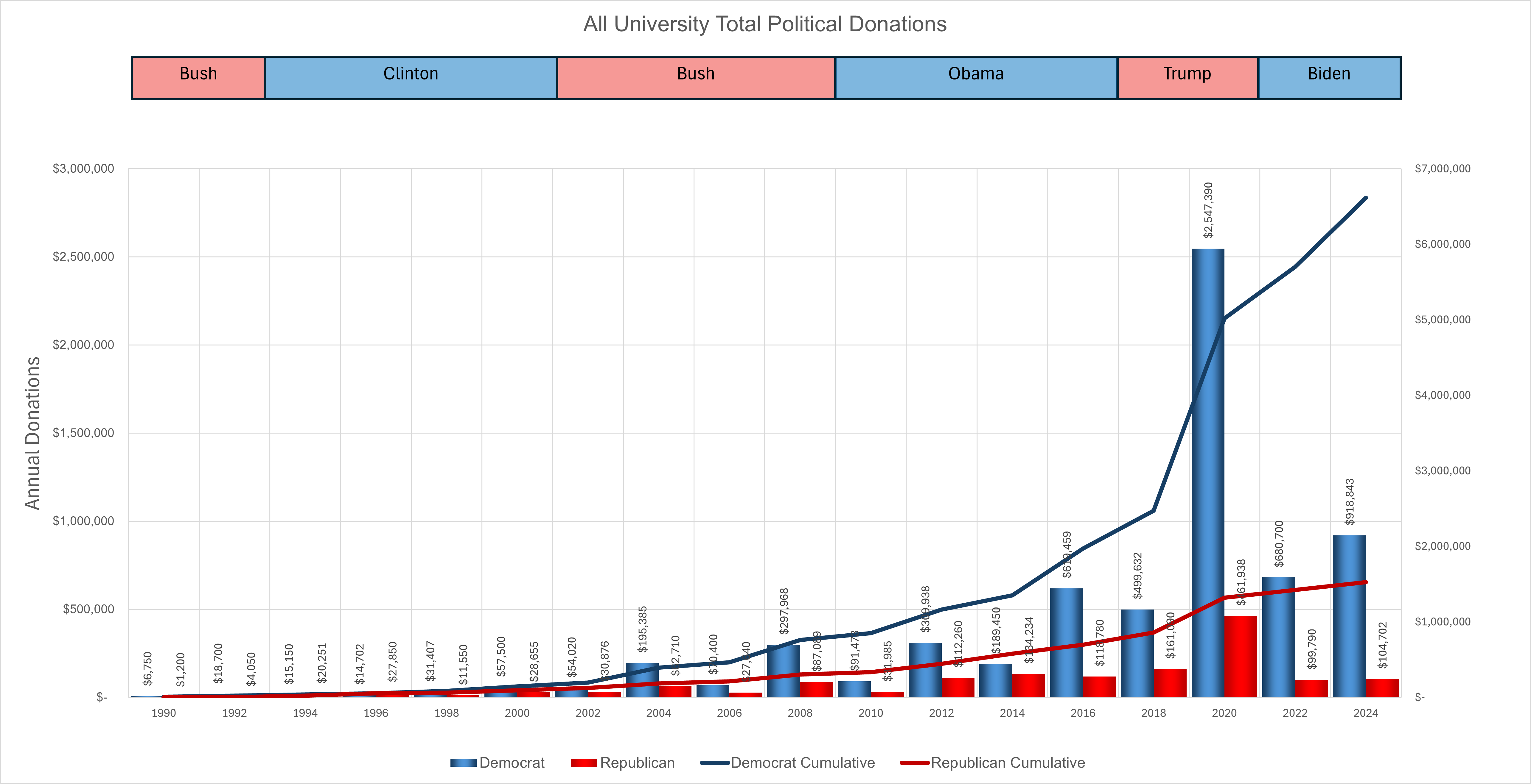
However, total political contributions moved significantly, with the faculty in the smaller schools adding another $620,700 to Democratic coffers and only $177,366 to Republican efforts in 2020. The thirty-five-year total contributions also widened, with $6.6 million (81.3%) going to Democrats and $1.5 million (18.7%) going to Republicans. This is a remarkable “uncoordinated” alignment between all the State schools.
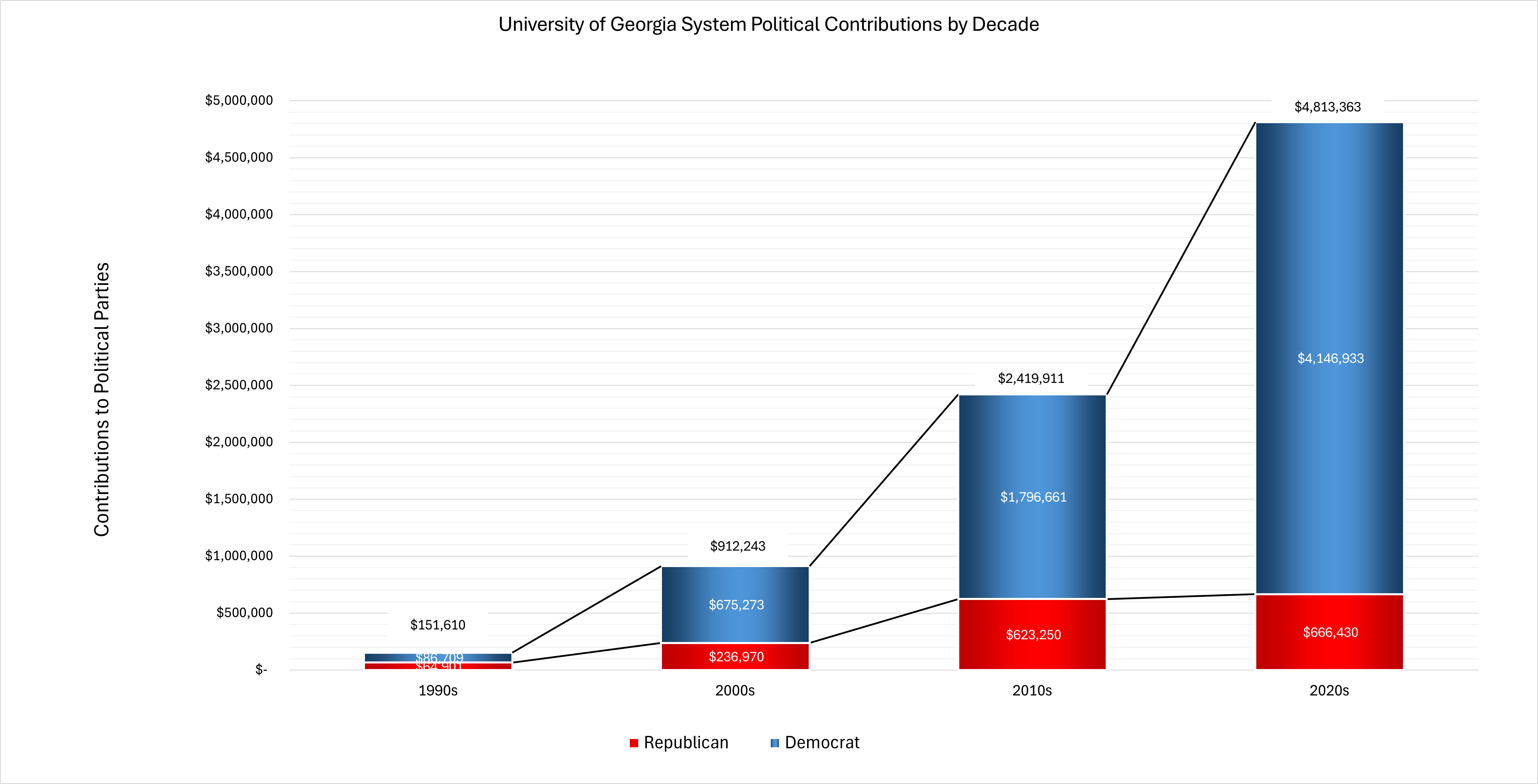
Looking at the donations by the decade helps visualize this shift more clearly and realize that if contributions align with activism, then activism is doubling each decade. In the decade of the 1990s, all political contributions totaled $151,610. In just the first five years of this decade, the contributions are $4,813,363, clearly on a path for about $10 million in donations. That amount of money can elect candidates and move policy. I have no problem with faculty and staff exercising their freedoms in politics. I do have a problem when this rises to the level of indoctrination. We all lose when students are presented with biased opinions or only one side of any discussion. It would seem to me that students from such environments enter the workforce with a skewed perspective of the real world.
The Hidden Disconnect
There is a vast disconnect between the political leanings of Georgia’s citizens, the Board of Regents, and the administration and faculty of individual schools. I have researched the careers and political contributions of each of the current members of the Board of Regents, and it only produces more head-scratching. All board members have business backgrounds and contribute almost exclusively to Republican candidates at various political levels. They mirror the population of Georgia and are, if anything, more conservative in their leanings.
The mystery is the disconnect between these board members and the educational institutions they oversee. I have difficulty believing the regents are only there for pleasant meetings, meals, and football tickets. Their backgrounds would indicate a preference for action and an appreciation for more conservative values.
We are missing a connection, and we will do a lot more searching over the remainder of 2025 to try and connect those dots.
Parental Warnings
For now, my conclusion is that anyone living in a conservative county in Georgia should think twice before sending one of their children off to one of our public colleges or universities. Young men and women immersed in this far-left ideology, culture, and thinking may not come home with their family’s shared core values. The child you entrusted to one of our universities for their education may go home as the anarchist you deplore.
There are private colleges and universities with conservative views that offer a more balanced view of education and politics. Because of their smaller enrollment, these institutions often provide more individual instruction with less indoctrination. With technological changes, the traditional four-year college course of study may not be the most successful for many. After all, the objective for most parents is to have their children grow up and become productive members of society.
Up next – A look at all private colleges and universities in Georgia and their combined influence when added to the public schools.
The Balanced Education Myth 1
The Balanced Education Myth 2
The Balanced Education Myth 3
The Balanced Education Myth 4
The Balanced Education Myth 5
The Balanced Education Myth 6
Resources and Further Reading
2024 United States presidential election in Georgia, Wikipedia, wikipedia.org, Last accessed January 21, 2025.
Colleges prepare for new legal and political terrain under Trump, By Lexi Lonas Cochran, The Hill, thehill.com, January 8, 2025.
Democratic Politicians Are in Denial on the Education Crisis, By Michael R. Bloomberg, Wall Street Journal, wsj.com, January 31, 2025.
Don’t Tell Me Where Your Priorities Are – James W. Frick, By Jessica Wei, Due, due.com, March 21, 2023.
Individual Georgia Colleges and Universities (separate searches and analysis), Open Secrets Database, opensecrets.org, Last accessed February 4, 2025.
Partisan Registration and Contributions of Faculty in Flagship Colleges, By Mitchell Langbert and Sean Stevens, National Association of Scholars, nas.org, January 17, 2020.
University of Georgia System Colleges and Universities, Open Secrets Database, opensecrets.org, Last accessed February 4, 2025.
Note
The information in these articles on the Balanced Education Myth was developed using the data readily available on the website opensecrets.org. Not all colleges can be found on this website, indicating they had no donations or omissions by OpenRecords.org or their data sources. However, we believe their records to be either complete or as complete as possible.
It is possible for a conservative faculty member to bypass the data collection process by donating through a spouse or other source. Given the consistency of the data across all colleges and universities we believe this to be a minor source of error if at all.